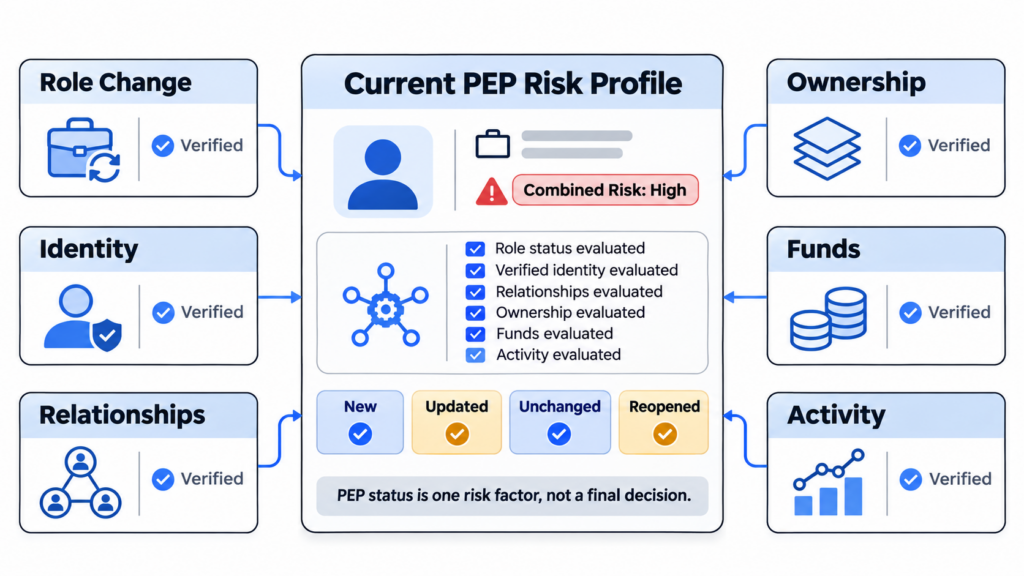
PEP screening at onboarding provides only a point-in-time assessment. A customer may assume a prominent public function later, become connected to a PEP, change beneficial ownership, or develop transaction patterns that no longer align with their declared source of wealth or funds.
Ongoing PEP monitoring helps organizations detect these changes throughout the customer lifecycle. The objective is not to treat every PEP as suspicious. It is to identify relevant changes, reassess the complete customer risk profile, and apply enhanced controls proportionate to the actual exposure.
FinAuth supports this process by combining screening results with verified identity, ownership, device, behavioral, and transaction evidence through its Risk Engine.
1. Why Is Onboarding PEP Screening Not Enough?
Customer risk can change after account approval.
Common changes include:
- A customer assumes or leaves a prominent public function.
- A new family or close-associate relationship is identified.
- Beneficial ownership or control changes.
- Watchlist records gain new aliases, roles, dates, or identifiers.
- Source-of-funds information changes.
- Account activity becomes inconsistent with the expected profile.
- New adverse media or network relationships emerge.
Without ongoing monitoring, an institution may continue treating the customer according to an outdated classification.
FATF Recommendation 12 expects institutions to maintain systems that identify whether customers or beneficial owners are PEPs and to conduct enhanced ongoing monitoring where the relationship presents the relevant PEP risk. These measures are preventive and do not imply that every PEP is involved in criminal activity.
2. Who Should Be Included in PEP Monitoring?
The scope may extend beyond the named customer. Depending on applicable regulation and policy, monitoring can include:
- Foreign PEPs
- Higher-risk domestic PEPs
- Officials of international organizations
- Family members
- Close associates
- Beneficial owners and controlling persons
- Authorized representatives and connected entities
Identity resolution is essential because common names, transliteration, incomplete records, and historical aliases can generate false positives.
FinAuth can strengthen the matching process with verified names, dates of birth, nationality, identity documents, facial identity, and ownership information. Unavailable information should be treated as unresolved—not automatically considered matching or conflicting.
3. What Events Should Trigger PEP Rescreening?
Organizations can combine scheduled screening with event-driven monitoring.
Useful triggers include:
- PEP database or watchlist updates
- Customer name, nationality, occupation, or address changes
- New beneficial owners, directors, or authorized users
- Addition of beneficiaries or counterparties
- Significant changes in transaction value or geography
- Account recovery or sensitive profile changes
- Adverse media updates
- New device, identity, or account relationships
- Periodic KYC refreshes
An event should not automatically produce a high-risk decision. It should initiate an updated assessment using the latest identity and customer evidence.
FinAuth can use these events to trigger targeted checks such as PEP rescreening, document reverification, Face Verification, Liveness Detection, ownership review, or enhanced due diligence.
4. How Should a New PEP Match Be Assessed?
A name match is an alert, not proof that the customer is the listed person.
The assessment should compare:
- Full name and aliases
- Date and place of birth
- Nationality and residence
- Current and former public roles
- Role start and end dates
- Identity document information
- Family and associate relationships
- Beneficial ownership
- Timeline consistency
Cases with missing information may require additional evidence. Materially conflicting identifiers may help disqualify a match, while several consistent attributes can increase relevance.
Commercial PEP databases can support detection, but FATF notes that databases alone are not sufficient to meet PEP obligations. Customer due diligence and risk-based investigation remain necessary.
5. Monitor the Relationship, Not Only the PEP Status
PEP classification is only one input into customer risk.
Ongoing monitoring should consider whether activity remains consistent with:
- The customer’s public function
- Declared business purpose
- Expected income
- Source of wealth
- Source of funds
- Ownership and control
- Typical transaction behavior
- Relevant geographic exposure
Potential risk indicators may include unexplained wealth changes, transactions inconsistent with known income, opaque corporate structures, unexpected third-party payments, rapid movement of funds, or relationships with higher-risk entities.
FATF distinguishes source of wealth—the origin of the customer’s overall wealth—from source of funds, which concerns the origin of assets involved in a specific relationship or transaction. It recommends using both when assessing whether ongoing activity is reasonably consistent with the customer profile.
6. Build a Risk-Based PEP Monitoring Workflow
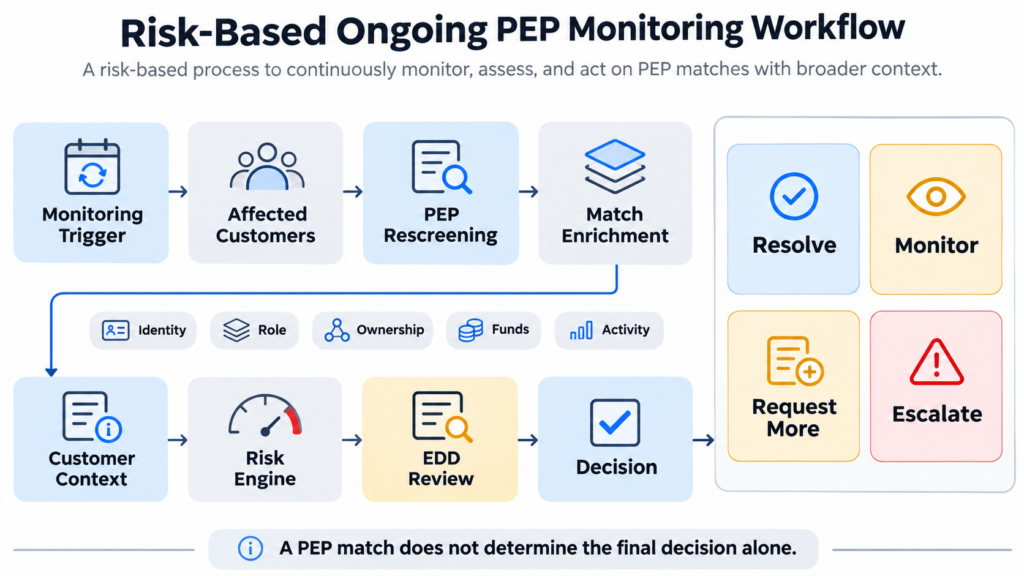
A scalable workflow can follow five stages.
Detect change. Ingest updated PEP data, customer-profile changes, ownership events, and transaction signals.
Identify affected customers. Determine which customers, beneficial owners, and connected parties require reassessment.
Enrich the match. Compare the alert with verified identity attributes, roles, timelines, ownership, funds, and activity.
Calculate combined risk. FinAuth’s Risk Engine can combine PEP relevance with Document Verification, Face Verification, Liveness Detection, device intelligence, behavioral patterns, account relationships, and transaction context.
Apply proportionate action. Outcomes may include resolving a false positive, requesting more information, applying enhanced monitoring, initiating EDD, seeking approval, or restricting activity according to policy.
FATF guidance emphasizes that decisions about establishing or continuing PEP relationships should be driven primarily by the assessed money-laundering and terrorist-financing risk and the institution’s ability to mitigate it.
7. Reduce Review Volume Without Weakening Controls
Sending every PEP update to manual review creates unnecessary operational load.
Effective controls include:
- Reassessing only customers affected by changed records
- Separating new alerts from unchanged historical matches
- Reopening resolved alerts only when material evidence changes
- Combining related customers into one network case
- Prioritizing multi-attribute matches
- Applying different monitoring levels by combined risk
- Recording the evidence behind every resolution
- Setting review dates and ownership for open cases
Automation should prioritize and organize evidence rather than make unsupported assumptions. High-relevance or high-impact cases should remain available for trained compliance review and senior approval where required.
8. Ongoing PEP Monitoring Q&A
Does becoming a PEP require automatic account closure?
No. PEP requirements are preventive and risk-based. The institution should assess the customer, role, ownership, funds, activity, and applicable legal obligations.
How often should PEPs be rescreened?
Frequency should reflect risk and regulation. Organizations can combine periodic rescreening with triggers such as database updates, role changes, ownership changes, and unusual activity.
Should former PEPs remain under enhanced monitoring?
A former role does not automatically remove every associated risk. Organizations should evaluate continuing influence, relationships, time elapsed, and other risk factors under applicable policy.
How does FinAuth support ongoing PEP monitoring?
FinAuth can combine external PEP results with verified identity, ownership, biometric, device, behavioral, network, and transaction evidence. This helps resolve low-relevance alerts and prioritize cases requiring EDD or enhanced monitoring.
9. Conclusion
Ongoing PEP monitoring should detect more than changes to a name on a database. It should reassess how role, identity, ownership, funds, relationships, and activity evolve after onboarding.
By connecting PEP screening with continuous identity and behavioral risk signals, FinAuth helps organizations update customer risk promptly, reduce unnecessary review, and apply enhanced controls where the combined evidence justifies them.