A device signal rarely proves fraud by itself. A new phone may belong to a genuine customer, an unusual network may reflect travel, and a rooted device may be used for legitimate testing.
The value of device intelligence comes from combining device integrity, session activity, account history, identity evidence, behavior, and cross-account relationships. When the same environment repeatedly appears across otherwise unrelated identities, the resulting pattern can reveal coordinated fraud that individual account checks may miss.
FinAuth brings these signals together in a unified Risk Engine, helping businesses distinguish normal device changes from automated abuse, synthetic identities, account takeover, and organized fraud networks.
1. What Is Device Intelligence?
Device intelligence evaluates the technical and behavioral context surrounding a digital interaction. Depending on the channel and applicable privacy requirements, signals may include:
- Device and operating-system characteristics
- App and platform integrity
- Root, jailbreak, hooking, or injection indicators
- Emulator, virtualization, cloning, or multi-instance environments
- Session timing, velocity, and interaction patterns
- Network and location consistency
- Historical relationships between devices and accounts
- Changes from the customer’s normal access pattern
These signals help answer two different questions:
Is this session trustworthy?
The system evaluates whether the current environment appears genuine, intact, and consistent with the claimed customer.
Is this device connected to wider fraud?
The system determines whether the same device or related environment appears across multiple identities, documents, accounts, beneficiaries, or suspicious events.
The second question is especially important for detecting coordinated risk.
2. Why Individual Device Signals Are Not Enough
An unfamiliar device is context, not proof of fraud. Customers replace phones, reinstall applications, travel, use corporate networks, or access services through multiple legitimate devices.
Similarly, a single technical anomaly should not automatically trigger rejection. Client-reported attributes may be incomplete or manipulated, while integrity controls have different capabilities across platforms.
OWASP recommends layered device and application integrity controls because single checks can be bypassed. It also notes that device attestation should be validated by the backend with freshness and replay protections rather than treated as a client-side verdict.
A strong fraud workflow therefore evaluates several dimensions together:
- Integrity: Does the environment show rooting, hooking, injection, tampering, virtualization, or app-cloning risk?
- History: Is the device known to the customer, and how has it behaved previously?
- Consistency: Do device, network, location, and declared identity information align?
- Velocity: How many identities, applications, logins, or transactions are associated with the environment?
- Relationships: Does the device connect accounts that also share faces, documents, contacts, beneficiaries, or transaction paths?
Combined evidence provides stronger confidence than any single attribute.
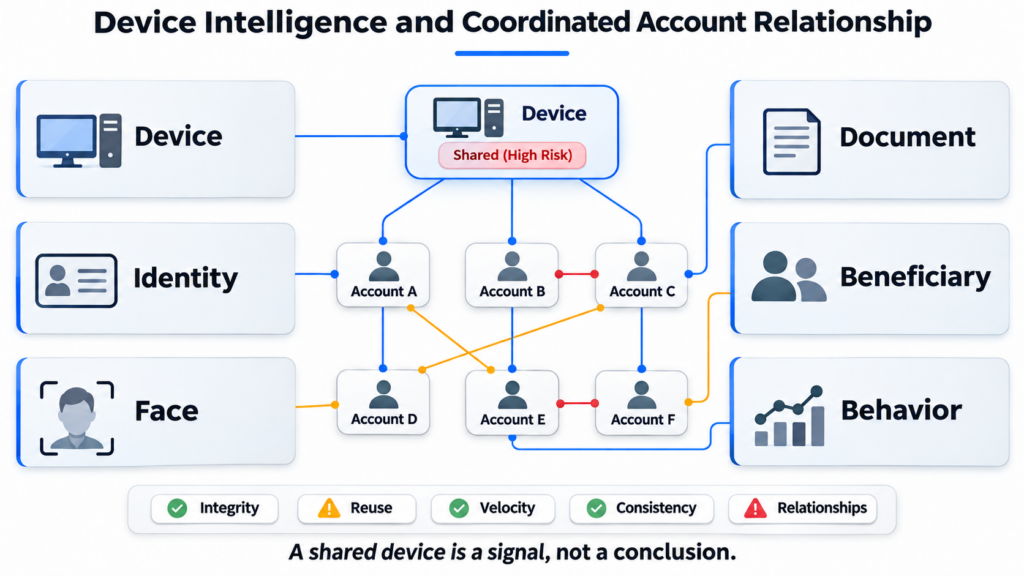
3. Device Patterns That Can Reveal Coordinated Fraud
Fraud rings often change names, documents, contact details, and network routes. Reusing infrastructure at scale, however, can create detectable relationships.
Shared devices across identities
One device appearing across several unrelated customer profiles may indicate account farming, mule-account management, synthetic identity activity, or centralized control. The risk becomes stronger when applications occur within a short period or share additional evidence.
High-risk environments
Rooted, jailbroken, emulated, virtualized, cloned, or hooked environments can provide attackers with greater control over application behavior and captured data. These conditions do not always prove malicious activity, but they can increase the risk of automation, injection, tampering, or control bypass.
Abnormal velocity
A device that creates many accounts, changes identities repeatedly, submits multiple documents, or performs rapid transactions may be operating beyond normal customer behavior.
Identity-device inconsistency
A stable device associated with one customer suddenly presenting a different face, identity document, location, or behavioral profile may require additional verification.
Multi-signal reuse
The strongest coordinated-risk patterns often combine a shared device with reused portraits, related documents, repeated contact details, common beneficiaries, or connected transaction flows.
FinAuth can evaluate both individual-session risk and cluster-level relationships, allowing the business to identify not only a suspicious account but also the wider network around it.
4. Device Intelligence Across the Customer Lifecycle
Device risk should not be limited to initial onboarding.
Digital onboarding: Detect automated applications, device farms, repeated identity attempts, injection, and synthetic identity clusters.
Login and account recovery: Identify unexpected devices, abnormal sessions, credential-stuffing patterns, and possible account takeover.
Sensitive account changes: Evaluate device history before allowing changes to authenticators, contact details, beneficiaries, payment information, or permissions.
Transactions: Combine device and session context with transaction value, beneficiary risk, behavior, and account history.
Ongoing monitoring: Recalculate relationships when new accounts, devices, documents, faces, or transaction links appear.
NIST recognizes ongoing session monitoring as a risk-reduction measure and identifies device characteristics, usage patterns, velocity, behavior, geolocation, and network characteristics as possible signals. It also emphasizes that these signals have privacy implications and should be covered by a privacy risk assessment.
5. Building a Risk-Based Device Decision Workflow
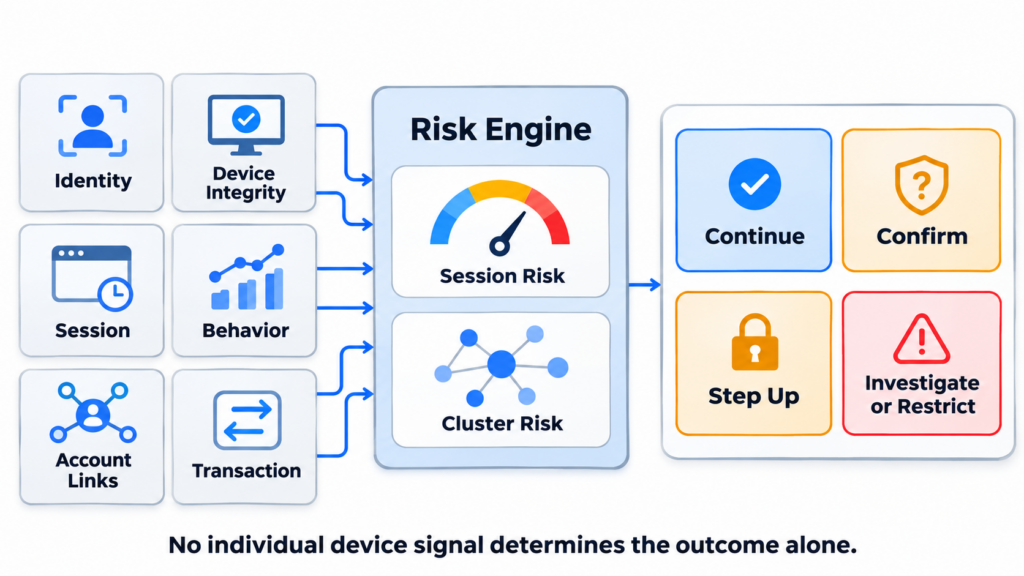
FinAuth can route device evidence alongside identity, document, biometric, behavioral, and network signals into its Risk Engine.
A practical decision model may include:
- Low risk: Known or consistent device, normal behavior, intact environment, and trusted identity evidence. Continue automatically.
- Medium risk: New device or minor inconsistency without strong attack evidence. Confirm the event or request additional verification.
- High risk: Compromised environment, abnormal velocity, or cross-account reuse combined with other suspicious signals. Apply step-up verification or priority review.
- Critical risk: Strong injection, coordinated identity reuse, account farming, or linked fraud evidence. Restrict the session and investigate the connected cluster.
Responses should remain proportionate. OWASP similarly recommends graded reactions to device-integrity findings, ranging from additional checks to restricting sensitive functionality depending on the risk profile.
6. Privacy-Aware Device Intelligence
Device intelligence should be designed around necessity, proportionality, transparency, and controlled retention.
Businesses should:
- Collect signals relevant to a defined fraud-prevention purpose
- Avoid treating invasive fingerprinting as the default for low-risk activity
- Protect or pseudonymize device relationship identifiers
- Limit access and retention according to operational need
- Monitor false positives across customer groups and platforms
- Provide recovery paths for legitimate customers using new or unusual devices
The objective is not permanent tracking. It is to identify meaningful risk during sensitive events while minimizing unnecessary data collection.
7. Device Intelligence Q&A
Can device intelligence identify fraud by itself?
No. Device intelligence provides risk evidence. Identity, document, biometric, behavioral, transaction, and relationship signals should contribute to the final decision.
Is every new device suspicious?
No. A new device is a common customer event. Its risk depends on the action being performed, account history, session integrity, behavior, and other evidence.
How does device intelligence detect fraud rings?
It identifies relationships such as one device appearing across multiple identities, documents, faces, beneficiaries, or suspicious transactions. These connections may reveal coordinated control.
What is the difference between device risk and session risk?
Device risk focuses on the environment, integrity, history, and reuse of the device. Session risk evaluates what is happening during the current interaction, including behavior, network context, velocity, and requested action.
How does FinAuth use device signals?
FinAuth combines device integrity, session activity, identity evidence, Face Verification, Liveness Detection, document results, behavior, and network relationships within its Risk Engine. No individual device signal determines the outcome alone.
8. Conclusion
Device intelligence is most valuable when it reveals relationships that isolated account checks cannot see. A suspicious device becomes more meaningful when it is linked to repeated identities, reused faces, unusual behavior, common beneficiaries, or coordinated transaction activity.
By evaluating both individual sessions and cross-account clusters, FinAuth helps businesses streamline trusted activity, apply proportionate verification, and uncover organized fraud earlier.