Proof of address can help businesses confirm where a customer currently resides, meet customer due diligence requirements, and investigate inconsistencies during digital onboarding. However, requesting a utility bill or bank statement from every customer can create unnecessary friction—especially when the address has already been validated through reliable digital sources.
A stronger approach is to request additional address evidence only when the product, regulation, customer profile, or observed risk requires it. FinAuth enables businesses to combine identity, document, device, behavioral, and contextual signals so proof-of-address requests can be applied proportionately rather than as a fixed step for every applicant.
1. What Is Risk-Based Proof of Address Verification?
Risk-based proof of address verification determines whether additional address evidence is necessary based on the assurance already available and the consequences of accepting an incorrect address.
The workflow may consider:
- Whether the submitted address was validated against a reliable source
- Whether the identity document includes a current residential address
- Whether the declared address is consistent with other customer information
- Whether the product has specific residency or geographic restrictions
- Whether device, network, transaction, or behavioral signals create additional risk
- Whether the customer or relationship requires enhanced due diligence
This avoids treating every customer identically. FATF guidance supports proportionate customer due diligence measures based on the risks identified rather than automatically applying the strongest available controls to all customers.
2. When Should Additional Address Evidence Be Requested?
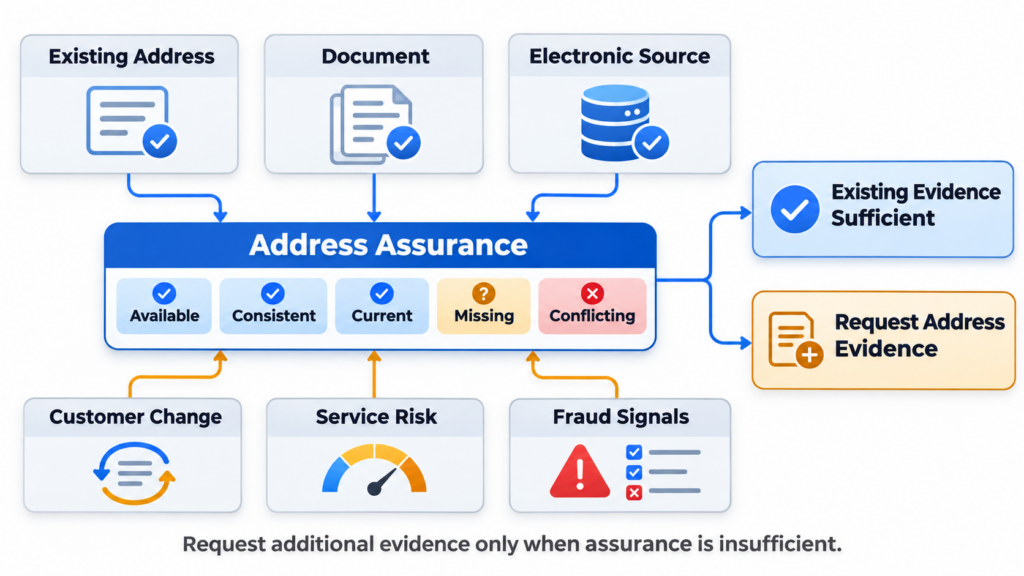
An additional address document may be appropriate when existing evidence does not provide sufficient confidence.
Common triggers include:
Address unavailable: The primary identity document does not contain a residential address, and no reliable electronic source is available.
Address mismatch: The declared address conflicts with an identity document, account record, authoritative source, or previously verified profile.
Insufficient recency: The available document may no longer reflect the customer’s current residence.
High-risk product or activity: The customer is applying for a regulated, high-value, cross-border, or geographically restricted service.
Customer profile change: An existing customer changes their residential address, contact details, ownership information, or operating location.
Fraud indicators: The session contains suspicious document, device, capture-source, behavioral, or network signals.
Enhanced due diligence: Screening, ownership, source-of-funds, or transaction risk creates a need for stronger supporting evidence.
A mismatch should not automatically mean fraud. Address formatting, transliteration, abbreviations, apartment numbering, and legitimate recent relocation can all produce differences that require normalization or confirmation.
3. What Documents Can Support Address Verification?
Acceptable evidence depends on the applicable regulation, market, customer type, and internal policy. Common examples include:
- Utility bills
- Bank or card statements
- Tax notices
- Government correspondence
- Tenancy documents
- Insurance statements
- Residence permits or identity documents containing an address
The relevant date also varies by document type. A utility bill may use its issue date or billing-period end, while a tenancy document may use an effective date and valid term.
Businesses should therefore define policies by document type rather than searching every file for any recent-looking date. They should also distinguish between unavailable information, unreadable information, and contradictory information.
Where permitted, electronic verification using reliable and independent data may remove the need for a customer-uploaded document. Regulatory guidance in some markets explicitly allows residential addresses to be verified through documentary or electronic sources, provided the organization takes reasonable steps to establish accuracy.
4. How Should Address Documents Be Validated?
Extracting a customer name and address is only the first step. A document can contain matching information while still being altered, fabricated, outdated, or captured from an untrusted source.
FinAuth can support a layered validation process:
Document classification: Determine the document type, expected layout, and applicable policy.
OCR extraction: Extract the name, address, issuer, document dates, reference fields, and other relevant information.
Address normalization: Standardize abbreviations, ordering, character sets, postal codes, and unit numbers before comparison.
Recency validation: Identify the date that genuinely represents the document’s relevance and apply the correct recency rule.
Authenticity analysis: Evaluate layout, typography, background patterns, image integrity, and potential manipulation.
Capture-integrity analysis: Detect possible screen recapture, print recapture, injection, or abnormal image-source characteristics.
Cross-field comparison: Compare the document with the customer’s declared address, verified identity, existing account data, and other available evidence.
NIST distinguishes attribute validation from evidence validation: an organization should confirm both that the relevant information is accurate and that the evidence itself is authentic, complete, and valid.
5. Building a Risk-Based Address Verification Workflow
A practical workflow should separate correctable quality issues from material security concerns.
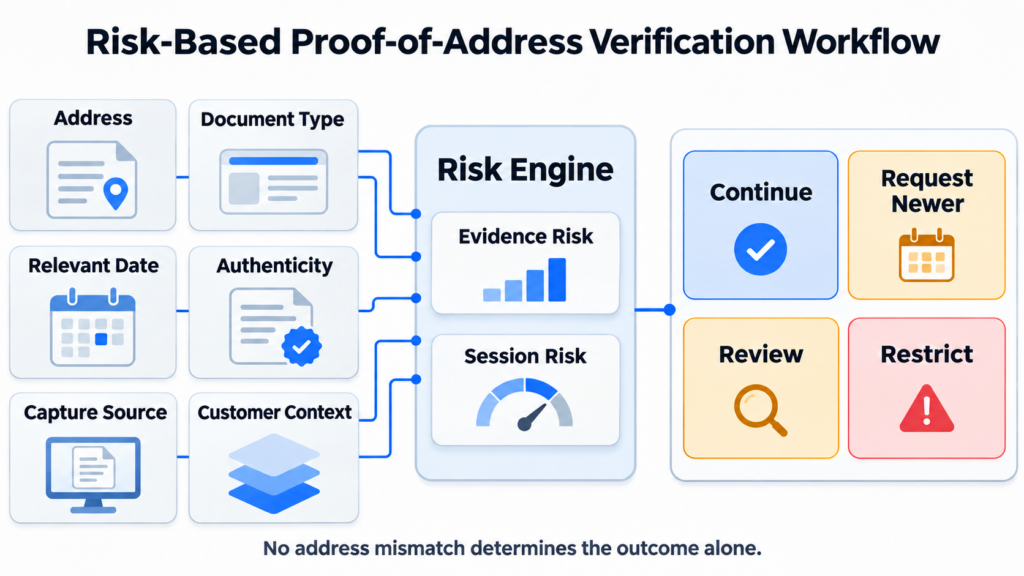
FinAuth can route address evidence and supporting signals into its Risk Engine:
- Low risk: The address is already supported by reliable data and is consistent with the customer profile. No additional document is required.
- Medium risk: Evidence is missing, outdated, unreadable, or affected by a correctable capture problem. Request a newer document or guided recapture.
- High risk: The address conflicts with other verified information or the session contains additional risk indicators. Route the case for review or stronger verification.
- Critical risk: Strong manipulation, identity fraud, prohibited geography, or coordinated fraud evidence is present. Restrict or reject the session according to policy.
No address mismatch, device signal, or document date should determine the outcome alone. The decision should reflect the combined evidence and the risk of the requested service.
6. How to Reduce Customer Friction
Proof-of-address requests should be specific and actionable. The customer should know:
- Why additional evidence is required
- Which document types are accepted
- Which name and address must be visible
- How recent the document must be
- Whether digital statements are permitted
- What caused a recapture request
FinAuth can classify uploaded documents, detect quality issues before submission, extract relevant fields automatically, and preserve completed verification steps. This reduces manual entry and prevents customers from restarting the entire identity-verification journey after a correctable error.
Organizations should also collect only the data necessary for the stated verification purpose. Unrelated balances, transactions, account numbers, or other sensitive information should not become decision inputs unless required by policy.
7. Proof of Address Q&A
When is proof of address required?
Requirements vary by market, product, customer type, and risk. Businesses should define when address evidence is mandatory and when reliable electronic validation or existing verified information is sufficient.
Does every customer need to upload an address document?
Not necessarily. A risk-based workflow may allow customers with validated and consistent address information to continue without an additional upload.
How recent should an address document be?
There is no universal period for every document and jurisdiction. The policy should define the relevant date and acceptable age for each supported document type.
Is a matching address enough to approve the document?
No. Address consistency does not prove document authenticity. The document’s structure, integrity, source, recency, and relationship to the verified customer should also be evaluated.
How does FinAuth support proof-of-address verification?
FinAuth combines document classification, OCR, date interpretation, authenticity analysis, capture-integrity checks, identity data, device signals, and risk-based decisioning. This helps businesses request additional evidence only when it materially improves assurance.
8. Conclusion
Additional proof of address should be a targeted risk control, not an automatic source of friction. Businesses should first evaluate the address information already available and request another document only when the assurance gap justifies it.
By combining address evidence with identity, document authenticity, device, session, and behavioral signals, FinAuth helps organizations streamline trusted customers while escalating uncertain or high-risk cases proportionately.