Digital identity verification often compares a fresh facial capture with the portrait on an identity document. Facial similarity alone, however, cannot establish that the camera is observing a genuine person. An attacker may present a printed photograph, replay a video, wear a mask, or inject manipulated media into the verification session.
Liveness Detection adds a separate security question: is the biometric sample being captured from a living person who is physically present? Combined with Face Verification, capture-integrity controls, document checks, and risk-based decisioning, it helps prevent stolen facial imagery from becoming a verified digital identity.
1. What Does Liveness Detection Verify?
Liveness Detection, commonly associated with presentation attack detection, analyzes whether the facial evidence originates from a live subject at the point of capture.
It is different from Face Verification:
- Face Verification asks whether two facial images appear to represent the same person.
- Liveness Detection asks whether the presented face comes from a live person rather than an imitation or replay.
- Injection Detection asks whether the media came through a trustworthy capture pipeline.
- Deepfake Analysis examines whether the media shows signs of synthetic generation or manipulation.
A high face-match score does not replace these controls. A high-quality replay of the correct person may match the reference portrait while still representing a spoofing attempt.
NIST defines liveness detection as analyzing anatomical characteristics or voluntary or involuntary reactions to determine whether a biometric sample comes from a living subject present at capture. Its current remote identity-proofing requirements call for tested presentation attack detection when biometric characteristics are collected and compared remotely.
2. Which Spoofing Attacks Can Liveness Detect?
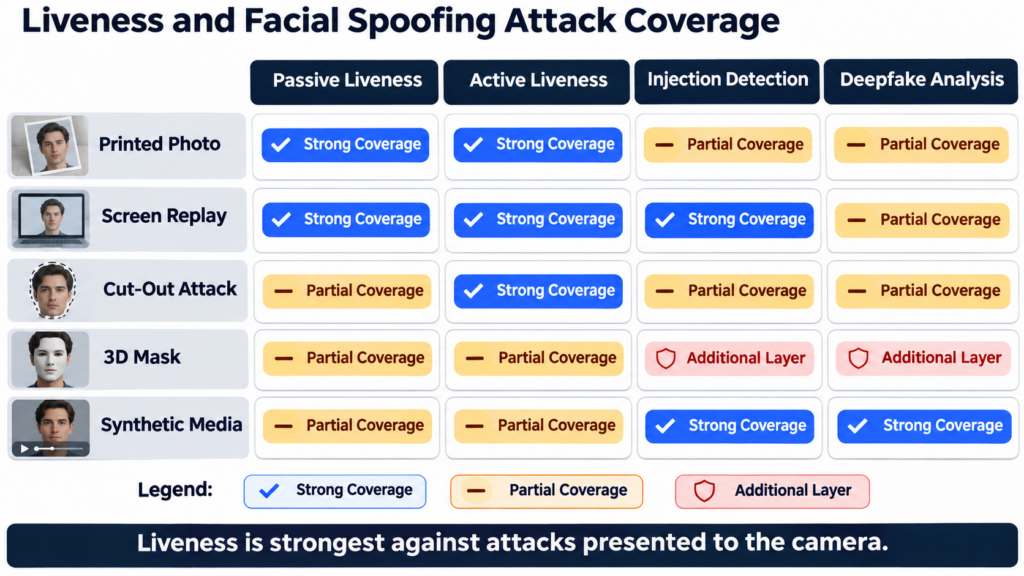
Liveness is primarily designed to identify attacks presented to a physical camera.
Printed photographs: An attacker presents a photograph of the target identity. Detection may consider depth, texture, reflection, motion, and the physical behavior of the presented material.
Screen replays: A facial photo or video is displayed on another screen. Analysis may detect display patterns, reflections, borders, moiré effects, unnatural motion, or inconsistencies across frames.
Cut-out and layered attacks: Openings or moving components may be added to a photograph to imitate blinking or facial movement. Spatial and temporal analysis can identify inconsistencies between real facial anatomy and the surrounding artifact.
Masks and three-dimensional replicas: More advanced attacks may reproduce facial shape or texture. Their effectiveness depends on the mask material, capture hardware, environmental conditions, and the detection model’s coverage.
Camera-presented synthetic media: A generated or manipulated face shown to a genuine camera may exhibit rendering artifacts, abnormal motion, or inconsistent facial detail. However, synthetic media requires additional analysis because a deepfake can sometimes depict a live operator’s movements.
NIST’s face PAD evaluation demonstrates why performance must be tested across different attack instruments. Detection results can vary substantially by algorithm and attack type; passing one attack class does not guarantee protection against every future presentation method.
3. Passive and Active Liveness Detection
Passive Liveness Detection operates in the background without requiring the user to complete a visible challenge. It can analyze facial texture, depth cues, light behavior, image quality, motion consistency, and temporal information from the capture.
This approach can reduce onboarding friction because genuine users generally need only position their face correctly. FinAuth Edge Liveness Detection can provide immediate capture guidance and early risk assessment on the user’s device.
Active Liveness Detection asks the user to perform an unpredictable action, such as changing head position or following another controlled prompt. The response can help establish that the subject is reacting in real time rather than presenting static media.
FinAuth Cloud Liveness Detection can support deeper server-side analysis, centralized model updates, and additional comparison across frames and signals. Depending on the risk, a workflow can begin with passive detection and request an active check only when stronger evidence is necessary.
Neither method is universally superior. The appropriate configuration depends on transaction value, attack exposure, user experience, device coverage, accessibility, and the required level of assurance.
4. Why Capture Quality Matters
Poor facial capture can resemble suspicious activity or conceal it. Low light, blur, extreme pose, obstruction, compression, and weak camera resolution may reduce both face-match and liveness confidence.
A secure workflow should distinguish correctable quality problems from attack indicators:
- Poor framing can trigger real-time guidance.
- Blur or low light can trigger recapture.
- An unsupported capture environment can require another verification method.
- Replay artifacts or abnormal media behavior can increase risk.
- Repeated failures across different signals can trigger step-up verification or review.
FinAuth uses quality analysis and guided recovery to help genuine users correct ordinary capture problems without lowering security thresholds. This reduces avoidable abandonment while preserving stronger responses for suspicious sessions.
5. What Liveness Detection Cannot Stop Alone
Liveness is not a complete defense against every form of biometric fraud.
A virtual camera may deliver manipulated video through software rather than presenting it to a physical sensor. A direct-injection attack may bypass the normal camera pipeline and submit prerecorded or synthetic media directly to the application. If the media appears internally consistent, a conventional liveness model may not know that the capture source has been replaced.
Current NIST guidance therefore calls for controls that increase confidence that digital media came from a genuine sensor. It also recommends analyzing submitted media for manipulation artifacts and considering virtual cameras, emulators, compromised devices, device attestation, and generative-AI indicators.
Liveness also cannot independently determine:
- Whether the live person owns the identity document.
- Whether the document is genuine or altered.
- Whether the user is being coerced.
- Whether a genuine customer’s account has been compromised.
- Whether the same face, device, or document is linked to other fraudulent accounts.
These risks require Face Verification, Document Verification, injection detection, device intelligence, behavioral signals, and relationship analysis.
6. Building a Layered Liveness Workflow
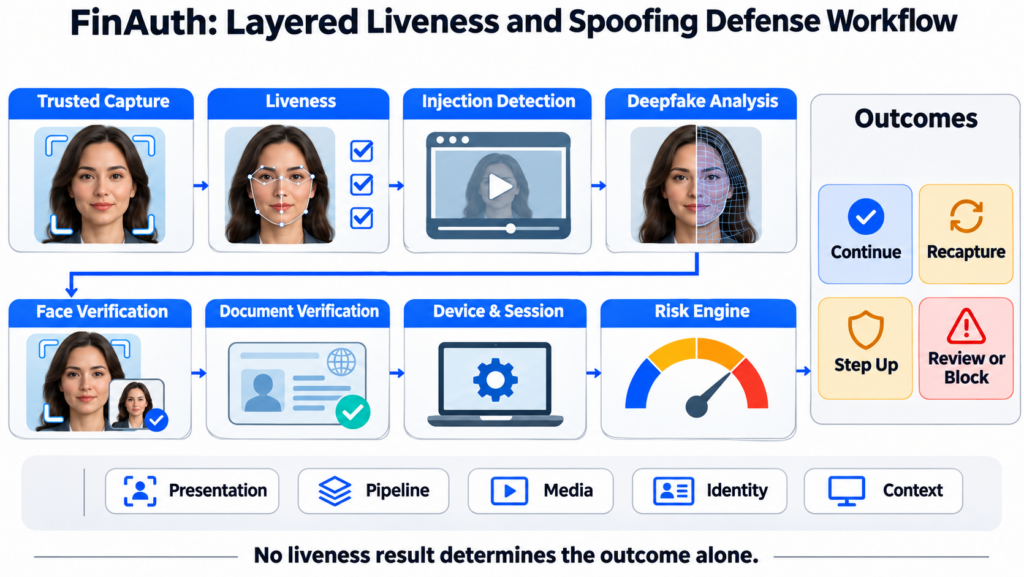
FinAuth can combine multiple defensive layers within a unified Risk Engine:
- Trusted capture: Evaluate the camera, application, device, and media pipeline.
- Liveness: Detect photographs, screens, masks, replays, and other presentation attacks.
- Injection and deepfake analysis: Identify virtual sources, manipulated media, and synthetic artifacts.
- Face Verification: Compare the live facial evidence with a trusted document portrait.
- Document Verification: Assess document structure, extracted data, authenticity, and manipulation risk.
- Contextual decisioning: Combine device, session, behavioral, identity, and network evidence.
Low-risk sessions can continue automatically. Quality failures may receive guided recapture. Uncertain sessions can be stepped up, while strong combined attack evidence can be reviewed or blocked.
7. Liveness Detection Q&A
Can liveness detection stop a printed-photo attack?
It is designed to detect presentation attacks such as printed photographs and screen replays. Actual performance depends on the detection model, capture conditions, attack instrument, and operating threshold.
Is liveness detection the same as face matching?
No. Liveness assesses genuine presence, while face matching assesses identity similarity. Secure remote verification generally requires both.
Can liveness detection identify deepfakes?
It may identify some camera-presented synthetic media, but it should not be treated as a complete deepfake defense. Deepfake analysis, injection detection, and device-integrity controls are also required.
Does active liveness always provide better security?
Not automatically. Active challenges provide useful real-time evidence but can increase friction and may still be simulated by advanced attacks. The control should be tested against the relevant threat model.
How does FinAuth respond to uncertain liveness results?
FinAuth can combine the result with capture quality, Face Verification, document authenticity, device intelligence, injection indicators, and session context. The Risk Engine can then request recapture, step up verification, or route the session for review.
8. Conclusion
Liveness Detection helps stop attackers from converting photographs, displays, replays, masks, and other presentation artifacts into verified identities. Its role is essential, but deliberately limited: it verifies evidence of genuine presence rather than proving the entire identity claim.
FinAuth strengthens liveness with Face Verification, document analysis, injection detection, deepfake analysis, device intelligence, and risk-based orchestration. Together, these layers provide stronger spoofing resistance without forcing every genuine user through the highest-friction verification path.