Manual customer due diligence reviews are necessary when evidence is incomplete, inconsistent, or materially risky. However, routing every alert, mismatch, or customer update to an analyst creates long queues, inconsistent decisions, and unnecessary onboarding friction.
The objective should not be to eliminate human review. It should be to automate cases supported by clear evidence, recover correctable issues without analyst intervention, and reserve specialist attention for customers whose combined risk genuinely requires investigation.
FinAuth supports this approach by combining identity, document, biometric, device, behavioral, screening, and transaction signals within a configurable Risk Engine.
1. Why CDD Review Queues Become Too Large
Manual workloads often grow because systems treat uncertainty as risk and individual alerts as conclusions.
Common causes include:
- Poor-quality identity documents being treated as suspicious
- OCR formatting differences creating false mismatches
- Common names generating repeated screening alerts
- Missing data being treated the same as conflicting data
- Every customer update triggering complete reverification
- Fixed review rules that ignore product and transaction risk
- Duplicate alerts being reviewed independently
- Decisions lacking reusable reason codes and audit evidence
These problems do not necessarily indicate weak detection. They often indicate that the workflow lacks sufficient enrichment, confidence bands, and exception handling before manual review.
2. Start With Reliable Customer Data
CDD automation depends on the quality of the information entering the workflow.
FinAuth can classify identity documents, extract structured fields through OCR, assess document authenticity, compare cross-field information, and evaluate capture integrity. Face Verification and Liveness Detection can then help establish whether the applicant matches the trusted portrait and is genuinely present.
Reliable identity attributes improve downstream processes such as:
- Sanctions and PEP screening
- Adverse media entity resolution
- Address consistency checks
- Beneficial-owner verification
- Duplicate-account detection
- Ongoing customer monitoring
FATF requires customer identity to be verified using reliable, independent documents, data, or information. It also supports proportionate measures based on the identified risk rather than identical treatment for every relationship.
3. Separate Quality Issues, Uncertainty, and Risk
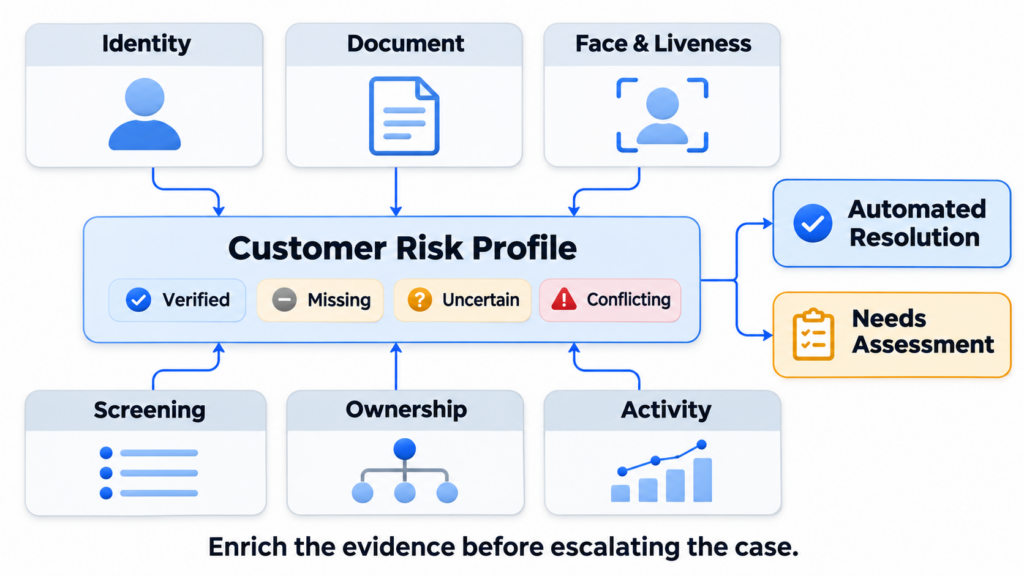
Not every failed check deserves manual investigation.
A useful CDD workflow should distinguish among:
Correctable quality issues: Blur, glare, cropping, poor facial framing, unreadable fields, or incomplete capture can trigger guided recapture.
Unavailable information: A field or reliable external source may not exist for a specific market or customer type. This should not automatically be treated as contradictory evidence.
Uncertain evidence: A borderline name match, address variation, or low-confidence OCR field may require confirmation or another source.
Material conflicts: Incompatible identity attributes, document manipulation, repeated biometric mismatches, suspicious ownership, or coordinated device relationships may justify specialist review.
This separation allows genuine customers to recover from ordinary errors while preserving escalation for meaningful risk.
4. Use Risk Bands Instead of Binary Rules
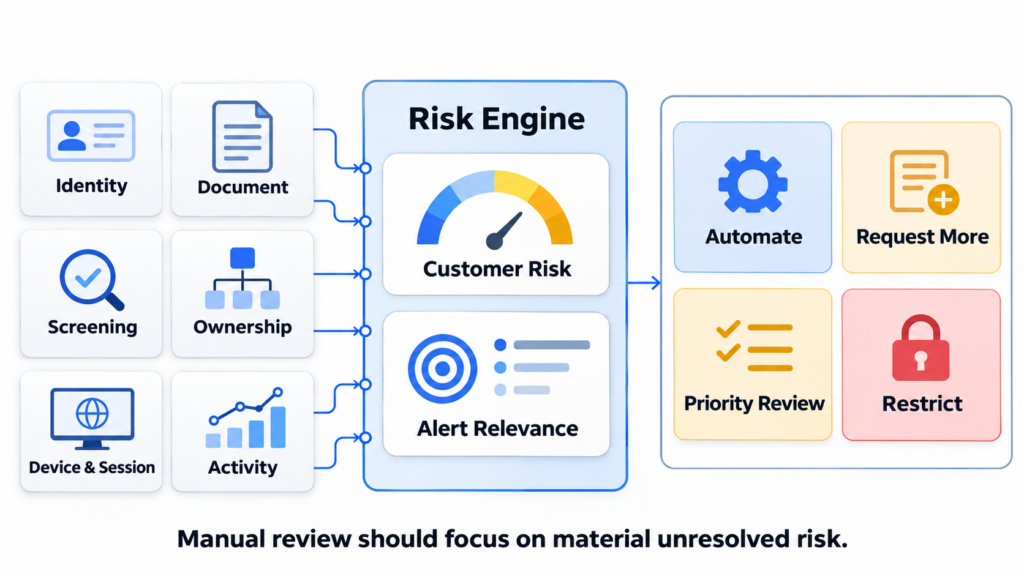
A binary pass-or-review model sends too many cases to analysts. FinAuth can instead combine available evidence into configurable decision bands.
- Low risk: Trusted identity, consistent attributes, authentic document, normal device and behavior. Approve automatically where policy permits.
- Medium risk: Correctable quality problem or limited uncertainty. Request confirmation, recapture, or an additional document.
- High risk: Multiple inconsistencies, relevant screening exposure, unusual ownership, or suspicious activity. Route to priority review.
- Critical risk: Strong fraud, sanctions, manipulation, injection, or coordinated-network evidence. Restrict the session and escalate according to policy.
No individual score should determine the decision alone. The Risk Engine should consider the customer, product, geography, requested action, and evidence combination.
FinCEN guidance similarly states that customer types do not have one uniform level of risk and that additional information may be unnecessary for lower-risk relationships while higher-risk cases may require deeper understanding.
5. Automate Alert Enrichment Before Review
Screening alerts should reach analysts with the available evidence already assembled.
For a possible sanctions or PEP match, the system can compare:
- Name and alias similarity
- Date of birth
- Nationality and geography
- Identity document data
- Position and timeline
- Ownership and relationships
- Customer activity
- Previous review outcomes
A weak name similarity with conflicting dates of birth may be automatically resolved where policy permits. A close match supported by consistent identity, ownership, and activity information should receive higher priority.
The same principle applies to document, device, and behavioral alerts: analysts should review an enriched case, not manually collect information already available across the verification workflow.
6. Apply Event-Driven Ongoing CDD
Unnecessary periodic reviews can create large workloads without corresponding risk value. A more focused model updates customer information when monitoring identifies a relevant change.
Possible triggers include:
- Identity or address changes
- Beneficial-ownership changes
- New high-risk counterparties
- Material transaction changes
- New sanctions, PEP, or adverse media alerts
- Account recovery or sensitive profile changes
- Device or network relationships linked to fraud
- Doubts about previously obtained customer information
FinCEN states that customer information updates are risk-based and may occur when normal monitoring reveals a relevant change. Its guidance also notes that routine periodic review alone does not necessarily require beneficial-ownership information to be collected again.
FinAuth can respond to each trigger proportionately, from a simple confirmation to Face Verification, Liveness Detection, document recapture, full CDD, enhanced due diligence, or manual review.
7. Preserve Human Oversight and Auditability
Automation should make decisions more consistent and explainable, not create an opaque shortcut.
A controlled workflow should record:
- Evidence considered
- Rules and thresholds applied
- Automated resolution reason
- Missing or conflicting information
- Customer risk level
- Actions requested
- Reviewer decision and rationale
- Policy or model version
Teams should monitor automation rates, false-positive rates, review volumes, decision times, overrides, confirmed fraud, missed risk, and outcomes by market and customer group.
Resolved cases should also feed back into rule and model calibration. Repeated analyst overrides may indicate weak thresholds, insufficient enrichment, or a policy that no longer reflects operational risk.
8. CDD Automation Q&A
Can CDD be fully automated?
Some low-risk and evidence-complete cases can be automated, but uncertain or high-risk customers may still require human judgment. The appropriate level depends on regulation, product risk, and internal policy.
How can businesses reduce false-positive CDD alerts?
Improve identity data, normalize fields, enrich screening matches, distinguish missing data from conflicts, suppress genuine duplicates, and assess alerts in the context of the complete customer profile.
Should every customer be reviewed periodically?
Requirements vary by jurisdiction and policy. A risk-based approach can combine scheduled controls with event-driven reviews triggered by material customer or risk changes.
What should always be routed to manual review?
Organizations should define their own escalation policy. Typical candidates include unresolved material conflicts, strong screening matches, suspicious ownership, document manipulation, coordinated fraud, and cases requiring regulatory judgment.
How does FinAuth reduce manual CDD review?
FinAuth combines document verification, OCR, Face Verification, Liveness Detection, device intelligence, behavioral signals, external screening results, and configurable risk decisioning. It can automate trusted cases, recover correctable failures, and prioritize cases supported by stronger combined-risk evidence.
9. Conclusion
Reducing manual CDD review does not require weaker controls. It requires better evidence, clearer distinctions between quality and risk, automated enrichment, proportionate decision bands, and event-driven monitoring.
By coordinating identity, document, biometric, device, behavioral, screening, and transaction evidence, FinAuth helps compliance teams automate routine cases while concentrating human expertise on the customers and alerts that matter most.