Forged identity documents are increasingly difficult to detect through simple visual inspection. Fraudsters can modify portraits and personal data, combine elements from different documents, reproduce genuine templates, or submit digitally manipulated copies during remote onboarding.
AI-based document verification helps identify these risks by comparing the submitted evidence with expected document structures, checking consistency across fields, analyzing image integrity, and evaluating how the document entered the verification session. However, no individual anomaly proves forgery. Reliable detection requires multiple document, biometric, device, and capture-integrity signals to be assessed together.
1. What Is AI-Based Forged Document Detection?
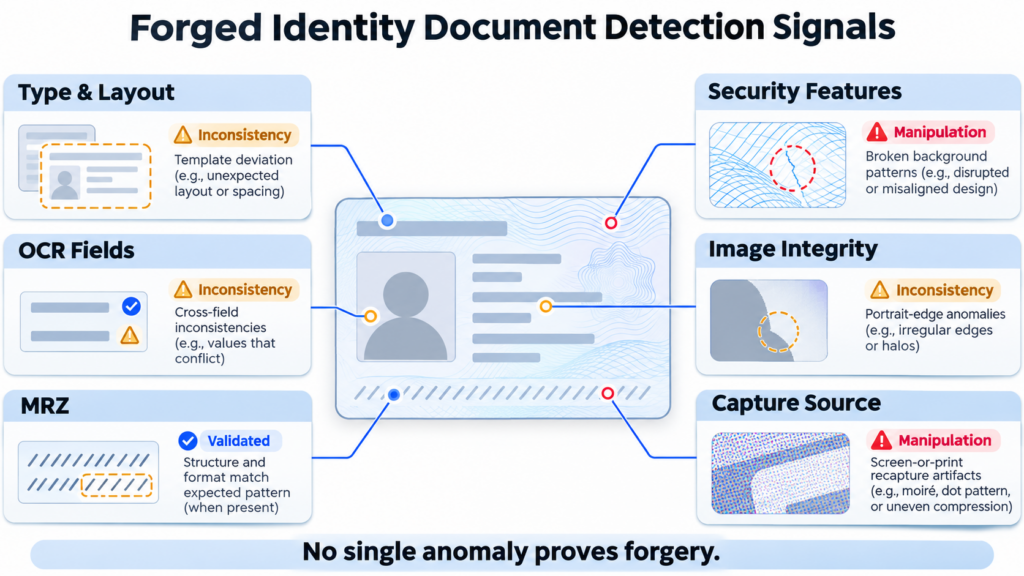
AI-based forged document detection uses computer vision, machine learning, OCR, document templates, and risk analysis to evaluate whether identity evidence appears genuine and unaltered.
The process typically answers several questions:
- Is the document type recognized and structurally correct?
- Are required fields present in the expected locations?
- Do fonts, spacing, colors, and background patterns match the template?
- Are visual fields consistent with the MRZ, barcode, or chip data when available?
- Does the image contain signs of digital editing, photo replacement, or compositing?
- Was a physical document captured live, or was an existing image presented through a screen, printout, or injected media stream?
NIST defines identity-evidence validation as confirming that evidence is authentic, accurate, and valid. Its guidance includes automated document validation, security-feature inspection, cross-checking printed and machine-readable data, live capture, and analysis for manipulation artifacts.
2. How AI Recognizes the Expected Document
Before detecting manipulation, the system must understand what the document should look like.
FinAuth can classify the document by type, issuing market, version, and layout. The submitted image is then compared with the appropriate document model rather than a generic identity-card design.
The analysis may evaluate:
Layout structure: Expected position, size, and alignment of portraits, text fields, signatures, machine-readable zones, and design elements.
Typography: Font family, character proportions, spacing, baseline alignment, and printing consistency.
Field rules: Expected date formats, document-number patterns, required fields, and logical relationships between issue and expiry dates.
Security design: Visible background patterns, overlapping elements, ghost portraits, transparent features, and other document-specific evidence observable through the available capture method.
Small inconsistencies across several areas can be more meaningful than one isolated visual difference. ICAO similarly recommends layered document security because no single feature can prevent or reveal every form of fraudulent attack.
3. Detecting Edited Data and Replaced Portraits
Fraudsters may alter a genuine document by replacing its portrait or changing names, dates, document numbers, and expiry information.
AI image analysis can identify indicators such as:
- Unnatural portrait boundaries or inconsistent background texture
- Differences in sharpness, noise, compression, or lighting
- Misaligned text or inconsistent character rendering
- Broken lines and security patterns around edited regions
- Local color or resolution differences
- Unexpected spacing between fields
- Laminate or surface irregularities
These signals must be interpreted carefully. Glare, compression, document wear, or poor camera quality may resemble manipulation. FinAuth therefore separates correctable capture-quality problems from stronger integrity indicators and can request a better image before escalating the session.
4. Cross-Checking Visual and Machine-Readable Data
A visually convincing document may still contain inconsistent data.
When available, FinAuth can extract relevant fields independently from:
- The visible inspection zone
- The machine-readable zone
- Supported barcodes
- Electronic document chips or digitally signed evidence
The system can normalize different formats and compare names, dates of birth, document numbers, nationality, sex markers, and expiry dates. It can also validate MRZ check digits and expected field structures.
A mismatch may indicate alteration, but it may also result from OCR uncertainty, transliteration, optional fields, or document-specific formatting. The workflow should distinguish between conflicting data, unreadable data, and data that is not applicable to that document type.
NIST requires printed data to be compared with MRZ or barcode data when those sources are present. For cryptographically protected electronic evidence, signature and trust-chain validation can provide stronger source and integrity assurance.
5. Detecting Digital Composites and Recaptured Documents
Not every fraudulent submission involves a physically altered card. An attacker may create a digital composite and present it as a camera capture.
Potential indicators include:
- Editing boundaries and inconsistent pixel structure
- Repeated textures or abnormal resampling
- Inconsistent compression across regions
- Screen pixels, moiré patterns, or display reflections
- Print artifacts and unusual halftone patterns
- Missing depth, motion, or surface-response evidence
- Virtual-camera or direct-media injection signals
A clean image is not necessarily genuine. FinAuth can combine document-image analysis with capture-source assessment, device integrity, session behavior, and injection detection to determine whether the evidence was captured through an expected trusted process.
6. Why Document AI Should Not Decide Alone
Document analysis establishes whether the evidence appears authentic; it does not establish by itself that the applicant is its rightful owner.
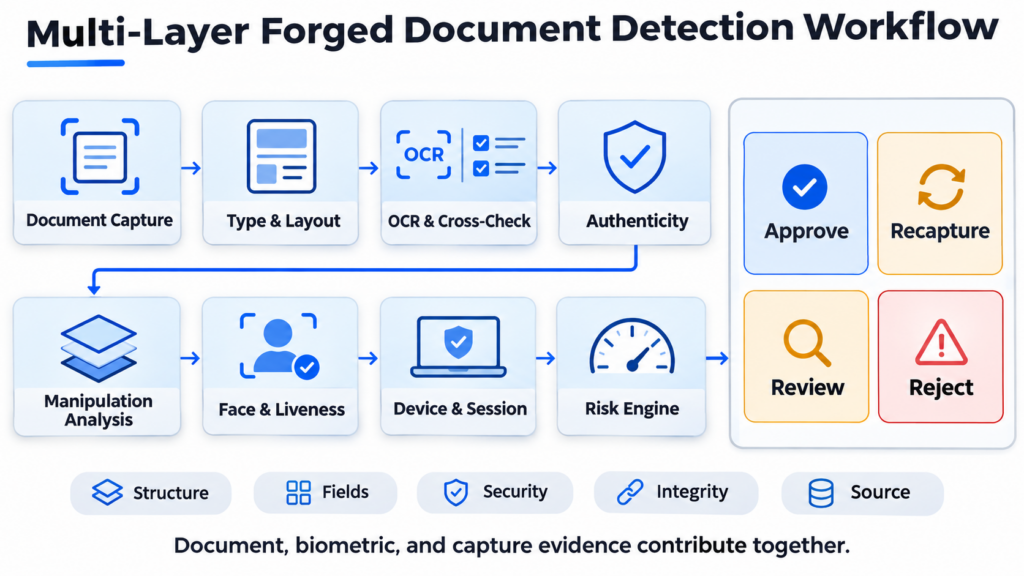
A stronger digital onboarding workflow combines:
Document Verification: Type, layout, OCR, cross-field consistency, security evidence, and manipulation analysis.
Face Verification: Comparison between the document portrait and the applicant’s facial capture.
Liveness Detection: Assessment of genuine presence and resistance to presentation attacks.
Capture integrity: Detection of recaptured, virtual-camera, deepfake, or injected media.
Device and session intelligence: Analysis of device integrity, reuse, linked accounts, abnormal behavior, and session risk.
FinAuth’s Risk Engine can evaluate these signals together. A low-quality image may lead to guided recapture, while document manipulation combined with facial inconsistency and device anomalies may require review or rejection.
7. Measuring Detection Performance
Forged-document detection models should be tested against both genuine documents and representative attacks.
Businesses should monitor:
- False acceptance and false rejection rates
- Detection rates by forgery and document type
- Capture-quality and recapture rates
- OCR and cross-field mismatch rates
- Manual-review outcomes
- Performance by device, market, and document version
- Newly observed attack patterns
NIST recommends testing automated media analysis against genuine and manipulated samples, documenting false-negative performance, and supplementing algorithmic decisions with manual review where necessary.
8. Forged Document Detection Q&A
Can AI confirm that an identity document is genuine?
AI can provide strong evidence by checking structure, fields, security features, image integrity, and capture source. The confidence available depends on the document, capture conditions, and accessible authenticity evidence.
Is an OCR mismatch proof of forgery?
No. OCR errors, transliteration, glare, damage, and formatting differences may cause mismatches. The system should evaluate confidence and document-specific rules before escalating.
Can a high-quality image still be fraudulent?
Yes. Digitally composited or injected images may appear extremely clear. Image quality must be evaluated separately from document authenticity and capture integrity.
How does FinAuth detect forged documents?
FinAuth combines document classification, OCR, layout analysis, cross-field validation, authenticity checks, manipulation detection, capture-source analysis, Face Verification, Liveness Detection, device intelligence, and risk-based decisioning.
9. Conclusion
AI-based forged document detection is most effective when it moves beyond a single visual check. Template structure, field consistency, security evidence, image integrity, and capture source each reveal different forms of risk.
FinAuth brings these layers together with biometric, device, and session intelligence, helping businesses automate trusted submissions, recover from correctable quality problems, and escalate evidence supported by stronger combined-risk indicators.