Customer risk does not remain fixed after onboarding. Sanctions lists change, customers assume politically exposed roles, beneficial ownership structures evolve, new adverse information appears, and account activity may diverge from the original business purpose.
Continuous customer rescreening helps financial institutions detect these changes without waiting for the next scheduled KYC review. The strongest approach combines list updates with verified identity, ownership, device, behavioral, and transaction evidence—then applies proportionate actions through a risk-based workflow.
1. What Is Continuous Customer Rescreening?
Continuous customer rescreening is the ongoing reassessment of customers and related parties against relevant risk sources after onboarding.
Depending on the institution’s policy and regulatory obligations, rescreening may cover:
- Sanctions and restricted-party lists
- Politically exposed persons and related parties
- Adverse media
- Internal watchlists
- Beneficial owners and authorized representatives
- Counterparties, beneficiaries, and connected accounts
Continuous does not necessarily mean rerunning every check after every event. It means that relevant list changes and customer events can trigger timely, targeted reassessment.
The FATF risk-based approach expects institutions to identify and understand their financial-crime exposure and prioritize controls in the areas presenting greater risk.
2. Why Onboarding Screening Is Not Enough
A customer may present limited risk when an account is opened but become higher risk later.
Common changes include:
External risk changes: A person or entity is added to a sanctions list, becomes a PEP, appears in relevant adverse media, or becomes connected to a newly identified high-risk party.
Customer changes: The customer updates their name, address, nationality, occupation, company structure, directors, or beneficial owners.
Account changes: New beneficiaries, unfamiliar devices, account recovery, permission changes, or unusual access patterns emerge.
Behavioral changes: Transaction value, frequency, geography, counterparties, or fund flows become inconsistent with the established customer profile.
FinCEN describes ongoing monitoring as identifying suspicious transactions and maintaining customer information on a risk basis. Its guidance also clarifies that routine periodic review alone does not necessarily require beneficial-ownership collection; a relevant risk change can provide the trigger.
3. What Should Trigger Customer Rescreening?
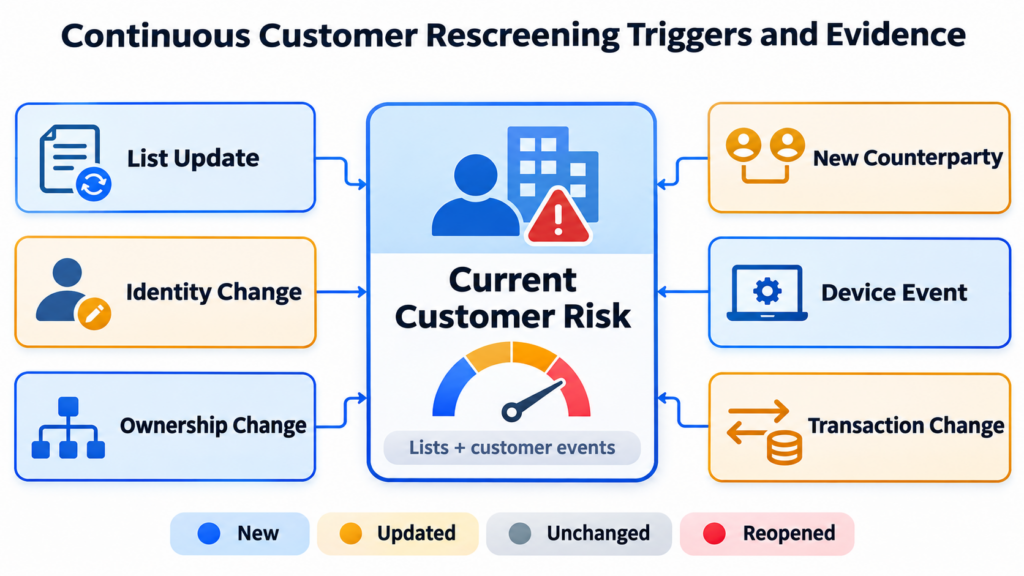
A practical framework combines scheduled, list-driven, and event-driven triggers.
List-driven triggers include new or amended sanctions, PEP, watchlist, and adverse-media records. The system should identify which customers or connected parties may be affected rather than automatically reopening every customer case.
Customer-driven triggers include changes to identity data, beneficial ownership, business purpose, expected activity, or geographic exposure.
Transaction-driven triggers include unusual fund movement, new high-risk counterparties, rapid changes in value or velocity, and activity inconsistent with the customer’s known profile.
Security-driven triggers include account recovery, device changes, repeated biometric failures, suspected account takeover, document manipulation, or linked-account risk.
These triggers should update the current risk assessment rather than create isolated alerts with no customer context.
4. Enrich Screening Matches Before Escalation
A new alert is not automatically a valid match. Common names, aliases, transliteration, incomplete list records, and limited customer data can create unnecessary review work.
Possible matches should be enriched with available attributes such as:
- Full name and aliases
- Date and place of birth
- Nationality and address
- Identity-document information
- Company registration data
- Beneficial ownership and relationships
- Position and relevant timeline
- Historical screening decisions
OFAC advises organizations to compare all available list and customer attributes when evaluating a possible sanctions match. A name similarity alone may be insufficient, while several consistent attributes can justify escalation.
FinAuth can provide verified identity attributes extracted from trusted evidence and combine them with external screening results. This helps compliance teams distinguish weak similarities from alerts supported by stronger identity consistency.
5. Combine Rescreening with Current Customer Risk
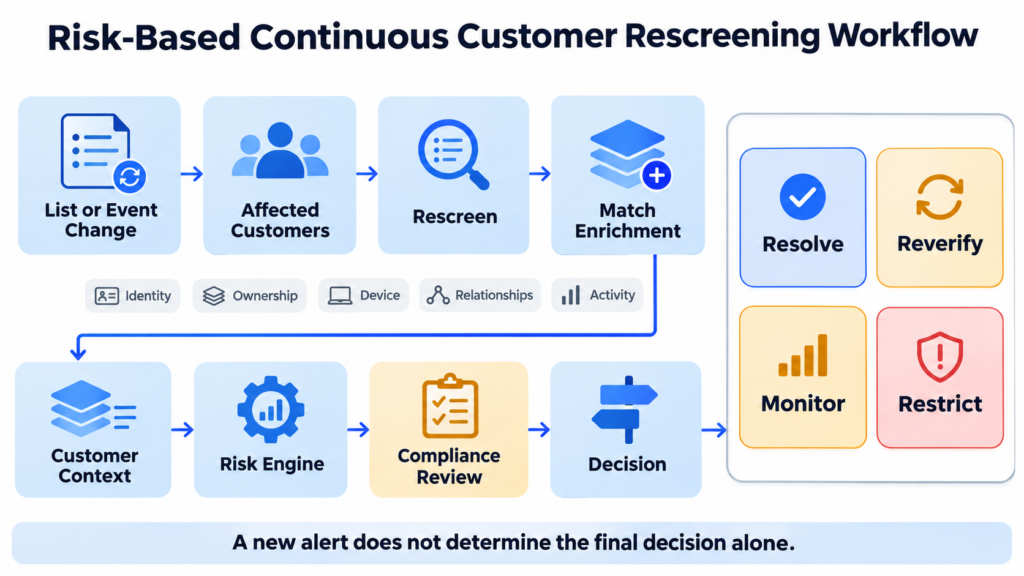
A screening result should not determine the final decision alone.
FinAuth’s Risk Engine can combine updated screening evidence with:
Identity integrity: Document authenticity, OCR consistency, Face Verification, Liveness Detection, and capture integrity.
Ownership and relationships: Beneficial owners, directors, authorized representatives, linked accounts, and connected counterparties.
Device and session risk: Device reuse, integrity anomalies, unusual access, account recovery, and possible injection attacks.
Behavior and transactions: Changes in value, velocity, geography, beneficiaries, transaction sequence, and customer baseline.
A possible match supported by matching identity attributes, high-risk ownership, suspicious transaction flows, and connected accounts should receive greater priority than a weak name similarity with contradictory attributes.
6. Build a Risk-Based Rescreening Workflow
A scalable workflow can follow six stages:
- Detect a change: Receive a list update or identify a material customer, ownership, security, or transaction event.
- Identify the affected population: Select customers and related parties potentially affected by the change.
- Rescreen relevant entities: Apply the appropriate sanctions, PEP, adverse-media, and internal watchlist controls.
- Enrich possible matches: Compare alerts with verified identity, ownership, relationship, device, and activity evidence.
- Recalculate customer risk: Evaluate both the individual alert and the broader customer or network profile.
- Apply proportionate action: Resolve low-relevance alerts, request updated evidence, increase monitoring, prioritize review, or restrict activity where required.
OFAC encourages organizations to establish risk-based sanctions compliance programs that reflect their customers, products, services, markets, and geographic exposure.
7. Avoid Repeating Full KYC Unnecessarily
Continuous rescreening should not force every customer through the complete onboarding process whenever a minor attribute changes.
The response should match the identified uncertainty:
- Request confirmation when a non-material field changes.
- Obtain an updated document when identity evidence is outdated or inconsistent.
- Use Face Verification and Liveness Detection for sensitive account changes.
- Reverify ownership when credible information indicates a structural change.
- Apply enhanced due diligence when several material risk indicators overlap.
- Restrict activity when confirmed legal or compliance obligations require it.
This targeted approach preserves assurance while reducing customer friction and manual-review volume.
8. Continuous Rescreening Q&A
How often should customers be rescreened?
Frequency should reflect regulatory requirements, customer risk, list-update availability, and relevant business events. Higher-risk customers generally require more frequent or event-driven reassessment.
Does every new screening alert require manual review?
No. Alerts can be enriched with verified identity and contextual evidence. Policy-approved low-relevance matches may be resolved automatically, while uncertain or high-risk cases require review.
Should a profile change trigger full KYC?
Not automatically. The institution should determine whether the change affects identity assurance or the customer’s risk profile and request only the evidence needed to address that risk.
How does FinAuth support continuous rescreening?
FinAuth verifies identity and combines screening outcomes with document, face, liveness, device, behavioral, transaction, and network signals. Its Risk Engine helps route customers to resolution, reverification, monitoring, enhanced review, or restriction.
9. Conclusion
Continuous customer rescreening helps institutions identify AML risk as lists, customer profiles, relationships, and account activity change.
By enriching new alerts with verified identity and current behavioral context, FinAuth enables businesses to resolve lower-risk changes efficiently while directing compliance resources toward customers supported by stronger combined-risk evidence.