A high eKYC drop-off rate does not necessarily mean identity verification is too strict. Users often abandon onboarding because instructions are unclear, document capture repeatedly fails, completed steps are lost, or the workflow applies the same level of verification to every session.
Removing controls may improve short-term completion rates but also increase exposure to forged documents, impersonation, deepfakes, injection attacks, and synthetic identities. A stronger approach is to eliminate avoidable friction while preserving the assurance required for each customer and use case.
FinAuth helps businesses achieve this balance through guided document capture, OCR, Document Verification, Face Verification, Liveness Detection, device intelligence, and risk-based workflow orchestration.
1. Measure Drop-Off at Each Verification Stage
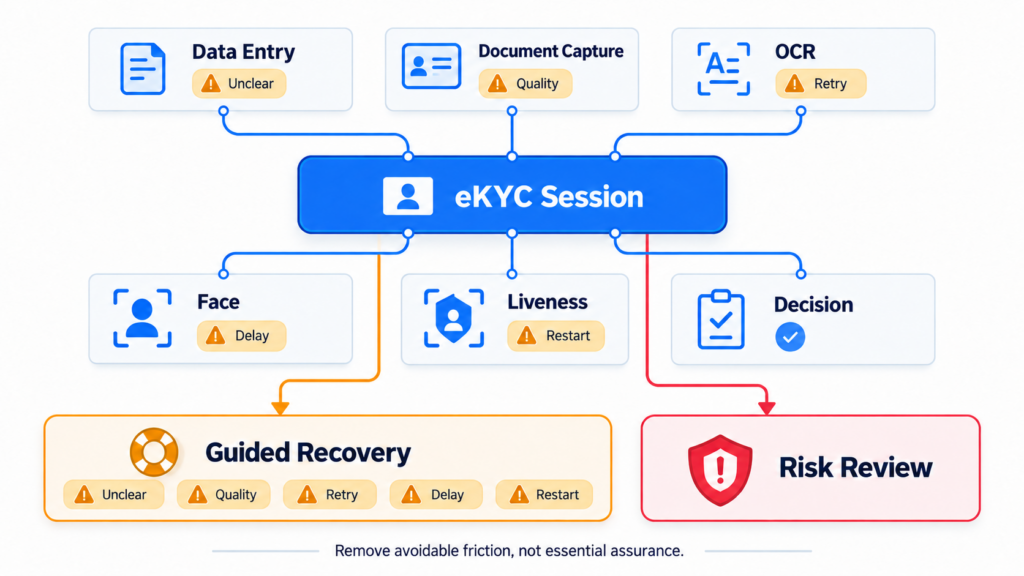
eKYC is a multi-stage journey rather than one conversion event. It may include:
- Customer data collection
- Identity document capture
- OCR and field confirmation
- Document authenticity checks
- Facial comparison
- Liveness Detection
- Screening and risk assessment
- Manual review or additional evidence
A single overall completion rate cannot reveal where users encounter problems. Businesses should measure entry, completion, retry, failure, and abandonment rates for every stage.
Useful breakdowns include document type, country, language, device, operating system, browser, network condition, and verification pathway. This helps distinguish a product design issue from an unsupported document, camera limitation, model-performance gap, or fraud control.
FinAuth provides structured results for individual checks, enabling teams to identify the precise source of friction instead of weakening the entire verification process.
2. Improve Document Capture Before Processing
Poor captures reduce both conversion and security. Blur, glare, missing edges, perspective distortion, low resolution, and uneven lighting can prevent OCR extraction while obscuring evidence of tampering.
Quality checks should operate during capture rather than after submission. The user should receive specific guidance such as:
- “Move the document closer.”
- “Place all four corners inside the frame.”
- “Reduce reflection over the portrait.”
- “Hold the document steady.”
- “Use the original document rather than a screen image.”
FinAuth can evaluate capture quality, classify the document, extract structured fields, and assess authenticity within one workflow. Correctable quality issues can trigger guided recapture, while screen, print, manipulation, or injection indicators can follow a security path.
NIST’s identity-proofing guidance recognizes automated document validation but requires evidence to be assessed for authenticity, accuracy, and validity. It also calls for live document capture and presence checks in remote optical inspection workflows.
3. Minimize Unnecessary Data Entry
Users should not repeatedly type information already extracted from a document.
OCR can prefill names, dates, document numbers, nationality, and address fields. The interface can then ask users to confirm only fields that are uncertain, missing, or materially inconsistent.
However, OCR confidence should support routing rather than determine identity assurance. A high-confidence extraction may still come from a forged document, while a low-confidence result may simply reflect glare or an unfamiliar typeface.
FinAuth combines field confidence with document structure, cross-field consistency, MRZ or barcode comparison where available, and authenticity evidence. This allows reliable fields to proceed automatically without treating extraction accuracy as proof that the document is genuine.
4. Separate User Errors From Fraud Indicators
A failed check does not always indicate an attack.
A legitimate customer may use an older device, have an unstable connection, submit a worn document, or struggle with capture instructions. Fraud indicators include a different class of evidence, such as document manipulation, virtual-camera use, media injection, repeated identity reuse, or suspicious device relationships.
The workflow should respond differently:
- Quality issue: Provide instructions and request targeted recapture.
- OCR uncertainty: Ask for field confirmation where policy permits.
- Temporary technical failure: Preserve progress and allow a safe retry.
- Identity inconsistency: Request additional evidence or stronger verification.
- Integrity or attack signal: Escalate, review, or block according to policy.
This separation prevents ordinary capture failures from creating unnecessary rejection while ensuring that attackers do not receive an easier recovery path.
5. Use Risk-Based Verification Paths
Requiring every applicant to complete the maximum verification journey creates unnecessary friction. At the same time, allowing all applicants to follow the shortest path can weaken assurance.
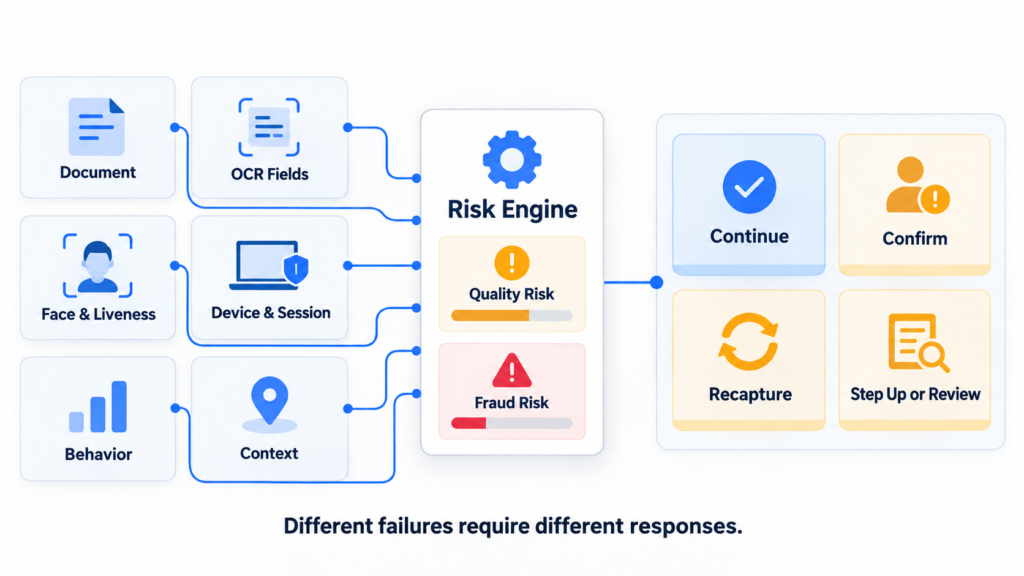
FinAuth’s Risk Engine can combine:
- Document authenticity and data consistency
- Face-match and liveness results
- Capture-integrity and injection signals
- Device and session intelligence
- Behavioral patterns
- Customer, product, and transaction context
- Cross-account identity and device relationships
The combined evidence can route users through proportionate paths:
- Low risk: Continue automatically.
- Moderate risk: Confirm a field or recapture one input.
- Elevated risk: Require stronger liveness, another document, or additional evidence.
- High risk: Route to priority review or reject.
NIST recommends offering multiple identity-proofing methods and exception mechanisms for users with different capabilities and technologies, while ensuring that alternative paths provide comparable assurance.
6. Preserve Progress and Provide Clear Recovery
Restarting the entire journey after one failed step creates avoidable abandonment.
A well-designed recovery flow should:
- Preserve successfully completed checks.
- Identify the exact field or capture that failed.
- Explain whether the issue is quality, consistency, or eligibility.
- Limit repeated attempts to prevent abuse.
- Change the verification method after repeated failure.
- Provide an accessible support or review route.
- Communicate expected review times and next steps.
Alternative pathways must not become security bypasses. If a user cannot complete an automated biometric check, the fallback should provide comparable assurance through another approved method.
NIST requires documented error and exception processes and accessible mechanisms for resolving identity-proofing failures, delays, and difficulties.
7. Optimize Conversion and Fraud Outcomes Together
Completion rate should never be evaluated in isolation.
Teams should monitor:
- First-attempt and eventual completion
- Drop-off by verification stage
- Document and facial recapture rates
- Time to automated decision
- Manual-review rate and turnaround time
- False rejection and confirmed fraud
- Step-up completion
- Recovery-path usage and outcomes
- Performance by device, market, and document type
If completion improves while fraud acceptance increases, the workflow has been weakened. If fraud rejection improves but genuine users cannot recover from routine quality issues, the workflow is overly rigid.
FinAuth’s structured results allow teams to evaluate conversion and risk together, recalibrate thresholds, and adjust routing rules without removing foundational identity controls.
8. eKYC Drop-Off Q&A
Why do users abandon eKYC?
Common causes include unclear instructions, poor document capture, repeated data entry, unexplained biometric failures, long processing times, and having to restart completed steps.
Can businesses shorten eKYC without weakening security?
Yes. Reliable data can be automated, duplicate inputs removed, and low-risk sessions streamlined. Higher-risk sessions should still receive proportionate document, biometric, device, or manual checks.
Should every failed verification be rejected?
No. Quality and technical failures should receive controlled recovery options. Manipulation, injection, identity inconsistency, or coordinated fraud signals require a security response.
How does FinAuth reduce eKYC drop-off?
FinAuth combines guided capture, OCR, Document Verification, Face Verification, Liveness Detection, device intelligence, and risk-based routing. This helps genuine users recover from correctable problems while directing suspicious sessions to stronger verification.
9. Conclusion
Reducing eKYC drop-off does not require weaker identity verification. It requires accurate stage-level measurement, better input quality, less duplicate work, clear recovery paths, and verification strength that reflects actual risk.
By coordinating document, biometric, device, behavioral, and contextual evidence, FinAuth helps businesses automate trusted sessions, recover legitimate users from ordinary errors, and maintain strong defenses against identity fraud.