OCR can turn identity documents into structured data within seconds, reducing manual entry and accelerating digital onboarding. However, extraction confidence varies by field, document type, language, image quality, and capture conditions.
A confidence-based OCR workflow should not treat every extracted value equally. High-confidence fields may be automated, uncertain fields may require confirmation or recapture, and material inconsistencies may require review. The final decision should also consider document authenticity, biometric verification, and session risk—not OCR confidence alone.
FinAuth enables this layered approach by combining document capture, OCR, authenticity analysis, Face Verification, Liveness Detection, and contextual risk signals.
1. What Is OCR Confidence?
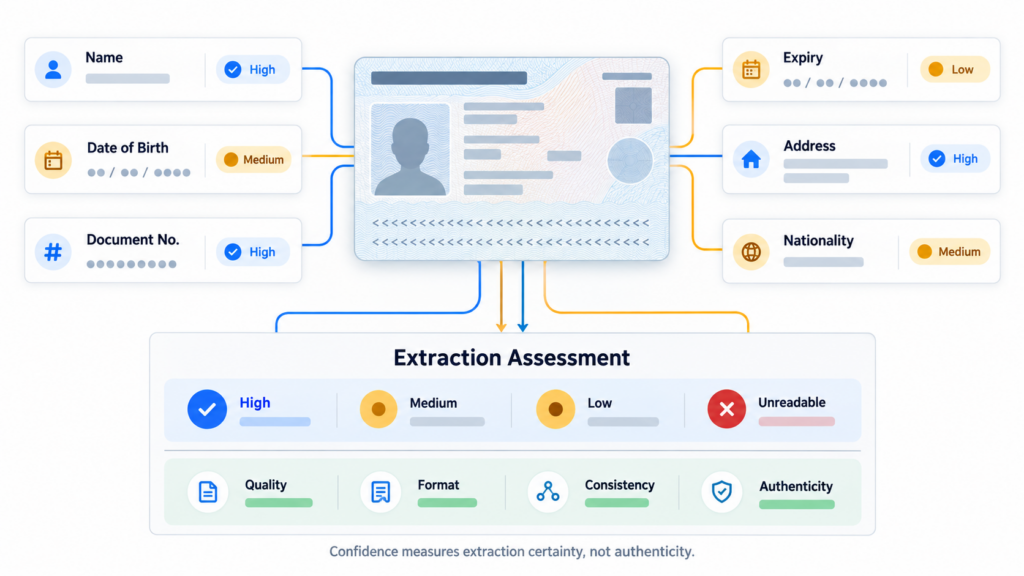
OCR confidence estimates how certain an extraction model is that it correctly recognized a character, word, or field.
Confidence may be calculated at several levels:
- Character level: Confidence in an individual letter or number.
- Word level: Confidence in the complete recognized value.
- Field level: Confidence that a name, date, or document number was extracted correctly.
- Document level: An aggregated view of extraction quality across the document.
These scores are useful for workflow routing, but they are not universal probabilities. A score of 90 from one OCR model may not represent the same accuracy as 90 from another. Thresholds must therefore be calibrated using representative documents, languages, devices, and capture conditions.
A high-confidence extraction also does not prove that the underlying document is authentic. OCR can accurately read information from a forged, altered, expired, or digitally recaptured document.
2. Why One OCR Threshold Is Not Enough
Fields have different operational and fraud consequences.
A minor address-formatting difference may be recoverable, while one incorrect character in a document number can prevent authoritative validation. Names containing multiple scripts, diacritics, or transliterations may also require different normalization rules from dates and numeric identifiers.
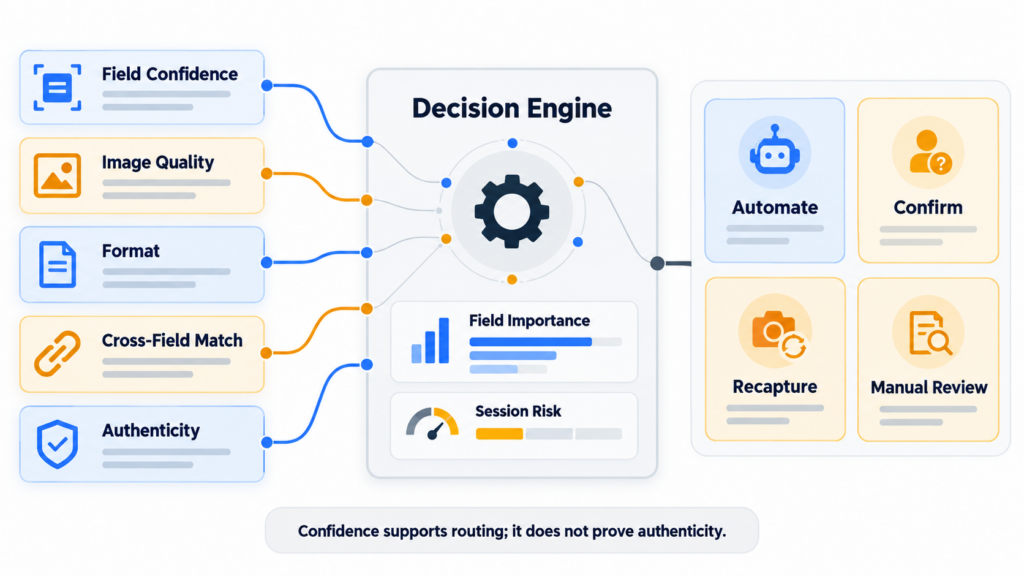
A practical workflow should consider:
- Field importance
- OCR confidence
- Image quality
- Expected format and length
- Cross-field consistency
- Availability of MRZ or barcode data
- Document authenticity signals
- Business and regulatory risk
For example, a low-confidence optional address line may not block onboarding. A low-confidence date of birth used for age eligibility should receive a stronger response.
3. When Can OCR Results Be Automated?
Automatic processing is most appropriate when the extraction is supported by multiple consistent signals.
A field may proceed automatically when:
- Its calibrated confidence exceeds the approved threshold.
- The image meets blur, glare, crop, and resolution requirements.
- The value follows the expected document format.
- Visual fields agree with available MRZ or barcode data.
- Required fields are complete.
- No document manipulation or recapture indicators are present.
- The surrounding identity session remains low risk.
NIST’s identity-proofing guidance separates identity resolution, evidence validation, and verification. It requires evidence to be evaluated for authenticity, accuracy, and validity rather than relying on data extraction alone.
FinAuth can extract structured document fields and evaluate them alongside template structure, document type, cross-field consistency, and authenticity evidence before allowing straight-through processing.
4. When Should the User Confirm or Recapture?
Not every uncertain extraction requires manual review. Many issues can be resolved through a targeted recovery step.
Request field confirmation when:
- The document image is usable, but one non-security-critical field is uncertain.
- Multiple plausible character interpretations exist.
- The field can be confirmed without weakening identity assurance.
Request recapture when:
- Blur or glare obscures required information.
- Document edges are missing.
- Perspective distortion affects multiple fields.
- Resolution is too low for reliable extraction.
- The document type or side cannot be identified.
- The capture appears to come from a screen or printout.
Guidance should be specific. “Reduce reflection over the date of birth” is more useful than “OCR failed.” FinAuth can use field- and quality-level results to request only the correction needed instead of restarting the entire verification journey.
5. When Is Manual Review Appropriate?
Manual review should be reserved for cases where human judgment can resolve material uncertainty.
Examples include:
- A required field remains uncertain after recapture.
- Visual, MRZ, or barcode values conflict.
- Document layout differs from the expected template.
- The document contains unusual damage or possible alteration.
- Multiple identity attributes conflict with customer-provided data.
- The session combines OCR uncertainty with elevated device or behavioral risk.
- Policy requires review for a particular document or customer type.
The review interface should show the original capture, extracted value, confidence, alternative interpretations, quality indicators, and specific reason for escalation. Reviewers should not have to search through the entire session to find the disputed field.
NIST recognizes both automated document validation and inspection by trained personnel. It also requires available MRZ or barcode data to be compared with printed fields during automated optical document inspection.
6. Building a Confidence-Based OCR Workflow
A scalable workflow can use four decision bands.
High confidence and consistent evidence: Accept the extracted field and continue automatically.
Moderate confidence with correctable quality issues: Provide guidance and request a targeted recapture.
Uncertain but recoverable evidence: Ask the user to confirm permitted fields or provide additional evidence.
Material conflict or combined risk: Route the case to manual review, enhanced verification, or rejection according to policy.
FinAuth’s Risk Engine can combine field confidence with document authenticity, cross-field consistency, facial comparison, liveness, device intelligence, and session behavior. This prevents one OCR score from determining the complete onboarding outcome.
7. How to Calibrate and Monitor Thresholds
Thresholds should be validated using production-representative data rather than selected document samples.
Teams should monitor:
- Field accuracy by document type and language
- False acceptance and false rejection rates
- Straight-through processing rate
- Recapture and abandonment rates
- User correction frequency
- Manual-review volume and resolution
- Fraud detected within each confidence band
- Performance by device and capture condition
Thresholds should be reassessed when OCR models, document templates, supported markets, or capture journeys change. NIST’s AI Risk Management Framework similarly promotes ongoing measurement and risk management across the AI lifecycle, including appropriate human oversight where required.
8. OCR Review Workflow Q&A
Does a low OCR confidence score indicate fraud?
No. It may result from blur, glare, unusual fonts, document damage, or language complexity. Fraud assessment requires additional integrity and contextual evidence.
Can high-confidence OCR data be trusted automatically?
Only when supporting checks also pass. High confidence indicates extraction certainty, not document authenticity or genuine ownership.
Should every uncertain field go to manual review?
No. Targeted confirmation or guided recapture can resolve many quality-related cases more efficiently.
How does FinAuth reduce OCR review work?
FinAuth combines field-level extraction results with quality checks, document validation, cross-field comparison, biometrics, and risk signals. This allows high-confidence cases to proceed while directing only material uncertainty to stronger verification.
9. Conclusion
Confidence-based OCR review is not simply a choice between automation and manual processing. Effective workflows apply different responses according to field importance, extraction certainty, capture quality, consistency, and overall identity risk.
By integrating OCR with document authenticity, biometrics, device intelligence, and risk-based orchestration, FinAuth helps businesses automate reliable data while escalating only the cases that require additional evidence or judgment.