The Operational Challenge: A “Verified” Borrower May Still Be Fabricated
A lending app can approve a borrower in minutes. The ID image is readable. OCR extracts the name and ID number. The selfie matches the document portrait. The phone number is active.
Then the loan defaults. During review, analysts find the same face, device fingerprint, address format, or payout account across multiple borrower profiles.
This is the practical risk of synthetic identity fraud in digital lending. The borrower is not always a stolen identity. It may be assembled from real, fake, and manipulated attributes: an edited ID, a re-photographed document, a reused selfie, or a device from an application farm.
This is difficult in ASEAN because lending is mobile-first, document formats vary by country, and many borrowers have limited formal credit history. The Google, Temasek, and Bain e-Conomy SEA report shows Southeast Asia’s digital economy at large scale, while the GSMA State of the Industry Report on Mobile Money tracks mobile financial transaction growth. More users can access credit, but remote onboarding must carry more trust burden.
Why Basic KYC Breaks Down
Synthetic identity fraud is not a single attack. It is a workflow.
Fraud teams test combinations of identity data, ID images, selfies, SIM cards, devices, IPs, and behavioral patterns. The objective is to pass enough controls at scale while keeping cost per application low.
Single-point KYC usually fails for three reasons:
- OCR-only document checks extract text but do not prove document authenticity.
- One-time face matching compares two images but may miss replay, injection, or face reuse.
- Per-application rules evaluate the current borrower but fail to link related applications.
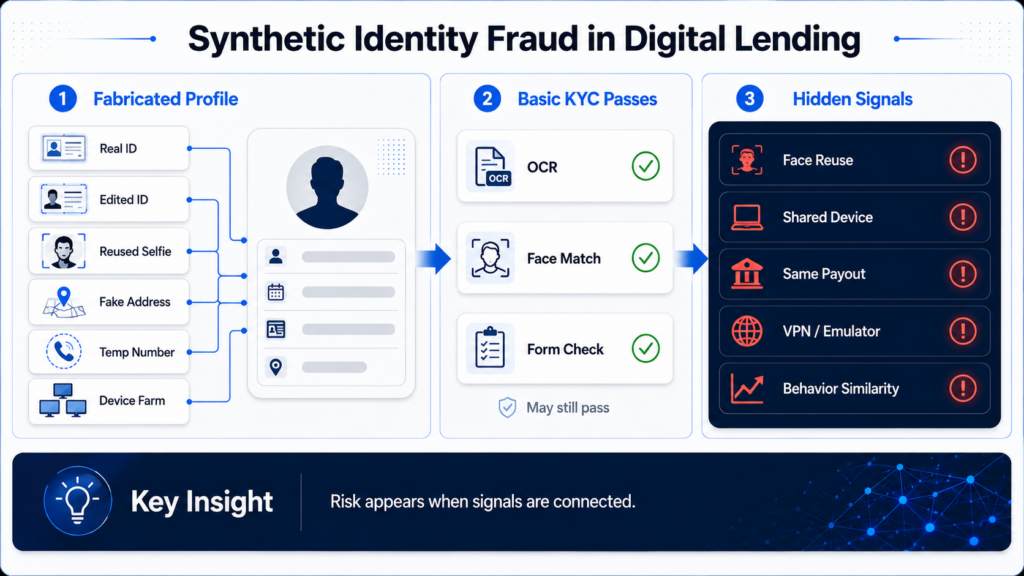
The NIST SP 800-63A identity proofing guidance separates evidence collection, validation, verification, and binding. “OCR completed” is not the same as “identity verified.” The FATF Digital Identity Guidance also reinforces risk-based digital identity controls for customer due diligence.
Under the Hood: How Fabricated Borrowers Pass Onboarding
Most lending onboarding flows submit REST API payloads with document images, selfie images, extracted fields, device IDs, and session IDs. The payload may be complete, but completeness is not authenticity.
A typical risk event may include ID number, image URLs, hashed device fingerprint, session ID, IP risk score, and timestamp. The backend must decide whether the borrower is genuine in seconds.
Latency increases when image files are too large, video frames are uncompressed, models run sequentially, REST calls are split across too many services, or slow third-party checks block decisioning. In low-bandwidth environments, packet loss and retries can create duplicate sessions, incomplete liveness flows, and inconsistent risk logs.
The harder problem is signal distribution. Synthetic identity fraud is often invisible in one application. It becomes visible when the platform detects relationships: the same face across different ID numbers, the same device across borrowers, the same IP subnet during application bursts, or the same payout account.
Step-by-Step Optimization Workflow
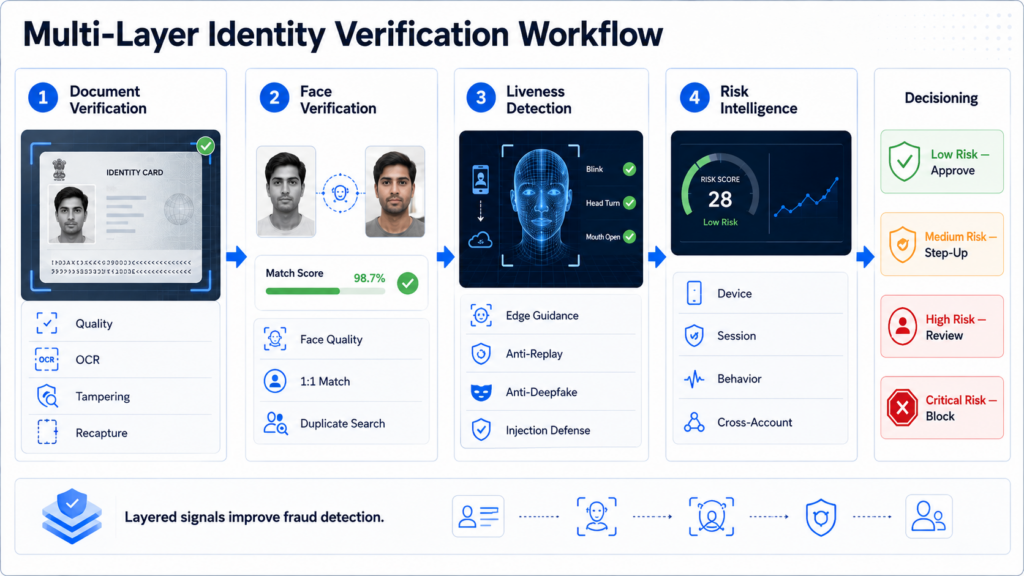
Step 1: Verify Document Authenticity Before Trusting OCR
OCR should sit inside a broader document verification pipeline.
The system should check image quality, document type, OCR confidence, field consistency, template layout, barcode or MRZ consistency, tampering artifacts, screenshot signals, and recapture patterns.
For ASEAN lenders, document coverage matters. Indonesia, the Philippines, Thailand, Vietnam, Malaysia, and Singapore use different identity formats. A narrow document model may perform well in one country and fail in another.
Step 2: Bind the Borrower’s Face to the Claimed Identity
Face verification should answer a specific technical question: does the live applicant match the ID portrait?
The workflow should include face quality assessment, crop normalization, 1:1 comparison, score calibration, and manual review routing for borderline scores.
For synthetic borrower detection, 1:N duplicate face search is important. A reused face may pass 1:1 matching against several manipulated documents. Cross-account face search can expose repeated borrower identities before credit is issued.
Step 3: Combine Edge Liveness With Cloud-Side Risk Models
Liveness detection should protect against printed photos, replay attacks, masks, deepfakes, and injection attacks.
A practical architecture uses both edge and cloud controls. The mobile SDK can perform capture guidance, frame stability checks, device integrity checks, and lightweight liveness screening. Cloud models can run multi-frame analysis, injection detection, and anti-deepfake scoring.
This reduces server overhead and improves completion rates in unstable networks. Technical teams should tune FPS, image compression, model size, timeout policy, retries, and API idempotency. The goal is reliable risk classification under real device and network constraints.
Step 4: Fuse Device, Session, Behavioral, and Cross-Account Signals
A risk engine should evaluate more than ID and face data.
Useful signals include device fingerprint, emulator risk, VPN or proxy usage, IP reputation, geolocation and timezone consistency, session duration, copy-paste behavior, typing rhythm, touch trajectory, repeated address formats, shared beneficiary accounts, and repeated face or document artifacts.
Rules remain useful for explainability, but static rules are not enough. Stronger architectures combine deterministic rules, ML risk scores, and graph-based correlation. API security is also part of the design. The OWASP API Security Top 10 highlights authentication and authorization risks that can affect identity verification APIs. Lending platforms should use request signing, rate limits, replay protection, and auditable logs.
Regional Context: ASEAN Lending Constraints
ASEAN lenders face fragmented identity infrastructure, uneven credit bureau coverage, varied mobile network quality, and fast-moving fraud rings. Compliance expectations also differ by market. Product teams need consent controls, data minimization, evidence retention, and explainable decisions.
The World Bank Global Findex shows the importance of mobile access in financial inclusion. For lenders, that means onboarding becomes the primary trust gateway.
How FinAuth Helps
FinAuth supports multi-layer borrower verification for mobile-first lending workflows.
The platform combines document verification, OCR, face verification, liveness detection, device and session intelligence, behavioral signals, risk orchestration, and audit evidence management. The SDK is optimized for low-bandwidth environments through guided capture, local quality checks, efficient image handling, and edge-cloud coordination.
The objective is not to reject every unusual applicant. It is to classify risk accurately enough to apply the right action:
- Low risk: approve
- Medium risk: request step-up verification
- High risk: route to manual review
- Critical risk: block or suspend the application
This helps lending teams reduce fabricated borrower exposure without damaging onboarding conversion.
Technical CTA
Review your current onboarding architecture across three areas: API latency, signal coverage, and cross-account detection. Then assess whether your KYC flow can detect repeated faces, shared devices, injected selfies, manipulated documents, and coordinated borrower clusters before credit is issued.
Schedule a technical deep-dive with FinAuth to map your borrower verification flow and define a layered identity risk architecture.
FAQ
What is synthetic identity fraud in digital lending?
It is a borrower profile built from real, fake, stolen, or manipulated identity attributes. The full identity does not represent a genuine individual.
Why is it difficult to detect?
Each signal may look acceptable alone. The fraud becomes clearer when document, face, device, session, and account relationship signals are analyzed together.
Is face matching enough?
No. Face matching verifies similarity between two images. It does not prove liveness, document authenticity, device trust, or uniqueness across accounts.
What metrics should lenders track?
Track approval rate, false rejection rate, manual review rate, fraud catch rate, default rate by risk tier, verification latency, API timeout rate, and repeated-identity cluster detection.