Deepfakes have moved beyond manipulated videos shared online. Fraudsters can now use AI-generated faces, real-time face swaps, animated portraits, synthetic voices, and injected media streams to target digital onboarding, account recovery, payments, and other identity-sensitive processes.
Detecting these attacks requires more than one deepfake classifier. Each technology observes a different part of the session, and each has limitations. A strong defense combines content analysis, liveness detection, capture-channel protection, device intelligence, contextual risk signals, and continuous decisioning.
Why Deepfake Detection Is Not One Technology
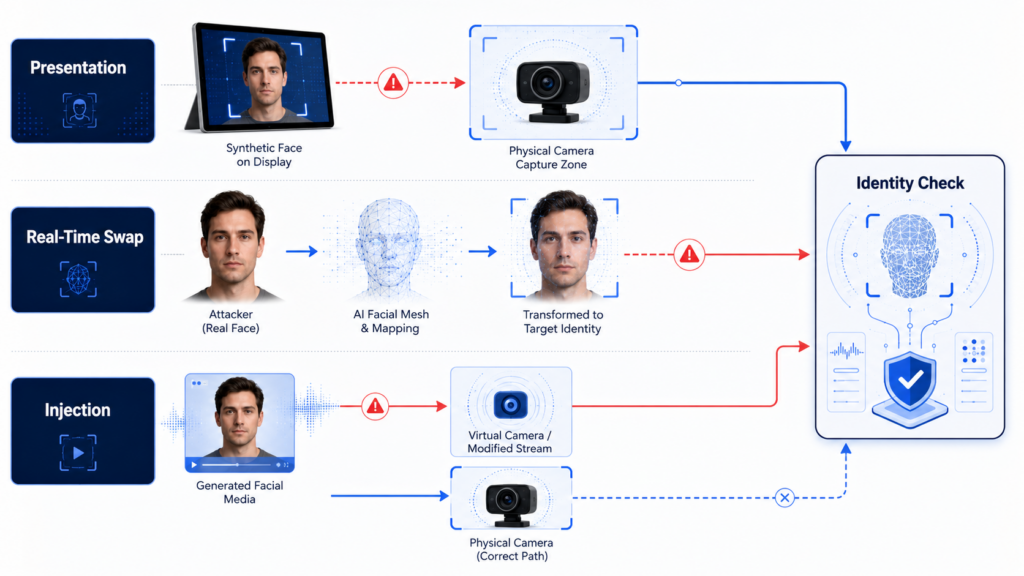
The term “deepfake” covers several attack methods.
A fraudster may display synthetic media on a screen in front of a physical camera. This is a presentation attack. Another attacker may use a virtual camera or modified application to inject generated content directly into the verification pipeline. A third may control a real person’s face through real-time reenactment or combine stolen identity data with synthetic media.
These attacks leave different signals. Screen presentations may reveal reflections or display patterns, while digitally injected content may preserve high image quality and bypass camera-level clues. Real-time face swaps may respond to simple challenges but still contain temporal, geometric, or blending inconsistencies.
No single model can observe every layer equally well.
Comparing Deepfake Detection Technologies
Visual Forensic Analysis
Visual forensic models analyze the submitted image or video for traces of generation and manipulation. They may examine facial boundaries, skin texture, lighting, reflections, compression, frequency patterns, and inconsistencies between facial regions.
Strengths: Useful for identifying synthetic or edited content already present in a media stream. It can operate without asking the user to perform additional actions.
Limitations: New generation methods may produce fewer known artifacts. Compression, low resolution, filters, and legitimate camera processing can also change the signals the model expects.
Visual analysis is valuable, but it should not be treated as permanent proof that media is genuine.
Temporal and Motion Analysis
Video provides information across multiple frames. Temporal models can evaluate blinking, lip movement, head motion, facial geometry, frame consistency, and the relationship between expressions and surrounding regions.
Strengths: Can detect instability that may not appear in a single image. It is useful against poorly synchronized face swaps and animated portraits.
Limitations: Real-time generation is improving, and short or low-frame-rate captures may provide limited evidence. Network and device performance can also create legitimate motion anomalies.
Passive Liveness Detection
Passive liveness determines whether a facial capture appears to come from a real person without requiring explicit actions. It can analyze depth, texture, illumination, reflections, motion, and other presentation characteristics.
Strengths: Low friction and suitable for high-volume onboarding or routine verification. It can detect many printed-photo, replay, mask, and screen-based attacks.
Limitations: A system focused only on physical presentation attacks may not identify media injected after the camera. Its effectiveness also depends on the attack coverage represented during training and testing.
Active Liveness and Challenge-Response
Active liveness asks the user to perform an action, such as turning their head or following a randomized instruction.
Strengths: Adds session-specific interaction that prerecorded media may not reproduce. Randomized challenges can strengthen step-up verification for higher-risk cases.
Limitations: It adds friction and accessibility considerations. Advanced real-time face manipulation systems may also respond to predictable challenges.
Active liveness should be risk-triggered rather than required for every customer.
Injection Attack Detection
Injection detection examines whether the media stream originates from the expected capture channel. It can identify virtual cameras, API hooks, modified SDKs, emulators, abnormal frame timing, and other stream-integrity risks.
Strengths: Addresses attacks that may bypass the physical camera and avoid traditional screen or print artifacts.
Limitations: Coverage depends on the platform, operating system, integration method, and attacker technique. It must evolve alongside new injection tools.
Device and Session Intelligence
Device intelligence evaluates the environment surrounding the biometric capture. Relevant signals can include device fingerprint, operating system, emulator status, proxy usage, IP reputation, location, timezone, and repeated verification attempts.
Strengths: Provides context that image analysis cannot. It can reveal coordinated fraud even when the submitted face appears convincing.
Limitations: Device anomalies do not always indicate fraud. Legitimate customers may use new devices, VPNs, or unusual networks.
Identity and Behavioral Consistency
A deepfake session may still conflict with the wider identity journey. Businesses can compare the live face with a verified document portrait and evaluate profile data, capture timing, interaction patterns, repeated identities, and account history.
Strengths: Detects inconsistencies across the entire process instead of judging the media alone.
Limitations: It requires sufficient historical and contextual data. Individual mismatches should be interpreted carefully to avoid unnecessary rejection.
Technology Comparison
| Technology | Primary Role | Main Strength | Key Limitation |
|---|---|---|---|
| Visual forensics | Detect synthetic artifacts | Low-friction media analysis | May weaken against new generators |
| Temporal analysis | Detect frame inconsistencies | Uses motion over time | Requires sufficient video quality |
| Passive liveness | Confirm genuine presence | Smooth user experience | May miss capture-channel attacks |
| Active liveness | Add interactive proof | Stronger step-up control | Adds user friction |
| Injection detection | Protect the media stream | Detects camera bypass | Platform-dependent coverage |
| Device intelligence | Assess session context | Reveals coordinated risk | Signals may be legitimate |
The comparison shows why technologies should complement one another. A strong visual detector cannot confirm device integrity, while a trusted device cannot prove that the facial media is genuine.
How to Build a Layered Defense
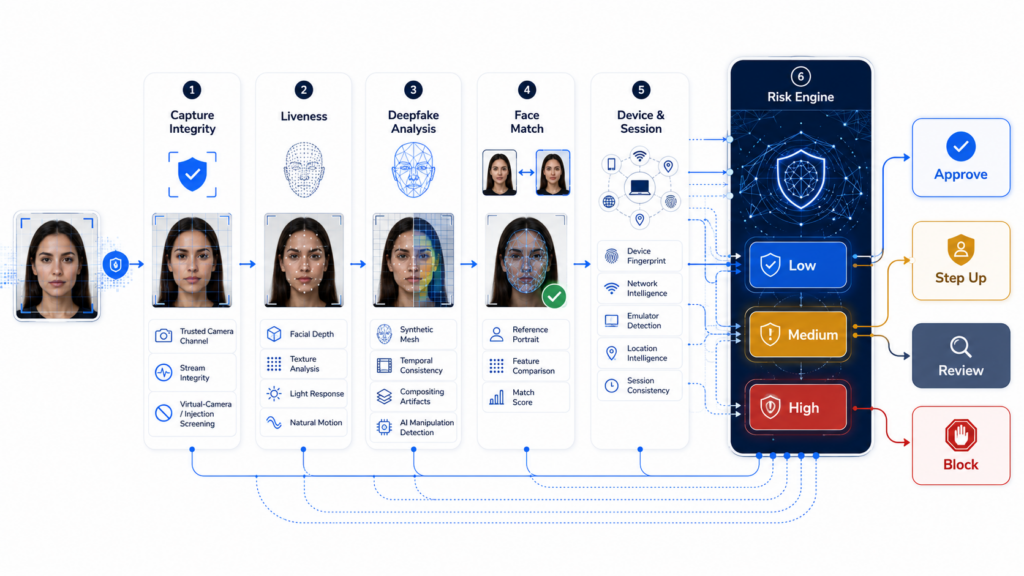
Protect the Capture Channel
Use secure SDK integration, application integrity controls, injection detection, and device intelligence to determine whether media originates from a trusted environment.
Analyze Presence and Authenticity
Apply passive liveness by default, then combine it with visual forensic and temporal analysis. Higher-risk sessions can receive randomized active checks.
Verify the Identity
Compare the current face with a trusted portrait obtained during verified onboarding. Evaluate face-match confidence together with document authenticity and identity-data consistency.
Combine Signals in a Risk Engine
The risk engine should fuse biometric, media, device, session, behavioral, and business-context signals. Possible actions include:
- Approve low-risk sessions
- Request stronger verification
- Recapture uncertain media
- Route suspicious cases for review
- Block critical attacks
A weak signal should not always determine the final result. Several connected anomalies are generally more meaningful than one isolated indicator.
Monitor New Attacks
Deepfake defenses degrade if models and policies remain static. Businesses should review production attacks, conduct adversarial testing, update attack datasets, monitor false acceptance and rejection, and refine thresholds over time.
Balancing Protection and User Experience
Layered security does not mean exposing every user to every control. Many checks can operate silently in the background. Passive liveness, stream integrity, device analysis, and behavioral monitoring can assess normal sessions without additional interaction.
Stronger active checks should be reserved for account recovery, sensitive profile changes, new devices, large withdrawals, and other high-risk events. This risk-based approach improves protection while limiting unnecessary onboarding or transaction friction.
Building Deepfake Defense with FinAuth
FinAuth combines Large Visual Model-powered analysis with Edge and Cloud liveness detection, deepfake and injection attack detection, face verification, document authenticity checks, device and session intelligence, behavioral risk analysis, and configurable risk decisioning.
These capabilities help businesses evaluate not only whether an image looks genuine, but whether the person, capture channel, device, identity, and overall session can be trusted.
Deepfake detection should not depend on finding one perfect model. The more resilient strategy is to build multiple detection layers, combine their evidence, and continuously adapt as AI-powered identity attacks evolve.