Identity documents can present the same information in multiple formats: printed visual fields, a machine-readable zone (MRZ), and a barcode. Comparing these representations helps businesses identify inconsistent data, capture errors, and potential document manipulation during digital onboarding.
However, matching fields do not automatically prove authenticity. A forged document may contain internally consistent information, while a genuine document may produce apparent mismatches because of glare, OCR errors, or legitimate formatting differences.
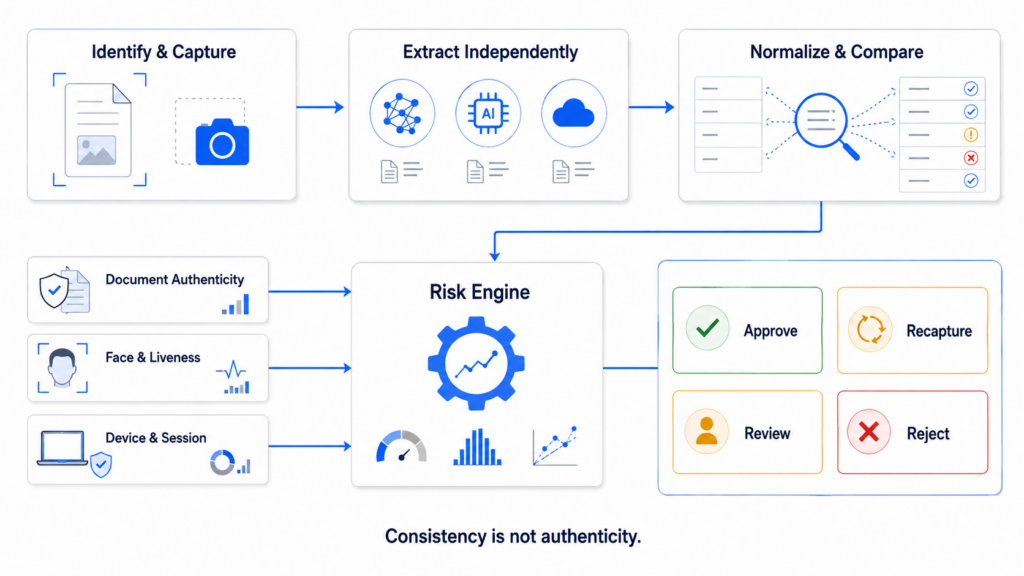
For FinAuth workflows, cross-checking should therefore support a broader decision that combines document authenticity, facial comparison, liveness, and device and session risk.
1. What Information Can Be Cross-Checked?
Three sources can contribute to document-data validation:
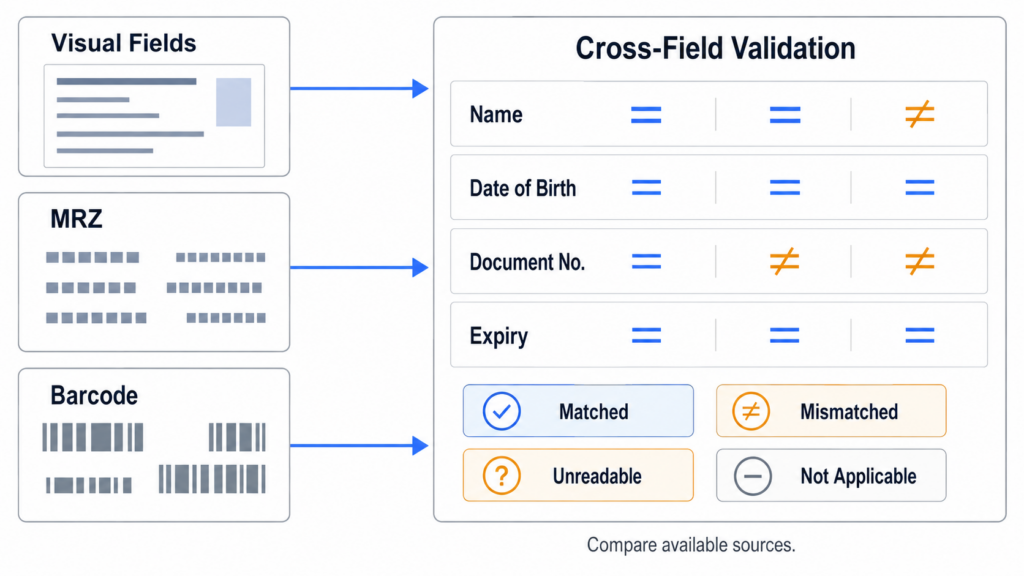
Visual fields: Human-readable information such as the holder’s name, date of birth, document number, and expiry date. OCR converts these printed fields into structured data.
MRZ: A standardized machine-readable area on supported travel documents. It follows defined rules for character sets, field structure, dates, and check digits. ICAO Doc 9303, Part 3
Barcode: Encoded information available on certain documents. The format and included fields depend on the issuing jurisdiction, document type, and version. AAMVA’s DL/ID standard addresses barcode and human-readable data for relevant driving licences and identification cards. AAMVA DL/ID Card Design Standard
Not every document contains all three sources. The workflow must first identify the document type and version, then compare only the fields expected to overlap. An absent, non-required barcode should not be treated as a verification failure.
2. Extract Each Source Before Comparing Results
Reliable cross-checking begins with independently extracted evidence.
The workflow should capture the required document sides, assess image quality, and preserve separate results for visual OCR, MRZ parsing, and barcode decoding. Each extracted value should retain its source and available confidence or read-status information.
This separation matters. If a system copies a visual OCR value into an unreadable MRZ field, a subsequent “match” no longer represents an independent comparison.
FinAuth’s document OCR and authenticity analysis provide the foundation for this process. Where barcode decoding is included in the deployment, its results can be incorporated into the verification workflow alongside document evidence.
Use distinct statuses:
- Matched: Comparable values agree.
- Mismatched: Comparable values disagree.
- Unreadable: The expected source could not be reliably extracted.
- Not applicable: The document does not require that source or field.
An unreadable field is missing evidence—not proof of inconsistency.
3. Normalize Legitimate Differences Without Hiding Errors
Cross-checking should compare meaning, not simply raw text.
Names may differ because of transliteration, spacing, punctuation, or permitted truncation. Dates may use different representations. Document numbers may require template-specific handling of separators or filler characters. ICAO explicitly specifies MRZ name conventions, transliteration, and date representation. ICAO Doc 9303, Part 3
Normalization should remain controlled:
- Preserve the original extracted values.
- Apply documented rules for the identified document version.
- Compare equivalent fields, not merely similar labels.
- Keep unresolved ambiguity visible to reviewers.
- Avoid automatically changing characters just to produce agreement.
For example, “O” and “0” may reflect an OCR error, but silently replacing one with the other can conceal a genuine document-number discrepancy.
FinAuth workflows should distinguish recognized formatting differences from unresolved identity-data conflicts.
4. Understand What Checksums and Decoding Actually Prove
MRZ check digits help detect certain errors in covered data. They do not authenticate the issuing authority or establish that the physical document is genuine. ICAO describes check digits as a mechanism for verifying correct reading of MRZ data. ICAO Doc 9303, Part 3
Similarly, successfully decoding a barcode establishes readability—not issuer authenticity. Barcode error correction and MRZ check digits are not digital signatures.
Three questions must remain separate:
Is the data readable?
Can the system extract and parse it?
Is the data consistent?
Do overlapping fields agree after valid normalization?
Is the evidence authentic?
Do document-security checks, capture-integrity analysis, and any supported issuer or cryptographic verification substantiate it?
Where authorized and available, issuer-record checks provide a separate comparison. For example, AAMVA’s DLDV service returns field-level match indicators against participating issuing jurisdictions’ records. This is different from comparing data printed on the same card. AAMVA DLDV Service
5. Route Discrepancies Through a Layered Workflow
The response should depend on the evidence behind the discrepancy.
Poor capture quality: Request guided recapture when glare, blur, cropping, or insufficient resolution prevents reliable extraction.
Recognized formatting difference: Continue the comparison using documented normalization rules.
Persistent field conflict: Escalate conflicting document numbers, birth dates, or other material attributes for additional evidence or review.
Consistent data with suspicious imagery: Continue investigating manipulation, portrait replacement, screen recapture, or other authenticity indicators.
Consistent document evidence with applicant risk: Assess whether the presenter is the rightful holder through Face Verification, Liveness Detection, and capture-integrity checks.
FinAuth’s Risk Engine can combine document findings with biometric, device, session, and behavioral signals to support proportionate decisions. Field agreement should contribute to the decision, not override strong evidence of fraud.
6. Frequently Asked Questions
Q1. Does a valid MRZ prove that an identity document is genuine?
No. Correct structure and passing check digits support data validation, but do not establish issuer authenticity or rightful ownership.
Q2. Should every identity document have an MRZ and a barcode?
No. Available data sources vary by document type and version. Verification should check expected sources rather than require every format universally.
Q3. Does a mismatch always mean document tampering?
No. Capture errors, OCR mistakes, and legitimate formatting differences can create apparent mismatches. Persistent conflicts require further assessment.
Q4. How does FinAuth strengthen cross-field verification?
FinAuth combines document OCR and authenticity evidence with face, liveness, device, and session signals. Cross-field findings can inform risk-based recapture, additional verification, review, or rejection.
7. Conclusion
Cross-checking MRZ, barcode, and visual fields strengthens document verification by exposing inconsistencies and improving evidence quality. Its value depends on independent extraction, document-aware comparison, and clear handling of unreadable or unavailable data.
Within FinAuth workflows, these checks complement authenticity analysis and holder verification—helping businesses make stronger onboarding decisions without treating every mismatch as fraud or every match as proof.