Liveness detection has become a core component of digital identity verification. By determining whether a biometric sample comes from a real person physically present during the session, it helps businesses defend against printed photos, replayed videos, masks, and other impersonation attempts.
But the threat environment is changing rapidly. Generative AI can now create realistic face images, animate stolen photos, perform real-time face swaps, and produce synthetic video at increasingly low cost. Fraudsters can also inject manipulated media directly into the verification process through virtual cameras, emulators, or compromised capture channels.
As identity attacks evolve, liveness detection must evolve with them. A model that performs well against known attacks today may provide insufficient protection against new techniques tomorrow.
AI Is Transforming Identity Attacks
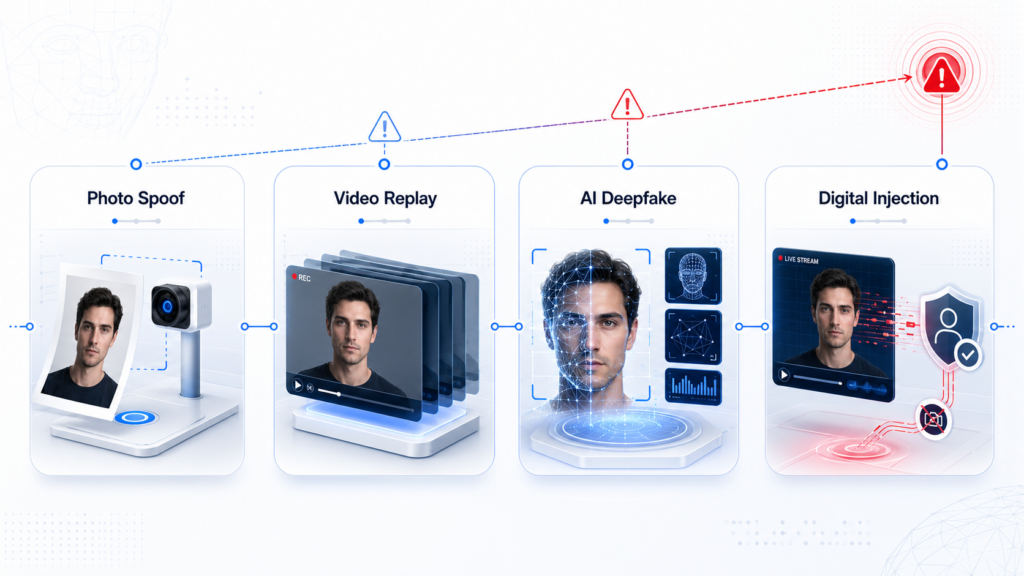
Traditional biometric attacks typically involve presenting a physical artifact to a camera. A fraudster might hold up a printed portrait, display a prerecorded video, or use a mask to imitate another person. Liveness detection systems analyze visual signals such as texture, reflections, depth, lighting, and motion to identify these attempts.
AI-powered identity fraud expands the attack surface.
Deepfake tools can generate expressions and head movements in real time. Face reenactment systems can animate a single stolen image. Synthetic content can imitate blinking, smiling, or turning the head, reducing the effectiveness of predictable challenge-response instructions.
Digital injection creates another challenge. Instead of showing fake content to the physical camera, an attacker replaces the camera stream with manipulated media. Because this content may not contain the screen reflections, print textures, or image-quality losses associated with traditional presentation attacks, a system focused only on camera-visible spoofing may fail to identify it.
Why Static Liveness Detection Is Not Enough
Liveness models are trained and tested against specific attack samples. If the attack landscape changes while the detection model remains unchanged, protection can gradually weaken.
Several factors contribute to this problem:
- New generative models produce increasingly realistic faces and motion.
- Attack tools can be adapted to target known verification workflows.
- Fixed challenges can be anticipated and reproduced.
- Different devices and operating environments create inconsistent capture conditions.
- New injection methods may bypass biometric analysis performed only at the image level.
A single liveness score also provides limited context. A suspicious session may involve a realistic face but also show signs of a virtual camera, emulator, proxy network, repeated registration pattern, or unusual device configuration. Evaluating the face without examining the wider session can leave important fraud signals unused.
Liveness detection should therefore be treated as part of a continuously updated identity risk system rather than a standalone, permanently configured control.
How Modern Liveness Detection Should Evolve
Expand Attack Coverage
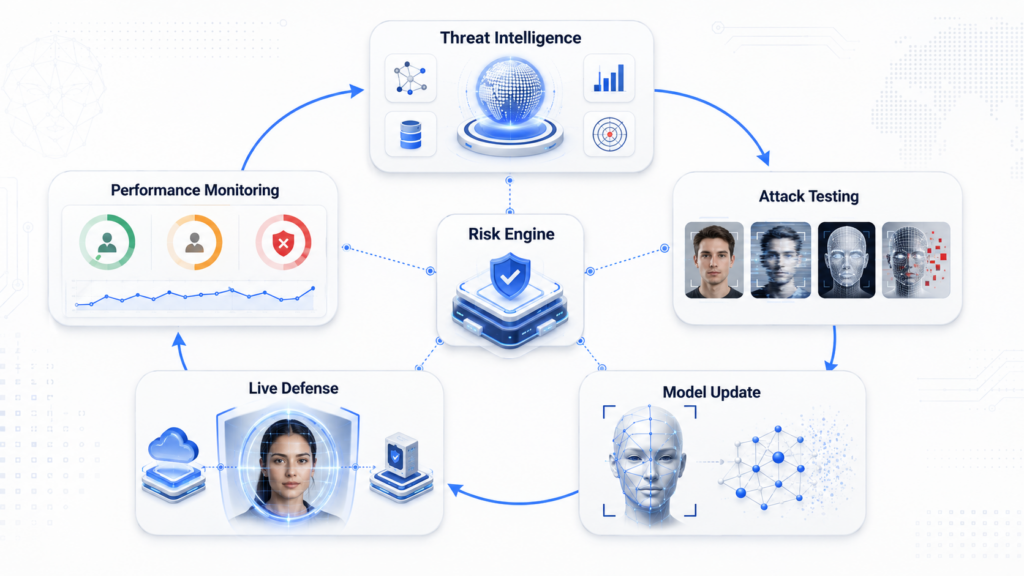
Testing should cover more than printed photos and screen replays. Attack libraries need to include 2D and 3D masks, manipulated videos, generated faces, real-time face swaps, virtual cameras, emulators, and direct media injection.
Production attacks should also feed back into model development. Newly discovered fraud patterns can be analyzed, labeled, and added to future training and evaluation datasets.
Combine Multiple Visual Signals
No single facial characteristic can reliably identify every attack. Modern liveness detection should analyze multiple complementary signals, including facial texture, depth, illumination, reflection, motion consistency, geometry, and temporal relationships across video frames.
Large visual models can strengthen this process by interpreting the complete visual context rather than evaluating isolated features. This helps identify inconsistencies that may be difficult to detect through individual rules.
Protect the Capture Channel
Determining whether a face appears live is only one part of the problem. The system must also assess whether the captured media comes from a trusted source.
Capture integrity controls can look for virtual-camera activity, emulator environments, SDK tampering, abnormal frame timing, metadata inconsistencies, and signs that the original media stream has been replaced or modified.
Combining biometric liveness with injection detection provides stronger protection against attacks that bypass the physical camera.
Use Risk-Based Verification
Not every verification session presents the same level of risk. A normal onboarding attempt from a trusted device may require only passive liveness, while account recovery, a new device login, or a large withdrawal may justify stronger checks.
A risk engine can combine liveness results with face-match confidence, document authenticity, device intelligence, network signals, user behavior, and transaction context. The system can then approve low-risk sessions, request step-up verification, route uncertain cases for review, or block high-risk attempts.
This approach concentrates security where it is needed without adding unnecessary friction to every user journey.
Monitor and Update Continuously
Liveness performance should be monitored throughout deployment. Relevant indicators include false acceptance, false rejection, attack detection rates, manual-review outcomes, device distribution, regional differences, and changes in fraud behavior.
Regular penetration testing and red-team exercises can expose weaknesses before they are exploited at scale. Thresholds, rules, models, and attack datasets should then be updated as part of a structured improvement cycle.
Stronger Security Should Not Mean More Friction
Continuous evolution does not mean forcing every user to complete additional actions. Passive liveness can remain the default for low-risk sessions, providing a fast and natural experience. Stronger active checks or manual review can be reserved for cases where combined signals indicate elevated risk.
Edge processing can deliver immediate capture-quality feedback, while cloud-based analysis can apply more advanced models and cross-session intelligence. Together, these layers help balance detection accuracy, response speed, and user conversion.
Building Adaptive Liveness Protection with FinAuth
FinAuth combines Edge and Cloud liveness detection with face verification, injection attack detection, device and session intelligence, behavioral risk analysis, and configurable risk decisioning.
This layered architecture allows businesses to evaluate both the biometric sample and the integrity of the wider verification session. Policies can be adapted according to the user, device, transaction, and risk level, while new fraud patterns can be incorporated into ongoing model and strategy updates.
AI-powered identity fraud will continue to advance. Effective protection depends not on deploying one fixed liveness model, but on building a defense system that learns, adapts, and improves as the threat landscape changes.
The objective is no longer simply to determine whether a face looks alive. It is to establish whether the person, capture channel, device, and entire verification session can be trusted.