Account recovery is one of the most sensitive moments in the customer lifecycle. When users forget passwords, lose devices, change phone numbers, or become locked out of their accounts, businesses must restore access quickly without creating an easy path for fraudsters.
Traditional recovery methods often rely on knowledge-based questions, email links, SMS codes, or customer support reviews. These controls can be weakened by phishing, SIM swapping, compromised email accounts, stolen personal data, and social engineering. For financial institutions and digital platforms, a failed recovery decision can lead directly to account takeover, unauthorized transactions, and customer data exposure.
Liveness detection strengthens account recovery by confirming that a real person is physically present during the verification process. When combined with face matching and risk-based decisioning, it allows businesses to verify identity with greater confidence while maintaining a streamlined customer experience.
Why Account Recovery Is a High-Risk Process
Attackers frequently target account recovery because it is designed to bypass normal login credentials. Instead of stealing a password and passing existing authentication controls, a fraudster may attempt to convince the platform that the legitimate user has lost access.
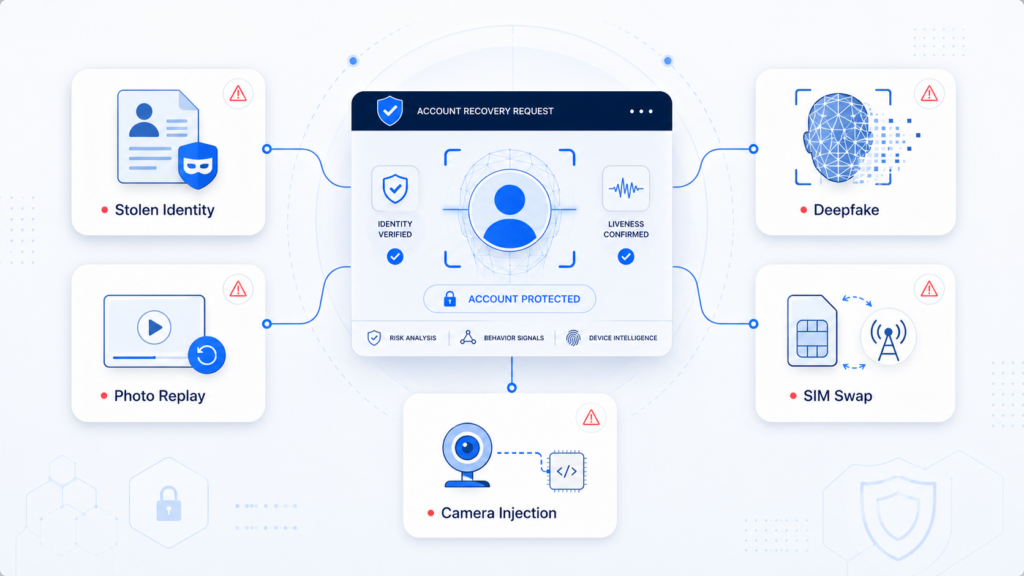
Common recovery risks include:
- Using stolen identity documents or personal information
- Uploading printed photos or images displayed on another screen
- Replaying previously recorded verification videos
- Using AI-generated face videos or manipulated media
- Injecting synthetic camera feeds into the verification process
- Taking control of the user’s email address or mobile number
- Socially engineering customer support agents
A recovery workflow based only on possession factors, such as an email address or phone number, may not prove that the person requesting access is the real account owner.
How Liveness Detection Supports Secure Recovery
Liveness detection analyzes whether the person appearing in front of the camera is physically present rather than represented by a photo, screen replay, recording, mask, or synthetic media.
During account recovery, the user may be asked to capture a selfie or short facial video. The system then evaluates multiple visual and technical signals, which may include facial texture, motion consistency, lighting, depth, image quality, camera behavior, and signs of digital injection.
Liveness detection is usually combined with face verification. The live facial capture is compared with a trusted reference image, such as:
- The portrait from the user’s verified identity document
- A previously approved onboarding selfie
- An existing biometric profile stored with user consent
- A recently verified facial image associated with the account
This creates two separate checks:
- Is a real person present?
- Does the person match the legitimate account owner?
Both questions must be answered before access is restored.
Active and Passive Liveness Detection
Active liveness detection requires the user to complete actions such as blinking, turning their head, or following an on-screen instruction. These actions provide additional evidence of live participation but may increase friction, especially when the user is under stress or using a low-quality device.
Passive liveness detection works in the background during a natural selfie or short video capture. It does not require the user to perform specific movements, making it more suitable for high-conversion recovery journeys.
The appropriate method depends on the account risk level. Passive liveness may be sufficient for lower-risk recovery requests, while active checks or additional verification may be triggered when the system identifies suspicious signals.
A Risk-Based Account Recovery Workflow
Liveness detection should not operate as an isolated control. A stronger recovery process combines biometric verification with account, device, behavioral, and transaction signals.
A typical workflow may include the following steps:
1. Recovery Request Analysis
The platform evaluates the recovery context, including the device, IP address, location, account history, recent profile changes, failed login attempts, and transaction activity.
2. Identity Evidence Collection
The user provides a live facial capture. For higher-risk cases, the system may also request an identity document or additional account information.
3. Liveness and Face Verification
The system checks whether the capture comes from a live person and compares the face with a trusted account reference.
4. Risk Decisioning
A risk engine combines biometric results with device and behavioral signals. The request can then be routed to different outcomes:
- Low risk: Restore access automatically
- Medium risk: Request additional verification
- High risk: Send the case for manual review
- Critical risk: Block the request and protect the account
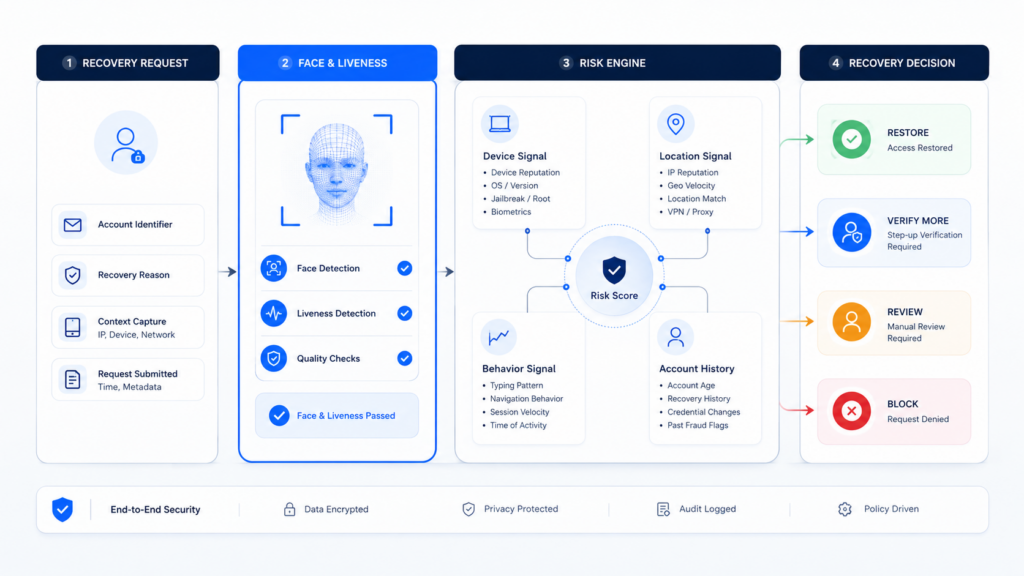
This approach avoids treating every recovery request in the same way. Legitimate customers can complete low-risk recovery quickly, while suspicious requests receive stronger controls.
Preventing Advanced Presentation and Injection Attacks
Basic selfie checks may not be sufficient against modern fraud techniques. Attackers can use high-resolution screen replays, face-swapping tools, virtual cameras, deepfake videos, or injected image streams to imitate a legitimate user.
An effective liveness solution should therefore detect both presentation attacks and digital injection attacks.
Presentation attack detection focuses on threats placed in front of a physical camera, such as printed photos, screen displays, masks, or replayed videos.
Injection detection focuses on manipulated or synthetic content introduced directly into the application, browser, camera pipeline, or virtual device environment.
Combining these capabilities is particularly important for remote account recovery, where the business cannot physically inspect the user or control their device environment.
Balancing Security and Customer Experience
Account recovery often occurs when customers are already frustrated. Complex verification steps can increase abandonment and support costs. However, weak verification can expose both customers and businesses to serious losses.
A balanced design should:
- Use passive checks where possible
- Trigger stronger verification only when risk increases
- Provide clear capture guidance
- Support different devices and network conditions
- Minimize unnecessary document requests
- Offer manual review for genuine users who cannot pass automated checks
- Maintain detailed audit records for every recovery decision
The goal is not to add more steps. It is to apply the right verification step at the right level of risk.
Strengthening Recovery with FinAuth
FinAuth supports secure account recovery by combining face verification, liveness detection, document verification, device signals, and risk-based decisioning within a unified identity verification workflow.
Businesses can configure different recovery policies based on account type, transaction exposure, customer history, and detected risk. Low-risk users can regain access efficiently, while suspicious attempts can be challenged, reviewed, or blocked.
By integrating liveness detection into a layered recovery strategy, digital businesses can reduce account takeover risk without creating unnecessary friction for legitimate customers.