Customer identity is not a one-time data point. It changes as customers move to new addresses, update documents, change devices, open new accounts, modify transaction behavior, or become exposed to new risk signals. For digital financial platforms, this creates a clear challenge: the KYC data collected during onboarding may gradually become outdated, incomplete, or misaligned with the customer’s current risk profile.
Traditional KYC refresh programs often rely on fixed review cycles. Low-risk customers may be reviewed every few years, while higher-risk customers may be reviewed more frequently. This model provides a basic compliance structure, but it is not always efficient for fast-moving digital businesses. Some customers may remain unchanged for years and require very little intervention. Others may present new risk within days after onboarding.
A risk-based KYC refresh strategy helps institutions keep customer verification up to date without creating unnecessary friction. Instead of treating every customer the same way, businesses can combine customer risk levels, behavior changes, document status, device signals, and transaction activity to decide when a KYC refresh is truly needed.
What Is KYC Refresh?
KYC refresh refers to the process of reviewing and updating customer identity information after the initial onboarding stage. It may include confirming personal details, revalidating identity documents, checking proof of address, updating beneficial ownership information, reviewing sanctions or PEP exposure, or requesting additional verification when risk changes.
The goal is not simply to collect the same information again. A strong KYC refresh process should answer three business-critical questions:
Is the customer information still accurate?
Has the customer’s risk profile changed?
Is additional verification required to maintain compliance and reduce fraud exposure?
In digital onboarding environments, KYC refresh should be closely connected with ongoing risk monitoring. A customer who passed verification during registration may still become risky later due to account takeover, synthetic identity behavior, mule account activity, device compromise, or unusual transaction patterns.
Why Fixed KYC Refresh Cycles Are No Longer Enough
Fixed-cycle reviews are easy to define, but they can be operationally expensive. If a platform refreshes too many customers at once, compliance teams face large review backlogs. If refresh requests are pushed directly to users, the business may also see higher drop-off, lower engagement, and more customer complaints.
The bigger issue is timing. A fixed review schedule may miss risk signals that happen between review periods. For example, a customer may suddenly log in from a high-risk device, change their phone number, add a new withdrawal account, and attempt a large transaction. Waiting for the next scheduled review would create unnecessary exposure.
On the other hand, reviewing a stable, low-risk customer too frequently adds cost without improving risk control. This is where risk-based refresh becomes more effective. It aligns verification depth with real risk, allowing businesses to focus resources on customers, events, and behaviors that actually require attention.
The Core of a Risk-Based KYC Refresh Strategy
A risk-based KYC refresh model should combine three layers: scheduled review, event-triggered review, and dynamic risk scoring.
Scheduled review remains useful as a baseline. It ensures that customer records are reviewed within defined intervals according to risk tier, regulatory expectations, and internal policy. High-risk customers may require more frequent reviews, while low-risk customers may follow a lighter cycle.
Event-triggered review adds responsiveness. Instead of waiting for a fixed review date, the system can initiate verification when specific risk events occur. Common triggers include expired identity documents, major profile changes, suspicious login behavior, device fingerprint changes, unusual transaction activity, repeated failed verification attempts, or new sanctions and watchlist exposure.
Dynamic risk scoring connects these signals into one decision framework. By continuously evaluating identity, device, behavior, and transaction indicators, businesses can determine whether the customer should pass without interruption, receive a light-touch update request, complete step-up verification, or be escalated for manual review.
Key Triggers for KYC Refresh
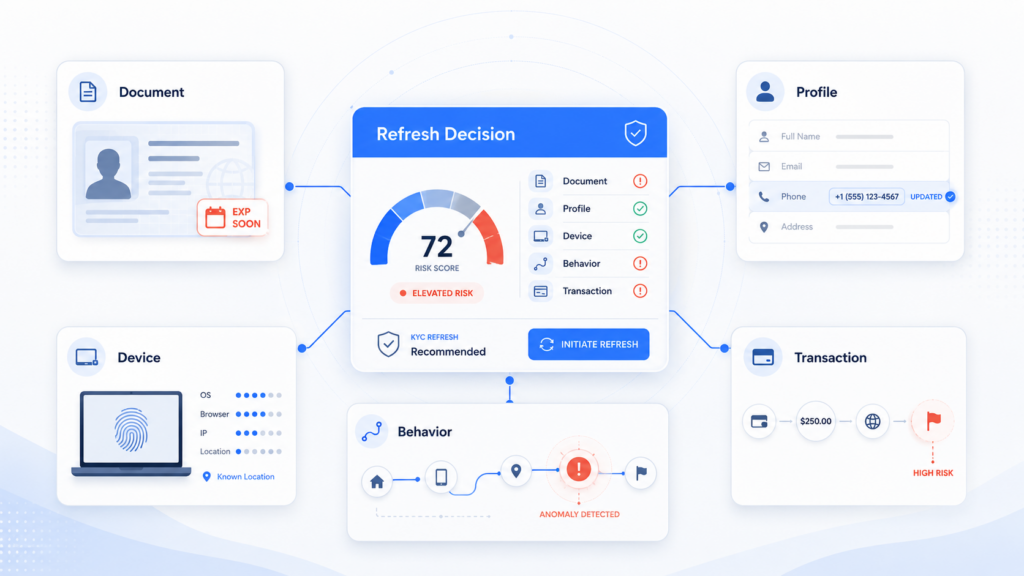
Not every change should trigger a full KYC refresh. A practical strategy should define clear trigger categories and corresponding actions.
Document-related triggers are among the most common. If an ID document is expired, near expiration, damaged, inconsistent, or suspected to be manipulated, the customer may need to resubmit a valid document. OCR can extract updated information, while document authenticity checks can detect tampering, recaptured documents, screenshots, or altered fields.
Profile-related triggers include changes to name, address, phone number, email, occupation, income source, or business ownership. Some changes may only require confirmation, while others may require supporting documents or enhanced due diligence.
Behavior-related triggers are especially important for digital platforms. Abnormal login locations, rapid device switching, unusual session patterns, high-risk IP addresses, emulator usage, VPN or proxy activity, and suspicious user behavior can indicate account takeover or identity misuse.
Transaction-related triggers may include sudden increases in transaction value, new high-risk recipients, cross-border activity, rapid withdrawals, or behavior that deviates from the customer’s historical profile.
External risk triggers may include sanctions updates, PEP status changes, adverse media exposure, or changes in country and industry risk. These signals are often handled through screening tools, but they should still feed into the broader KYC refresh strategy.
How to Reduce Customer Friction
The biggest challenge in KYC refresh is balancing compliance, fraud prevention, and customer experience. Asking every customer to complete full identity verification too often will damage conversion and retention. A risk-based model helps by matching the verification journey to the level of risk.
For low-risk updates, businesses can use passive checks or simple confirmation flows. For example, if a customer’s information remains consistent and no suspicious activity is detected, the system may only require a brief profile confirmation.
For medium-risk cases, step-up verification may be more appropriate. The customer may be asked to resubmit a document, complete face verification, or provide proof of address. This adds assurance without sending every case to manual review.
For high-risk cases, the platform may require enhanced verification, manual investigation, temporary account restrictions, or additional compliance review. The key is to apply stronger controls only when justified by risk signals.
This tiered approach helps businesses maintain an up-to-date customer profile while avoiding unnecessary disruption for trusted users.
The Role of AI in KYC Refresh
AI can make KYC refresh more precise and scalable. Instead of relying only on rule-based review dates, AI models can identify patterns across identity documents, facial verification, liveness checks, device data, session behavior, and historical risk outcomes.
For document refresh, AI-powered OCR can extract fields from updated IDs, proof-of-address documents, and financial statements. Document verification models can assess authenticity, detect manipulation, and compare extracted information with existing customer records.
For biometric refresh, face matching can confirm whether the current user is consistent with the original onboarded identity. Liveness detection helps prevent presentation attacks, replay attacks, deepfakes, and virtual camera injection.
For account risk, device and behavioral intelligence can detect when a trusted customer account may have been compromised. This is especially valuable for refresh flows triggered by sensitive actions such as password reset, new device login, beneficiary changes, or high-value withdrawals.
Building a KYC Refresh Workflow with FinAuth
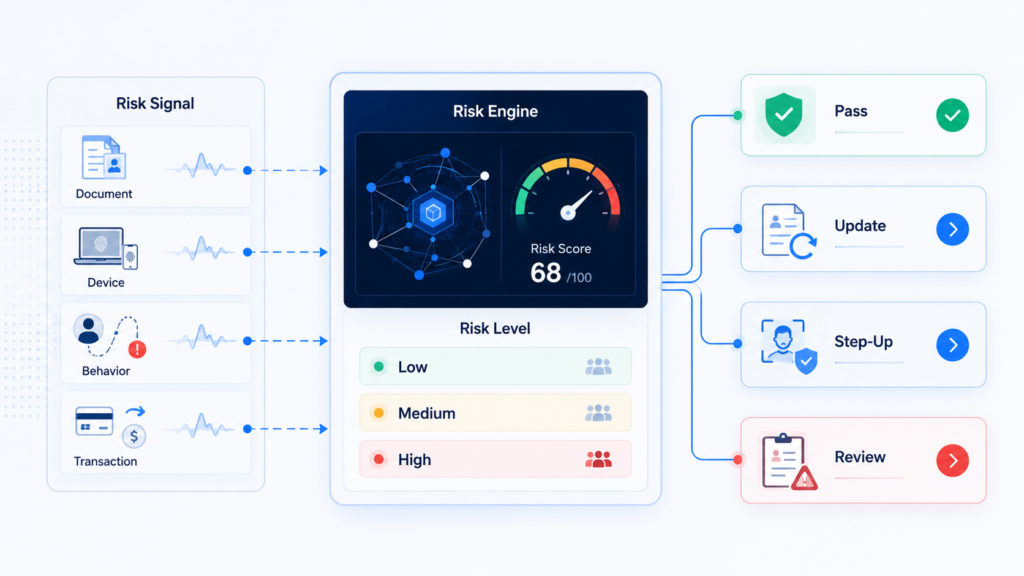
FinAuth supports a risk-based KYC refresh framework by connecting identity verification, liveness detection, document intelligence, device risk, behavioral signals, and decisioning into one workflow.
A typical refresh journey may start with a risk signal. The signal could come from an expired ID, a major profile update, a suspicious login, or a transaction anomaly. FinAuth can then apply the appropriate verification layer based on the risk level.
For low-risk customers, the platform may only require data confirmation or document validity checks. For medium-risk customers, FinAuth can request updated document capture, OCR extraction, face match, and liveness verification. For high-risk customers, the system can escalate the case to enhanced review with full audit evidence.
This approach allows digital businesses to keep customer verification current without forcing every user through the same high-friction process.
Best Practices for Risk-Based KYC Refresh
A strong KYC refresh program should start with clear risk segmentation. Customers should be grouped by risk level based on onboarding results, geography, product usage, transaction behavior, and ongoing monitoring data.
Second, businesses should define refresh triggers and map them to specific actions. A minor profile update should not trigger the same workflow as a suspicious device change or sanctions exposure.
Third, verification depth should be proportional. Low-risk cases should be handled with minimal friction, while high-risk cases should receive stronger controls.
Fourth, auditability is essential. Every refresh decision should be traceable, including the trigger, verification result, risk score, decision logic, and reviewer action if manual review is involved.
Finally, the strategy should be continuously optimized. Fraud patterns change, customer behavior changes, and regulatory expectations evolve. Refresh rules, risk thresholds, and verification flows should be reviewed regularly to maintain effectiveness.
Conclusion
KYC refresh is no longer just a periodic compliance task. For digital financial businesses, it is a core part of ongoing customer risk management. A risk-based strategy helps institutions keep customer information accurate, detect emerging threats, and reduce unnecessary friction for trusted users.
By combining scheduled reviews, event-triggered checks, AI-powered verification, and dynamic risk decisioning, businesses can create a more efficient and scalable KYC refresh model.
FinAuth helps digital platforms move from static KYC review cycles to intelligent, risk-based customer verification. With document verification, face match, liveness detection, device risk, behavioral intelligence, and audit-ready decisioning, FinAuth enables businesses to keep customer verification up to date while balancing compliance, security, and user experience.