Account takeover has become one of the most difficult fraud risks for digital platforms to control. Unlike fake account registration, account takeover does not always begin with a new user, a suspicious document, or a failed identity check. In many cases, the account itself is real. The user has passed onboarding, completed verification, built transaction history, and may even be considered low risk by the platform.
This is what makes account takeover especially dangerous. Once a fraudster gains access to a legitimate account, they can move quickly: reset security settings, change personal information, add new payment methods, transfer funds, redeem rewards, apply for credit, or use the trusted account to attack other users. Traditional login security alone is often not enough, because stolen credentials, OTP interception, SIM swap, phishing, malware, and social engineering can all help fraudsters bypass basic authentication.
To detect account takeover more effectively, digital platforms need to look beyond static identity attributes. They need to understand whether the current user behavior matches the normal behavior of the account owner. This is where behavioral signals become critical.
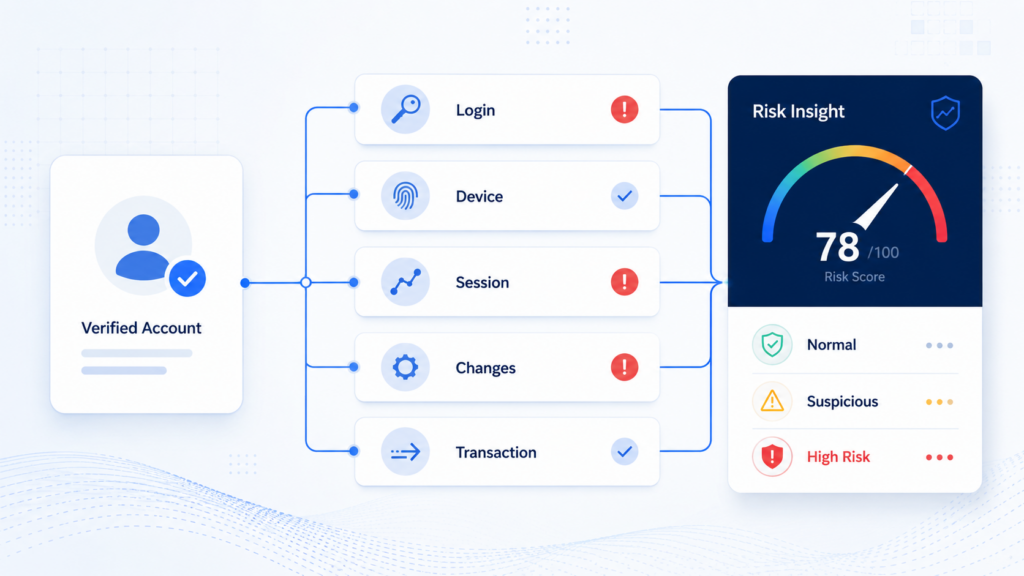
What Are Behavioral Signals in Account Takeover Detection?
Behavioral signals are patterns generated by how users interact with a digital platform. These signals may include login behavior, device usage, typing rhythm, navigation flow, transaction timing, session duration, account settings changes, and the sequence of actions taken after login.
Unlike identity data, behavioral signals are dynamic. They continuously reflect how a user behaves in real time. A legitimate user may have stable patterns over time, while an attacker often behaves differently because their goal is not normal platform usage. Their goal is to take control, extract value, and exit before detection.
For example, a genuine user may log in from a familiar device, browse account information, check transaction history, and complete a routine action. An attacker may log in from a new device, immediately change the password, add a new withdrawal account, disable notifications, and initiate a high-risk transaction within minutes. Each action may appear possible on its own, but the behavior sequence creates a strong risk signal.
Why Behavioral Signals Matter for Digital Platforms
Account takeover detection is no longer just a banking problem. Digital wallets, lending apps, e-commerce platforms, ride-hailing services, gaming platforms, crypto exchanges, social networks, and online marketplaces all face similar risks. Any platform with stored value, personal data, loyalty points, payment access, credit limits, or user reputation can become a target.
The challenge is that account takeover often happens after the user has already been verified. That means onboarding checks such as document verification, face matching, and liveness detection are important but not sufficient on their own. Platforms also need continuous risk monitoring across the account lifecycle.
Behavioral signals help fill this gap. They allow platforms to identify suspicious activity after login, during sensitive operations, and before irreversible losses occur. Instead of treating identity verification as a one-time event, platforms can use behavior-based risk signals to decide when to allow, challenge, delay, or block an action.
Key Behavioral Signals for Account Takeover Detection
1. Unusual Login Patterns
Login behavior is often the first indicator of account takeover risk. A login from a new device, unfamiliar IP address, unusual location, proxy, VPN, emulator, or inconsistent time zone may indicate that the account is being accessed by someone other than the legitimate user.
However, a single new login signal should not automatically trigger rejection. Real users also travel, change phones, use public networks, or log in at unusual times. The key is to evaluate login behavior in context. For example, a new-device login followed by normal browsing may be acceptable, while a new-device login followed by immediate password reset and withdrawal request should be treated as higher risk.
2. Abnormal Session Behavior
Fraudsters often behave differently within a session. They may move faster than normal users, skip typical browsing steps, access sensitive pages directly, or repeat high-value actions in a short time window. Session behavior can reveal intent that static login checks cannot.
Examples of suspicious session behavior include unusually short time between login and transaction, direct navigation to security settings, repeated failed attempts to change account information, rapid switching between pages, or accessing features that the account owner rarely uses. These patterns suggest that the user may not be interacting naturally with the platform.
3. Sensitive Account Changes
Account takeover attacks often involve changes to account control points. These include password reset, email change, phone number change, device binding, payment method update, withdrawal account addition, address change, or notification preference changes.
These actions are not necessarily fraudulent by themselves. But when multiple sensitive changes happen together, especially from an unfamiliar session, the risk increases significantly. For example, changing a phone number and immediately attempting a high-value transfer can indicate that the attacker is trying to take over both access and recovery channels.
Platforms should treat sensitive changes as step-up moments. A low-risk user may proceed with minimal friction, while a high-risk session may require face verification, liveness detection, additional authentication, or manual review.
4. Typing and Interaction Patterns
Behavioral biometrics can also help detect suspicious users. The way a user types, clicks, scrolls, pauses, copies and pastes, or interacts with form fields can create a behavioral profile over time. Attackers using stolen credentials, scripted tools, remote access environments, or automation may produce interaction patterns that differ from the legitimate user.
For example, excessive copy-paste behavior during login, unnatural typing intervals, robotic mouse movement, or inconsistent interaction speed may indicate automation or remote control. These signals are most useful when combined with device, session, and transaction context rather than used in isolation.
5. Transaction and Value Extraction Behavior
Many account takeover attacks are financially motivated. After gaining access, attackers often attempt to extract value quickly. This may include transferring funds, withdrawing balances, purchasing gift cards, redeeming points, applying for credit, changing payout accounts, or sending money to newly added recipients.
Transaction behavior should be evaluated against account history. Is this amount typical for the user? Is the recipient new? Has the device been used before? Did the user just update account credentials? Is the transaction happening immediately after login? Has the account shown similar behavior in the past?
A transaction that appears normal in isolation may become suspicious when connected to recent account changes, new-device login, or abnormal session behavior.
6. Recovery and Reset Abuse
Account recovery is a common entry point for account takeover. Fraudsters may use leaked personal data, compromised email accounts, SIM swap, or social engineering to reset login credentials. Once they control the recovery process, they can lock out the legitimate user.
Suspicious recovery patterns may include repeated reset attempts, recovery from a new device, multiple accounts using similar recovery data, sudden changes to phone or email, or recovery followed by immediate high-risk activity. Platforms should monitor the full recovery journey, not just whether the user passed an OTP or knowledge-based check.
7. Cross-Account and Network Behavior
Fraudsters often operate at scale. The same device, IP range, emulator environment, payment instrument, address, or behavioral pattern may appear across multiple accounts. By analyzing network-level behavior, platforms can detect coordinated account takeover campaigns earlier.
For example, multiple unrelated accounts logging in from the same device cluster and attempting withdrawals to similar accounts may suggest organized fraud. Similarly, many accounts changing contact information to related phone numbers or emails may indicate a broader takeover pattern.
Cross-account intelligence is especially important for platforms with large user bases, where fraudsters may test stolen credentials across many accounts before launching high-value attacks.
How Behavioral Signals Support Risk-Based Decisions
Behavioral signals should not be used as simple yes-or-no rules. A risk-based approach is more effective. Each signal contributes to a broader risk score, which can then drive different responses.
For low-risk behavior, the platform can allow the user to proceed normally. For medium-risk behavior, the platform may trigger step-up verification. For high-risk behavior, the platform may delay the action, limit transaction value, require face verification, or route the case to manual review. For critical-risk behavior, the platform may block the action and protect the account.
This approach helps platforms balance security and user experience. Legitimate users should not face unnecessary friction every time they log in. At the same time, suspicious sessions should not be allowed to complete high-risk actions simply because the password or OTP was correct.
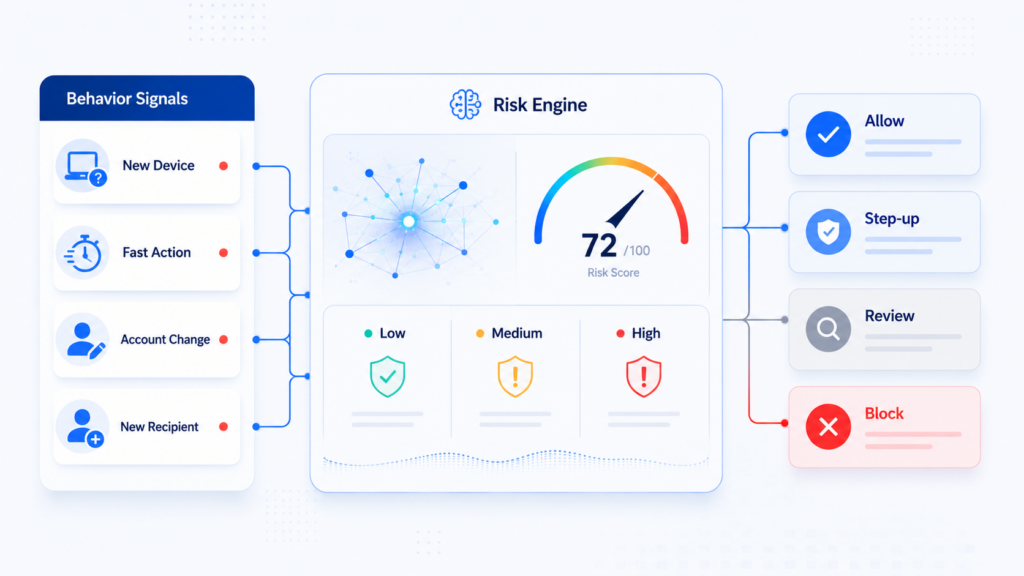
How FinAuth Helps Detect Suspicious Account Behavior
FinAuth supports account takeover prevention by combining identity verification, liveness detection, device and session risk, behavioral signals, and risk-based decisioning. Instead of relying on one single checkpoint, FinAuth helps digital platforms assess risk across the full account lifecycle.
During login, FinAuth can help evaluate whether the session is consistent with the user’s normal access pattern. During sensitive operations, such as password reset, profile change, new device binding, or high-value transaction, FinAuth can trigger adaptive verification based on the risk level. When behavior becomes suspicious, platforms can require stronger checks such as face matching and liveness detection before allowing the action to continue.
This layered approach is especially valuable for financial services, digital wallets, lending platforms, marketplaces, and other digital businesses where account access is directly connected to money, data, or trust.
Building a Stronger Account Protection Strategy
Account takeover detection requires more than login security. Fraudsters do not always look suspicious at the first step. They may enter with valid credentials, pass basic authentication, and only reveal risk through their behavior after access is granted.
That is why behavioral signals are becoming a core part of modern fraud prevention. By analyzing how users log in, navigate, change settings, recover accounts, and perform transactions, digital platforms can identify suspicious behavior before it becomes financial loss or user harm.
The most effective strategy is not to replace identity verification with behavioral analysis, but to combine them. Document verification, face recognition, liveness detection, device intelligence, behavioral signals, and risk engines all play different roles. Together, they help platforms move from one-time verification to continuous account protection.
For digital platforms facing rising account takeover risk, behavioral signals provide a practical way to detect suspicious users, reduce fraud losses, and protect trusted customers without adding unnecessary friction to every interaction.