Sensitive account changes can give an attacker lasting control even when the initial login appears legitimate. Replacing an authenticator, changing contact details, adding a beneficiary, or modifying account ownership may allow fraudulent access to continue after the original session ends.
Reverification adds assurance before these changes take effect. The goal is not to repeat full KYC for every profile update, but to apply proportionate checks based on the sensitivity of the action, current session risk, and strength of existing identity evidence.
FinAuth helps businesses combine authentication history, identity verification, facial comparison, liveness, device intelligence, and behavioral context within one risk-based decision workflow.
1. What Is Reverification?
Reverification confirms that the person requesting a sensitive change remains the legitimate account holder. It differs from routine authentication because it responds to a specific event whose consequences may be difficult to reverse.
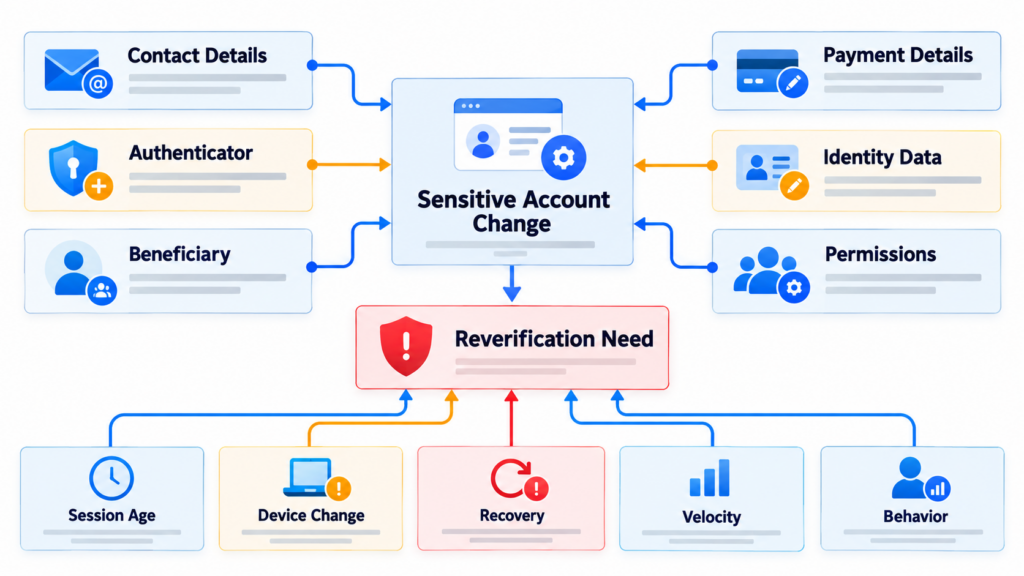
Sensitive changes commonly include:
- Replacing a phone number or email address.
- Resetting a password through account recovery.
- Adding or removing an authenticator.
- Changing withdrawal or payment details.
- Creating a new beneficiary.
- Updating legal identity information.
- Modifying business ownership or account administrators.
- Increasing transaction or account limits.
NIST defines reauthentication as confirming the subscriber’s continued presence and intent during an authenticated session. It also notes that access tokens alone should not be interpreted as proof that the subscriber is still present.
2. Classify Changes by Impact
Not every update requires the same level of assurance. A low-impact preference change should not receive the same treatment as replacing the recovery email or adding a new account administrator.
A practical classification can include:
Low sensitivity: Language, display preferences, or non-security notifications.
Medium sensitivity: Address, occupation, or other customer-profile information that may affect compliance records.
High sensitivity: Password recovery, verified contact changes, authenticator replacement, beneficiary creation, or payment-detail updates.
Critical sensitivity: Legal identity changes, ownership changes, administrator replacement, or actions occurring during a suspected account takeover.
The classification should reflect both the action and its consequences. A contact-detail change becomes more dangerous when the new contact will immediately be used for password recovery or transaction approval.
3. Assess the Current Session Before Adding Friction
A sensitive action should trigger a fresh assessment of the session, even when the customer has already logged in successfully.
Useful signals include:
- Whether the device is known to the account.
- Device and account tenure.
- Browser, operating-system, or network changes.
- Session age and authentication strength.
- Rooting, emulation, automation, or tampering indicators.
- Abnormal navigation or interaction patterns.
- Recent recovery attempts or failed challenges.
- Links to other suspicious accounts.
- Whether an unusual transaction follows the change.
NIST describes session monitoring as the continuing assessment of characteristics such as usage patterns, velocity, behavior, device and browser attributes, geolocation, and network information. When fraud is suspected, the response may include reauthentication, session termination, or escalation. pages.nist.gov
A new device alone should not prove fraud. The decision should reflect the combination of action sensitivity, authentication strength, session integrity, and historical behavior.
4. Match the Reverification Method to the Risk
The verification method should provide enough assurance for the requested change without automatically restarting the entire onboarding process.
Possible responses include:
- Recent strong authentication: Allow the change when the session is recent, trusted, and sufficiently authenticated.
- Reauthentication: Ask the customer to use an existing authenticator again.
- Trusted-channel confirmation: Notify or obtain confirmation through a previously verified channel rather than the newly supplied contact.
- Face Verification and Liveness Detection: Confirm that the person requesting the change matches the previously verified identity and is genuinely present.
- Document reverification: Request updated identity evidence when legal identity information changes or existing evidence is no longer sufficient.
- Manual review: Escalate cases involving conflicting identity data, suspicious recovery activity, or high-impact ownership changes.
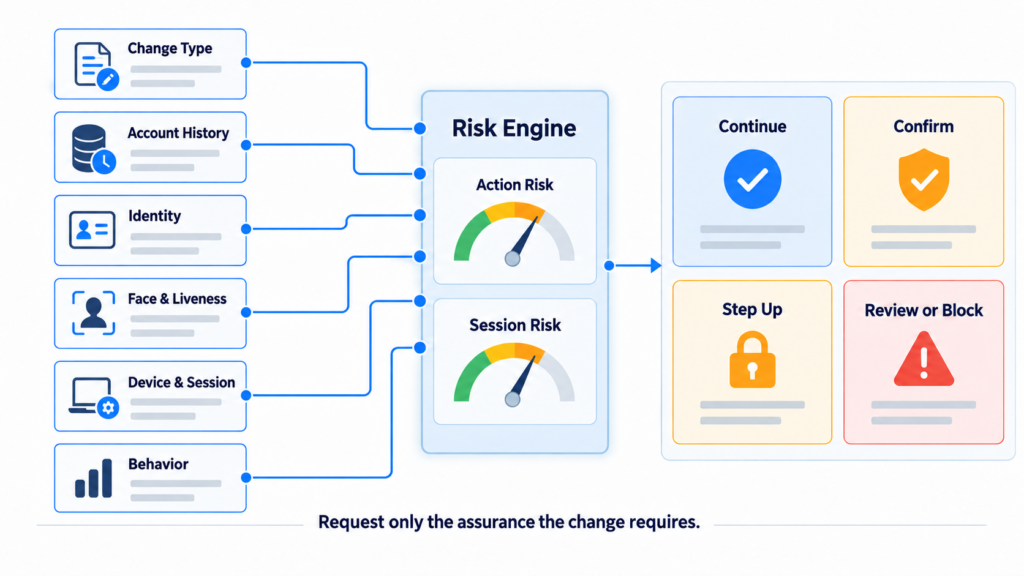
FinAuth can select these steps dynamically through its Risk Engine, allowing low-risk changes to proceed efficiently while applying stronger controls to uncertain sessions.
5. Protect Contact and Authenticator Changes
Contact and authenticator changes require special attention because they may transfer control of future security challenges to an attacker.
Effective controls include:
- Confirming the action through an existing trusted channel.
- Requiring an already bound authenticator where possible.
- Applying velocity limits to repeated change attempts.
- Preventing a newly added authenticator from immediately approving critical actions.
- Notifying the customer through the previous contact method.
- Providing a clear way to report an unauthorized change.
- Revoking or reviewing active sessions after a high-risk update.
NIST treats authenticator binding and account recovery as security-sensitive lifecycle events. Its guidance requires recovery to follow documented risk analysis and calls for subscriber notification after recovery events.
6. Build a Risk-Based Reverification Workflow
FinAuth can combine the following evidence before deciding how a sensitive change should proceed:
- Account and authentication history.
- Verified identity information.
- Document authenticity.
- Face-match and liveness results.
- Device integrity and session context.
- Behavioral and linked-account risk.
- Change sensitivity and transaction impact.
The resulting workflow can apply four broad outcomes:
- Continue: Permit a low-risk change with minimal interruption.
- Confirm: Reauthenticate or confirm through a trusted channel.
- Step Up: Require Face Verification, Liveness Detection, or additional evidence.
- Review or Block: Pause the change when strong account-takeover or identity-risk indicators remain unresolved.
No individual device signal, biometric score, or profile mismatch should determine the outcome alone.
7. Design Recovery Paths for Legitimate Customers
Customers may lose access to an old phone, email address, authenticator, or identity document. A secure process must support these legitimate cases without creating a weak alternative route for attackers.
Recovery options should provide comparable assurance, preserve completed steps where appropriate, and explain what the customer needs to do next. Where immediate confirmation is impossible, businesses may use temporary restrictions, delayed activation, specialist review, or partial identity reproving.
Usability is part of security. NIST warns that difficult authentication experiences can encourage workarounds that weaken controls and recommends minimizing unnecessary burden while supporting appropriate alternatives.
8. Reverification Q&A
When should an account change require reverification?
Reverification is appropriate when a change affects account control, recovery, payments, legal identity, ownership, permissions, or other high-impact functions.
Should every sensitive change require full KYC again?
No. FinAuth can use existing verified identity evidence and select proportionate controls based on the action, session, device, and behavioral risk.
Can face verification secure account changes?
Yes. Face Verification with Liveness Detection can help confirm that the requester matches the established customer and is genuinely present. It should be combined with session and account context.
How can businesses reduce reverification friction?
Use recent authentication where sufficient, preserve valid evidence, request only the missing assurance, provide clear instructions, and reserve stronger checks for elevated-risk sessions.
9. Conclusion
Reverification protects the account changes most likely to enable persistent fraud. An effective design classifies each action by impact, reassesses the current session, and applies only the verification strength needed to address the identified risk.
With FinAuth, organizations can combine identity, document, biometric, device, behavioral, and account-history signals to secure sensitive changes while preserving an efficient experience for legitimate customers.