Account takeover can begin with valid-looking credentials. An attacker may obtain a password, intercept an authentication code, abuse account recovery, or hijack an authenticated session. Because the login may appear successful, authentication results alone may not reveal who is controlling the account.
Device intelligence adds context to each access attempt. It evaluates device history, environment integrity, session behavior, account relationships, and activity sequences. When these signals are combined through FinAuth’s Risk Engine, businesses can identify suspicious access without automatically blocking every customer using a new device.
1. What Is Device Intelligence for Account Takeover Detection?
Device intelligence evaluates characteristics associated with the endpoint and session used to access an account. Relevant signals may include:
- Whether the device has previously accessed the account.
- How long the device-account relationship has existed.
- Material changes in browser, operating system, or environment.
- Indicators of emulation, automation, tampering, or virtualization.
- Network and location consistency.
- Login, recovery, beneficiary, and transaction velocity.
- Connections between the device and other identities or accounts.
These signals should indicate risk rather than act as standalone identity proof. A known device can be compromised, while a legitimate customer may use a new device after upgrading hardware, clearing browser data, or traveling.
NIST recognizes device or account tenure, device fingerprinting, transaction analytics, and velocity analysis as useful fraud-management signals. It also emphasizes monitoring controls for effectiveness and unintended impacts.
2. Why Successful Authentication May Still Be Suspicious
Passwords and authentication codes establish that a claimant possesses certain credentials. They do not always establish that the legitimate customer is controlling the session.
Suspicious access may involve:
- Stolen passwords or credential stuffing.
- Phishing-assisted authentication.
- Unauthorized authenticator enrollment.
- Abuse of account recovery.
- Malware or remote-control tools.
- Stolen session tokens.
- Social engineering against support teams.
Device intelligence helps detect inconsistencies surrounding an otherwise successful login. An unfamiliar environment may not be dangerous alone, but it becomes more significant when followed by recovery-detail changes, a new beneficiary, and an unusually large transfer.
NIST notes that unexpected geolocation, network ranges, timing patterns, and browser metadata may justify additional risk-based controls. However, these fraud indicators supplement authentication and do not replace an authentication factor.
3. Device Signals That Can Reveal Account Takeover
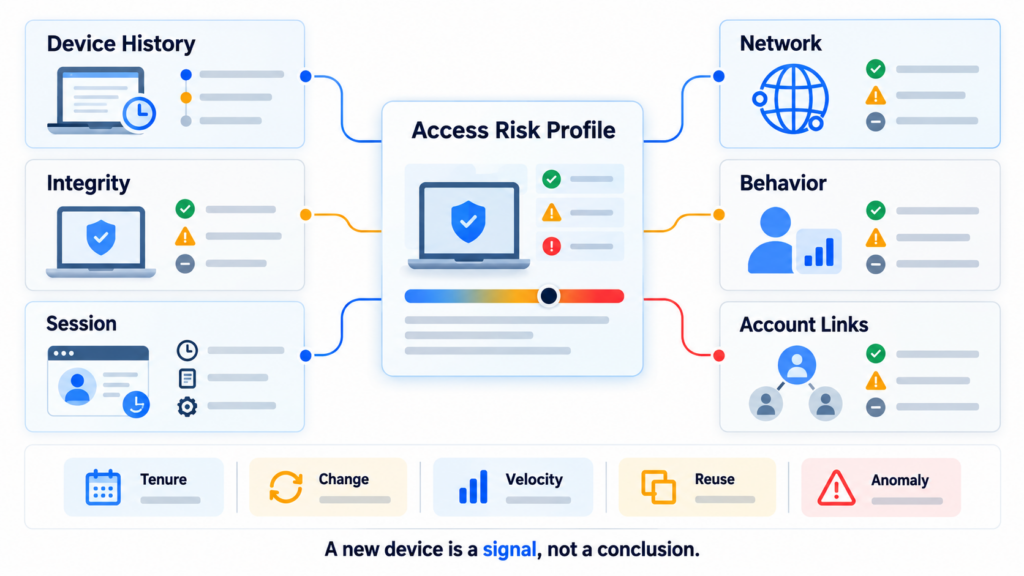
Device history: A first-seen device or a sudden break from a long-standing access pattern can raise risk, particularly during sensitive activity.
Environment integrity: Automation frameworks, emulators, rooted environments, application tampering, or inconsistent client characteristics can indicate that the access channel is being manipulated.
Session continuity: Abrupt changes in session attributes, abnormal token use, or activity inconsistent with the original authentication event may indicate session abuse.
Velocity and reuse: One environment attempting many accounts, identities, recovery requests, or authentication challenges within a short period can reveal coordinated activity.
Account relationships: A device previously associated with confirmed fraud or linked to multiple unrelated profiles deserves greater scrutiny.
Behavioral sequence: The order of actions often matters more than one event. A login followed rapidly by password reset, contact-detail modification, beneficiary creation, and fund movement is more concerning than an isolated new-device login.
FinAuth Device & Session Intelligence can structure these observations and combine them with identity, behavioral, network, and transaction evidence.
4. Why a New Device Should Not Automatically Mean Fraud
New devices are common. Customers replace computers, change browsers, travel, use accessibility tools, or access services from work and home. Blocking every first-seen environment creates false positives and unnecessary support work.
A risk-based policy should examine:
- Whether authentication was completed securely.
- Whether the customer’s behavior remains consistent.
- Whether the environment shows integrity concerns.
- Whether account recovery or profile changes occurred.
- Whether the device is linked to other suspicious accounts.
- Whether a high-risk transaction follows the access event.
Low-risk customers can continue normally. Moderate uncertainty may trigger confirmation through an established channel. Stronger combined risk may justify Face Verification, Liveness Detection, or manual investigation.
5. Building a Multi-Signal Account Takeover Workflow
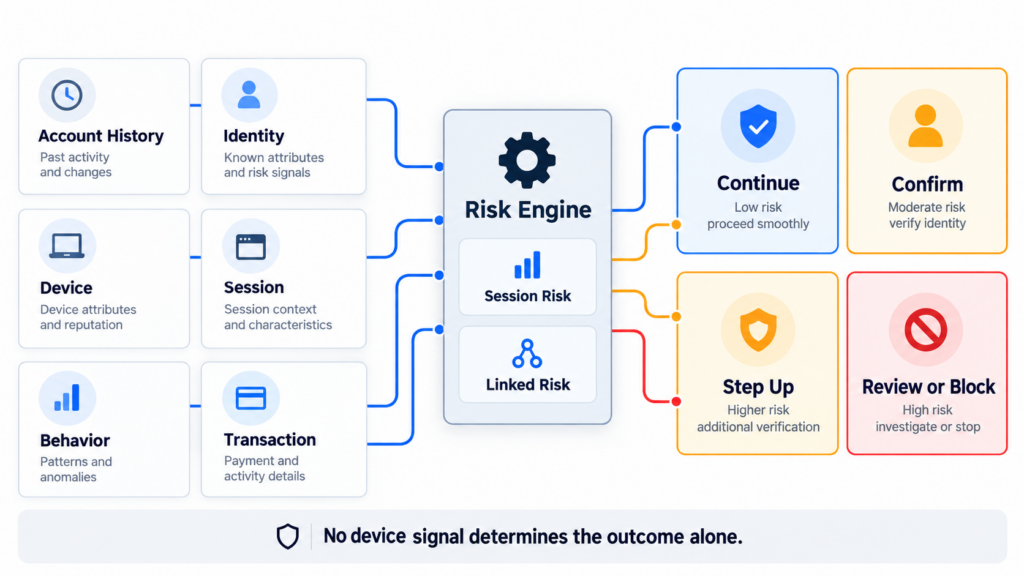
FinAuth can combine six evidence groups within its Risk Engine:
- Account history: Previous devices, access patterns, authenticators, and trusted relationships.
- Identity: Verified customer information and earlier KYC evidence.
- Device: Recognition, tenure, integrity, reuse, and environment changes.
- Session: Authentication context, continuity, network conditions, and navigation sequence.
- Behavior: Interaction patterns and deviation from the customer’s baseline.
- Transaction: Beneficiary, value, velocity, and relationship risk.
The resulting workflow can apply proportionate actions:
- Low risk: Continue without unnecessary interruption.
- Medium risk: Ask the customer to confirm the event.
- High risk: Require stronger authentication or Face Verification with Liveness Detection.
- Critical risk: Restrict the activity and route the case for priority review.
No device identifier, IP address, location change, or behavioral anomaly should determine the outcome alone.
6. Protect Account Recovery and Sensitive Actions
Account recovery requires particular care because it can allow an attacker to replace the authenticators protecting the account.
Controls can include checking device and account tenure, notifying previously verified contact channels, limiting repeated recovery attempts, and requiring identity reverification when combined risk is high. NIST requires recovery methods to be based on documented risk analysis and requires subscriber notification after recovery events.
Risk should also be reassessed before sensitive actions such as adding an authenticator, changing contact information, creating a beneficiary, or initiating an unusual transaction. A session that appeared acceptable at login may become high risk later.
7. Measure Accuracy, Privacy, and Customer Impact
Teams should monitor confirmed account takeovers, false-positive rates, step-up completion, recovery fraud, new-device conversion, review outcomes, and devices linked across multiple accounts.
Device intelligence should also follow data-minimization and retention policies. Businesses should collect signals relevant to fraud prevention, protect stored identifiers, limit access, and assess whether controls affect legitimate user populations unfairly.
8. Account Takeover Detection Q&A
What device signals indicate account takeover?
Important signals include unfamiliar environments, integrity problems, abnormal velocity, suspicious account links, session discontinuity, and sensitive actions that deviate from established behavior.
Is an unfamiliar device enough to block account access?
No. A new device is contextual evidence, not proof of compromise. FinAuth combines it with authentication, identity, session, behavioral, and transaction risk before selecting an action.
How does FinAuth detect suspicious account access?
FinAuth Device & Session Intelligence evaluates device history, integrity, reuse, velocity, and session conditions. Its Risk Engine combines those results with identity, biometric, behavioral, network, and transaction signals.
When should Face Verification be used for account takeover prevention?
Face Verification with Liveness Detection can be applied when combined risk justifies identity reverification, such as suspicious recovery, authenticator replacement, or high-risk transactions.
9. Conclusion
Device intelligence helps expose suspicious access that valid credentials may not reveal. Its greatest value comes from connecting device history and integrity with session behavior, account relationships, identity evidence, and transaction context.
FinAuth enables this multi-signal approach so trusted customers can continue efficiently while uncertain and high-risk sessions receive proportionate verification, investigation, or restriction.