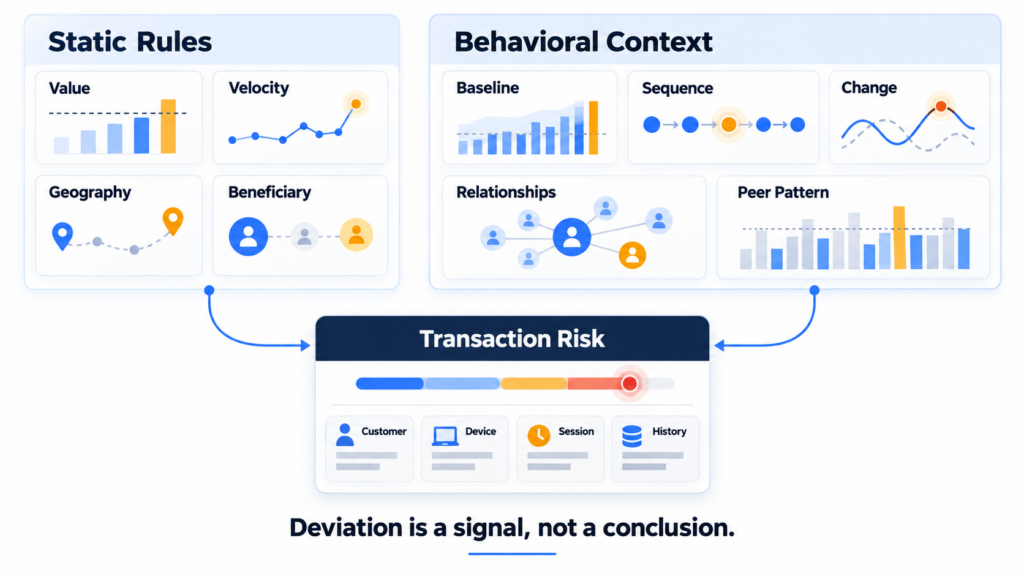
Static transaction rules remain useful for identifying known risks. A transfer above a defined value, activity involving a high-risk jurisdiction, or an unusual number of payments within a short period can trigger an alert.
However, fraudsters can adapt their behavior to remain below fixed thresholds. A transaction that appears normal in isolation may still be suspicious when compared with the customer’s identity, device history, previous activity, peer group, or connected accounts.
Behavioral analytics strengthens transaction monitoring by evaluating how activity changes over time and whether a transaction is consistent with the customer and session performing it.
1. What Are the Limitations of Static Transaction Rules?
Static rules apply predefined conditions to every relevant transaction. Typical examples include:
- Transaction value exceeds a threshold.
- Too many transfers occur within a defined period.
- Funds move to a restricted destination.
- A newly added beneficiary receives a large payment.
- Several failed attempts precede a successful transaction.
These rules are transparent and easy to audit, but they evaluate activity against fixed boundaries. Fraudsters may avoid detection by splitting payments, rotating accounts, slowing transaction velocity, or remaining just below review thresholds.
Static rules can also generate unnecessary alerts. A large transaction may be normal for a business account but unusual for a newly opened consumer account. A cross-border payment may be expected for one customer and inconsistent with another customer’s profile.
The rule identifies the event, but context determines its relevance.
2. How Behavioral Analytics Adds Context
Behavioral analytics builds a baseline from the customer’s historical activity and evaluates deviations from that baseline.
Relevant dimensions can include:
- Typical transaction values and frequencies
- Normal login times and session duration
- Common devices and access environments
- Usual beneficiaries and destinations
- Navigation and interaction patterns
- Time between login, profile changes, and payment
- Failed attempts, corrections, and retries
- Relationships with other accounts or devices
The objective is not to treat every deviation as fraud. A customer may travel, purchase an expensive item, change devices, or begin using a new financial product. Risk increases when several unusual behaviors occur together or conflict with verified customer information.
FATF describes ongoing monitoring as assessing whether transactions remain consistent with the institution’s knowledge of the customer, product, business relationship, and risk profile. It also recommends adjusting monitoring depth according to customer and institutional risk.
3. Behavioral Patterns That May Indicate Suspicious Transactions
Velocity changes
A sudden increase in transaction frequency, rapid fund movement, or repeated transfers across several accounts may indicate account abuse or coordinated fraud.
New-beneficiary risk
A payment to a new beneficiary becomes more significant when it follows a password reset, device change, profile update, or unusual login.
Account takeover behavior
A fraudster may use correct credentials but behave differently from the legitimate customer. Changes in device integrity, navigation, session timing, transaction sequence, and beneficiary selection can increase risk.
Dormant-account activation
An inactive account that suddenly receives funds and quickly transfers them elsewhere may require stronger review, particularly when accompanied by a new device or identity changes.
Transaction structuring
Multiple payments below a fixed threshold may collectively represent a higher-risk pattern. Behavioral analytics can assess aggregate value, timing, recipients, and related accounts.
Coordinated activity
Several accounts may share devices, facial identities, contact information, beneficiaries, or transaction patterns. Graph relationships can reveal organized activity that account-level monitoring misses.
These patterns should be treated as investigation signals rather than automatic proof of criminal activity.
4. Combine Behavior With Identity and Device Evidence
Behavioral analytics becomes more effective when it is connected to identity and session evidence.
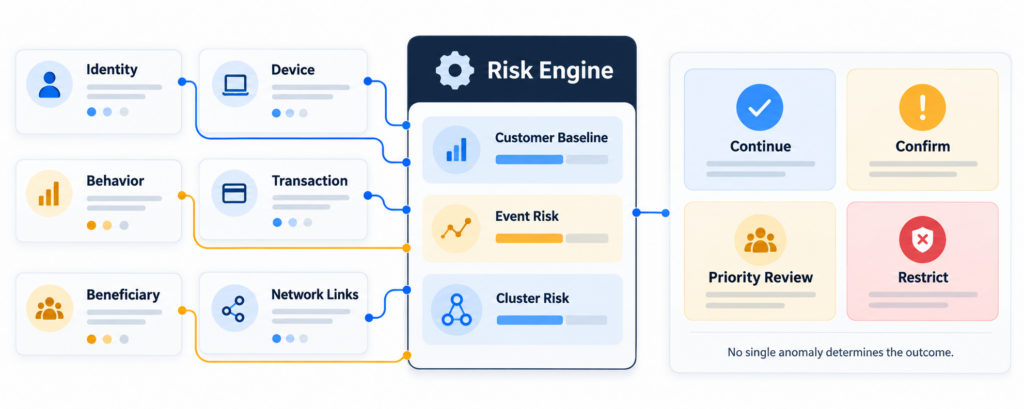
FinAuth can combine:
- Identity: Verified attributes, customer type, account age, and KYC status
- Document: Authenticity, manipulation, recapture, and data consistency
- Face and liveness: Facial similarity, genuine presence, and injection risk
- Device and session: Device integrity, tenure, network context, and related accounts
- Behavior: Velocity, navigation, profile changes, and transaction sequence
- Transaction: Value, beneficiary, geography, channel, and payment purpose
For example, an unusually large transfer may remain manageable when it comes from a trusted device and matches the customer’s established activity. The same transfer may require intervention when it follows an account recovery, originates from a high-risk environment, and sends funds to a new beneficiary shared with other suspicious accounts.
NIST identifies behavioral analytics, device fingerprinting, transaction analytics, network indicators, and velocity analysis as complementary protections against scaled and automated identity fraud.
5. Use Risk-Based Responses Instead of One Alert Queue
Not every anomaly requires manual investigation. FinAuth’s Risk Engine can evaluate the severity, reliability, recency, and combination of signals before selecting a proportionate action.
Low risk: The transaction aligns with historical behavior, verified identity, and trusted device signals. It can continue automatically.
Medium risk: A limited behavioral deviation or new beneficiary may trigger confirmation, additional authentication, or Face Verification.
High risk: Multiple anomalies—such as a new device, abnormal velocity, and profile changes—may require Liveness Detection, stronger identity verification, delayed execution, or priority review.
Critical risk: Evidence of account takeover, injection, coordinated fraud, or links to confirmed high-risk entities may justify restriction or blocking according to business policy and applicable requirements.
This model allows businesses to preserve low-friction journeys for normal customers while concentrating operational resources on transactions supported by stronger combined-risk evidence.
6. Keep Models Explainable and Reviewable
Behavioral models should support investigators rather than produce unexplained scores.
A useful alert should show:
- What changed from the customer’s normal behavior
- Which rules or models were triggered
- The relevant time window
- Supporting identity and device evidence
- Related accounts, beneficiaries, or sessions
- Whether the behavior is isolated or repeated
- The recommended action
FATF notes that financial institutions using automated monitoring should understand their systems’ operating rules, verify their integrity, and confirm that they address identified risks.
Human review remains important for complex or consequential cases. Reviewer outcomes can also improve thresholds, detection logic, and future prioritization.
7. Measure Detection Quality, Not Only Alert Volume
A lower alert count does not automatically mean better monitoring. Teams should assess whether the system is finding relevant risk while controlling unnecessary friction.
Useful metrics include:
- Confirmed risk by rule and behavioral indicator
- False-positive and false-negative rates
- Alert-to-investigation conversion
- Time to review and resolution
- Step-up verification success
- Loss prevented or recovered
- Transactions detected only through combined signals
- Performance by customer segment, product, and market
- Changes in behavior before confirmed fraud
- Investigator disagreement and override rates
FATF has noted that advanced analytics can help distinguish suspicious activity from normal behavior, strengthen ongoing monitoring, and reduce unnecessary initial review when implemented appropriately.
8. Behavioral Analytics Q&A
What is behavioral transaction monitoring?
It evaluates whether a transaction is consistent with a customer’s historical activity, current session, identity profile, device history, and related accounts.
Can behavioral analytics replace static rules?
No. Static rules remain useful for explicit policies and known risk patterns. Behavioral analytics complements them by detecting deviations, sequences, and relationships that fixed thresholds may miss.
Is unusual behavior always suspicious?
No. Legitimate customers change devices, travel, add beneficiaries, and make atypical purchases. FinAuth evaluates behavioral changes alongside identity, device, biometric, and transaction context.
How does FinAuth detect account takeover risk?
FinAuth can combine device changes, session anomalies, recovery events, behavioral deviations, biometric evidence, beneficiary risk, and transaction activity within its Risk Engine.
How can businesses reduce transaction-monitoring false positives?
They can segment customers appropriately, incorporate historical and peer context, correlate multiple signals, explain alert drivers, and recalibrate rules using confirmed investigation outcomes.
9. Conclusion
Static rules identify known conditions, but they cannot fully explain whether a transaction is normal for the customer performing it.
By combining behavioral analytics with identity verification, document intelligence, Face Verification, Liveness Detection, device intelligence, network relationships, and transaction context, FinAuth helps businesses identify subtle and coordinated risk while keeping trusted activity moving.