Proof of address documents help businesses determine whether a customer can be associated with a claimed residential or business location. However, extracting the correct address is only part of the verification process. The document must also be recent enough to support the intended decision.
Recency validation is not simply checking whether any visible date falls within a fixed number of days. Different document types use different dates, issuance cycles, and validity models. A reliable workflow must identify the document, extract the relevant date, apply the correct policy, and assess authenticity and consistency before accepting the evidence.
FinAuth combines document classification, OCR, date normalization, address matching, authenticity analysis, and risk-based decisioning to automate this process.
1. What Does Address Document Recency Mean?
Document recency measures the time between the relevant document date and the date on which the document is submitted for verification.
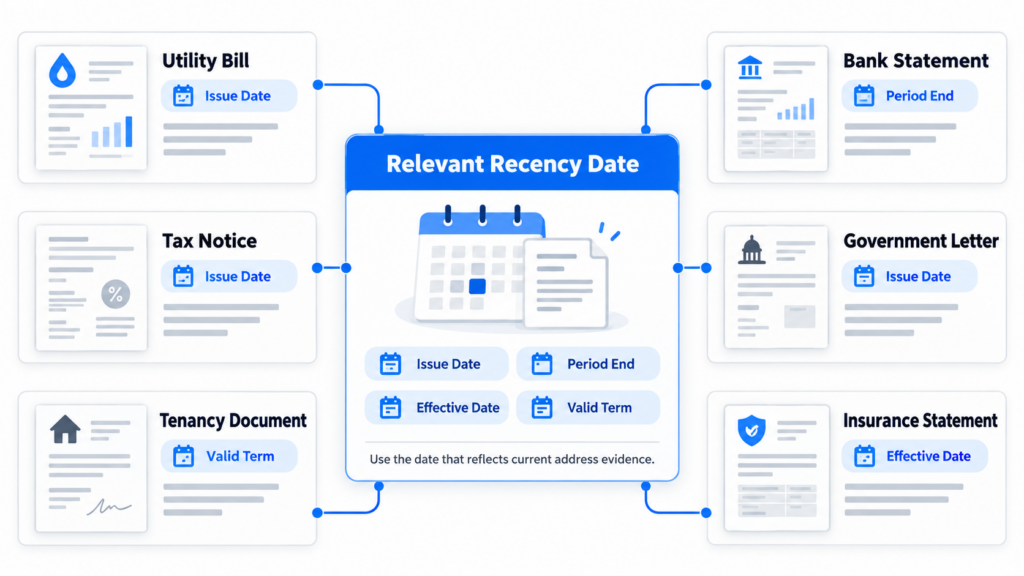
The relevant date depends on the evidence type:
- Utility bill: Issue date or billing-period end date
- Bank statement: Statement date or period end date
- Tax document: Assessment or issuance date
- Government correspondence: Letter or notice date
- Tenancy document: Agreement start date and current term
- Insurance statement: Issue date and coverage period
- Official registration: Effective date, renewal date, or validity period
The newest date printed on a document is not always the correct reference. A payment due date may occur after the statement was issued, while a transaction date may appear inside a much older bank statement. The system must understand the document’s structure and date semantics.
2. Why One Universal Recency Rule Is Unreliable
A blanket rule such as “all documents must be less than three months old” may be easy to implement, but it does not fit every document, market, or customer.
Some documents are issued monthly, while others are annual or remain valid until replaced. Certain customers may receive only digital statements. In other markets, official correspondence or residential registration records may provide stronger address evidence than utility bills.
Businesses should define recency policies according to:
- Applicable regulation and internal compliance policy
- Document type and issuance frequency
- Customer and product risk
- Residential versus business address
- Onboarding, reverification, or account-recovery use case
- Availability of authoritative data sources
- Market-specific document practices
JMLSG guidance includes examples such as current bank or card statements, utility bills, current council tax demands, and recent evidence of benefits or grants. This illustrates that acceptable evidence and the meaning of “current” depend on the document and verification framework.
3. Identify the Correct Date Before Calculating Age
Automated recency validation should first classify the document, then locate the field that represents issuance or current coverage.
FinAuth OCR can extract multiple visible dates and assign them contextual labels, such as:
- Issue date
- Statement date
- Billing start and end dates
- Due date
- Effective date
- Expiry date
- Transaction date
- Print or download date
The system can then select the correct date according to the recognized document type and configured policy.
For example, a bank statement dated September 30 should not be treated as current because it contains an October transaction added through editing. Similarly, a tenancy agreement signed several years ago may remain relevant if it shows an active term or valid renewal, but the original signature date alone may not prove current occupancy.
If the relevant date is missing, unreadable, contradictory, or ambiguous, the result should be inconclusive rather than automatically accepted.
4. Normalize Dates Across Formats and Markets
Dates may appear in different scripts, languages, and formats. “03/04/2026” could mean March 4 or April 3 depending on the market. Some documents use local calendars, abbreviated month names, or billing periods rather than one issue date.
A robust workflow should:
- Detect the expected date format from document type and market
- Normalize dates into a consistent internal format
- Validate real calendar values
- Resolve day-month ambiguity conservatively
- Compare issue, period, due, and expiry dates
- Detect impossible or inconsistent sequences
- Calculate document age using the submission timestamp
- Preserve the original extracted value for audit
FinAuth can combine multilingual OCR with document classification and market configuration so recency rules are applied to the correct normalized field rather than an arbitrary date string.
5. Recency Does Not Prove Authenticity or Current Residence
A recent date alone does not make a document trustworthy. Fraudsters may alter the issue date, replace an address, assemble a digital composite, or submit a newly generated document associated with another person.
Address verification should therefore also evaluate:
- Document template and layout
- Typography and field alignment
- Image manipulation indicators
- Screen, print, or file recapture
- Name and address consistency
- Issuer and document-type plausibility
- Duplicate or reused documents
- Metadata and capture-source integrity
- Consistency with other verified customer information
FATF requires customer identity verification to use reliable, independent source documents, data, or information. Its guidance also emphasizes that reliability should account for governance, technology, processes, and the risk of fraud or counterfeiting—not merely whether information is recent.
6. Build a Risk-Based Recency Workflow
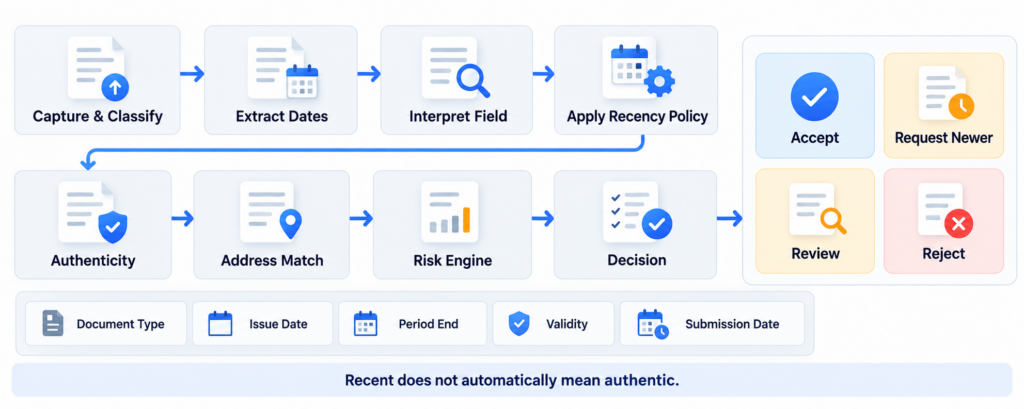
FinAuth can structure address document validation into the following stages:
- Capture and classify: Identify the document and check image quality.
- Extract independently: Read the name, address, relevant dates, issuer, and reference fields.
- Interpret the date: Determine whether the date represents issuance, billing, validity, or another event.
- Apply policy: Compare document age with the rule configured for its type, market, product, and risk tier.
- Validate authenticity: Examine layout, manipulation, recapture, and consistency signals.
- Calculate combined risk: Send recency, address, identity, device, and session evidence to the FinAuth Risk Engine.
- Select an action: Approve, request a newer document, review the evidence, or reject suspicious submissions.
A document slightly outside a standard time window may require additional evidence rather than immediate rejection. A supposedly recent document with strong manipulation indicators should receive risk review regardless of its date.
7. Handle Common Recency Exceptions
Automated workflows should include controlled exception paths for:
- Customers without household bills in their own name
- Annual documents that remain valid
- Recently relocated customers
- Students or customers living with family
- Digital-only statements
- Documents with billing periods crossing the policy cutoff
- Markets using official residential registries
- Documents containing only partial or ambiguous dates
Alternative evidence should provide comparable assurance and follow the business’s applicable regulatory and risk policies. The workflow should record why an exception was accepted and which supplementary checks were completed.
8. Address Document Recency Q&A
How recent should a proof of address document be?
There is no universal period for every market and document. Businesses should configure the accepted age according to applicable requirements, document type, issuance frequency, product risk, and internal policy.
Which date should be used on a utility bill?
Usually the issue date or billing-period end date, depending on policy. A due date, payment date, or unrelated service date should not automatically determine recency.
Can an annual document prove a current address?
Potentially. The decision should consider whether the document remains valid, the issuer, the customer risk, and whether additional evidence is required.
Does FinAuth only check the document date?
No. FinAuth can classify the document, extract and normalize dates, compare names and addresses, analyze authenticity and recapture risk, and combine the results with identity, device, and session signals.
What happens when the date is unreadable or ambiguous?
The workflow can request a clearer capture, ask for another document, or route the case for review rather than treating the document as current.
9. Conclusion
Address document recency validation requires more than subtracting one visible date from the submission date. The system must recognize the evidence type, understand which date is relevant, normalize it correctly, apply market-specific policy, and assess whether the document is authentic and consistent.
By combining OCR, document classification, configurable recency policies, authenticity analysis, and risk-based orchestration, FinAuth helps businesses verify current address evidence without forcing every customer and document into one inflexible rule.