Remote customer onboarding has become the default entry point for digital banks, fintech platforms, e-wallets, lending apps, gaming platforms, and cross-border financial services. A user can open an account, submit an ID document, take a selfie, and complete identity verification within minutes.
This level of convenience is now a baseline expectation. But it also creates a new security challenge: the onboarding session is often unsupervised, device-based, and exposed to increasingly sophisticated identity fraud.
For years, many KYC workflows relied on document OCR and face comparison as the core verification process. The system checked whether the ID document appeared valid and whether the selfie matched the portrait on the ID. That approach is still important, but it is no longer sufficient on its own.
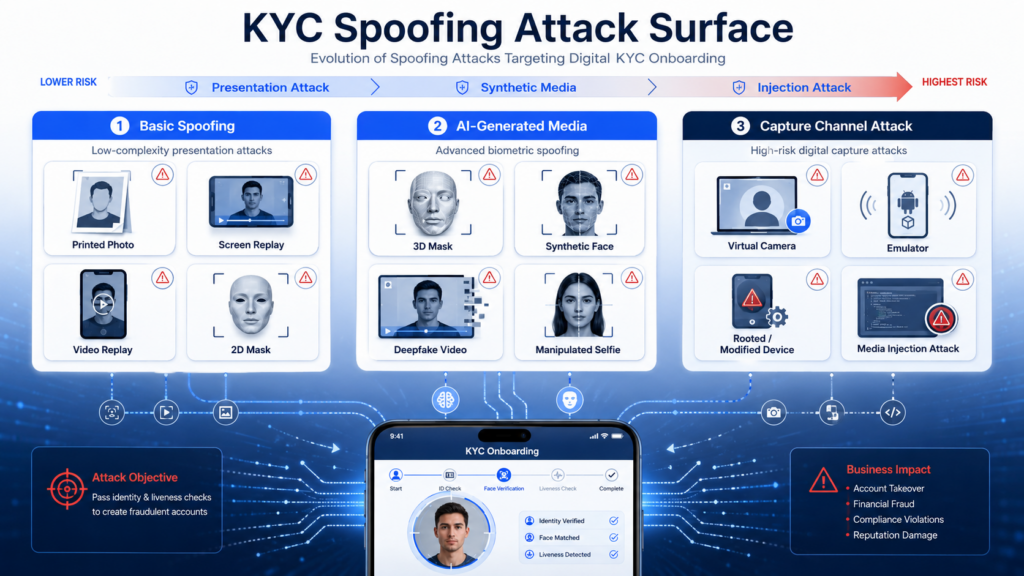
Fraudsters are no longer limited to holding up a printed photo in front of a camera. Today’s attacks can involve replayed videos, 3D masks, manipulated selfies, AI-generated faces, synthetic identity documents, virtual cameras, emulators, and injection attacks that bypass the camera capture process entirely.
This is why liveness detection has become a critical layer in modern KYC and AI identity verification.
What Is Liveness Detection in KYC?
Liveness detection is a biometric security capability designed to determine whether the face presented during verification belongs to a real, live person who is physically present during the onboarding session.
In a KYC workflow, liveness detection helps answer a question that face matching alone cannot answer:
Is this a real person in front of the camera right now, or is it a spoofing attempt?
Face comparison verifies similarity between two face images. Liveness detection verifies the authenticity of the biometric presentation itself. Both are necessary, but they solve different problems.
A strong KYC process should confirm three things:
- The identity document is authentic and belongs to a real person.
- The face captured during onboarding matches the face on the identity document.
- The face capture comes from a live, present person rather than a spoof, replay, synthetic image, or injected media stream.
Without the third layer, a digital onboarding process may approve a session that looks correct on the surface but is actually controlled by an attacker.
Why Traditional Face Verification Is Not Enough
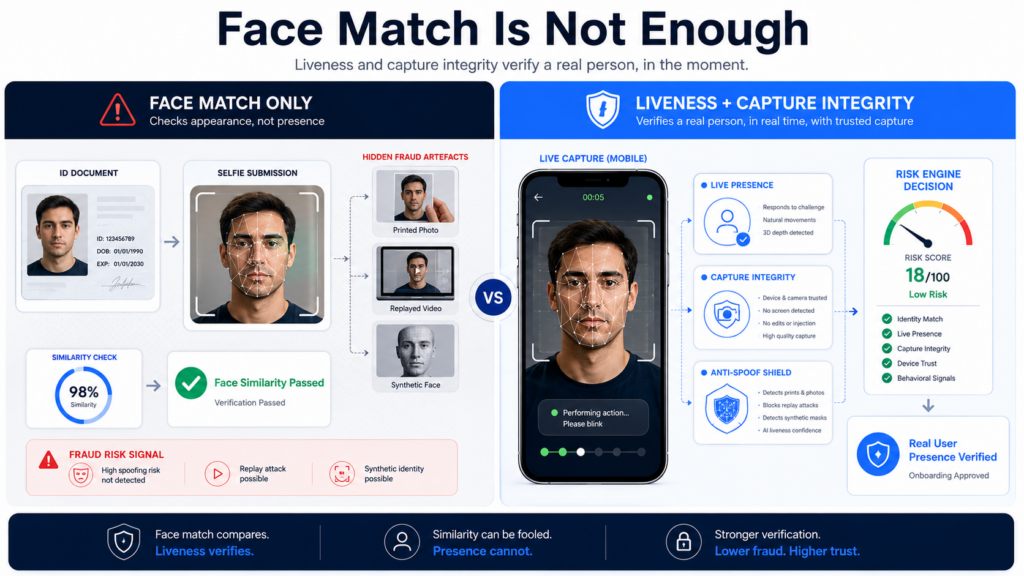
Basic face recognition can compare facial features and produce a similarity score. This is useful for verifying whether the selfie and the document portrait likely belong to the same person.
However, a matching score does not prove that the selfie was captured from a live person.
A fraudster may use a stolen ID image and present a printed photo. Another may replay a recorded video on a second device. A more advanced attacker may use deepfake tools to generate a face that resembles the target identity. In higher-risk scenarios, the attacker may inject pre-generated video frames directly into the onboarding flow, bypassing the physical camera.
In all of these cases, face comparison may still receive a plausible face image. The system may see a face, detect facial landmarks, and calculate a match. But if the system cannot verify liveness and capture integrity, it may still be vulnerable.
This is especially relevant for financial services, where fake accounts can be used for mule activity, bonus abuse, loan fraud, account takeover preparation, payment fraud, and laundering-related activity.
In other words, liveness detection is not just a biometric feature. It is an onboarding risk control.
Common Spoofing Attacks in Digital Onboarding
Spoofing attacks vary in complexity, cost, and technical sophistication. A modern KYC system needs to defend against both low-cost presentation attacks and more advanced digital manipulation.
Photo and Print Attacks
This is one of the most basic attack types. The fraudster presents a printed photo or a photo displayed on another screen to the camera. While simple, this attack can still be effective against weak onboarding flows that only check whether a face exists in the frame.
Replay Attacks
In a replay attack, the fraudster uses a pre-recorded video of the target person. This may include blinking, head movement, or other gestures intended to pass basic motion checks.
Mask and 3D Artefact Attacks
More sophisticated attackers may use 3D masks, silicone masks, partial masks, or other physical artefacts. These are harder to detect because they may create depth, shadows, and physical structure that look more realistic than flat images.
Deepfake Attacks
Deepfake tools can generate synthetic face videos or manipulate a fraudster’s face to resemble another person. As generative AI becomes more accessible, deepfake-based onboarding fraud is becoming easier to attempt at scale.
Injection Attacks
Injection attacks are among the most dangerous threats to remote onboarding. Instead of presenting a spoof to the camera, the attacker attempts to replace the live camera feed with pre-generated or manipulated media. This can happen through virtual cameras, rooted devices, emulators, modified apps, or compromised capture environments.
A KYC platform that only analyzes the final image may miss this attack vector. The system must also verify the integrity of the capture channel and detect suspicious device or media-stream behavior.
How AI Liveness Detection Works
AI-powered liveness detection uses computer vision, biometric analysis, and risk signals to distinguish genuine live users from spoofing attempts. The exact technical implementation varies by provider, but modern systems generally combine multiple detection layers.
Texture and Image Artefact Analysis
AI models can analyze visual patterns that are difficult for humans to notice, such as printing artefacts, screen moiré, reflection patterns, edge distortion, compression noise, abnormal skin texture, and inconsistencies caused by display replay.
Motion and Challenge Response
Some systems ask users to perform a simple action, such as blinking, turning their head, nodding, or following instructions. This can help verify real-time interaction, especially when combined with randomized prompts that make pre-recorded videos harder to reuse.
Passive Liveness Detection
Passive liveness detection works without requiring the user to perform obvious actions. The system analyzes the capture itself to determine whether the face is likely to be live. This can reduce friction and improve completion rates, especially for mobile onboarding.
Depth, Light, and Environmental Signals
Advanced systems may analyze depth cues, lighting consistency, shadow behavior, face geometry, and environmental changes to detect whether the input is coming from a real 3D person in a real capture environment.
Device and Capture Integrity Signals
For high-risk onboarding scenarios, liveness detection should not stop at the face. The system should also evaluate whether the capture device, camera stream, operating environment, and session behavior appear trustworthy.
Signals such as virtual camera usage, emulator behavior, device tampering, abnormal camera access, inconsistent metadata, and suspicious network patterns can provide important context for fraud prevention.
Active vs. Passive Liveness Detection
There are two common approaches to liveness detection: active and passive.
Active liveness detection requires the user to perform a visible action. For example, the system may ask the user to blink, smile, turn their head, read numbers, or follow an on-screen prompt. The advantage is that it introduces real-time interaction. The drawback is that it adds friction and may reduce completion rates if the instructions are unclear or if the user is in a low-light or noisy environment.
Passive liveness detection runs in the background. The user may only need to take a selfie or complete a short face capture. The system analyzes visual and behavioral signals without adding extra steps. The advantage is a smoother user experience. The challenge is that the underlying AI models must be robust enough to detect spoofing attempts without relying on obvious user actions.
For many KYC workflows, the best approach is not choosing one method universally. It is using risk-based orchestration.
Low-risk users may pass through passive liveness detection with minimal friction. Higher-risk sessions may trigger active challenges, additional document checks, manual review, or step-up verification. This allows businesses to balance fraud prevention with conversion.
Liveness Detection as Part of AI Identity Verification
Liveness detection should not operate as an isolated check. It becomes more effective when integrated into a broader AI identity verification framework.
A modern KYC decision engine should combine:
- Document OCR and authenticity checks
- Face detection and quality assessment
- Face comparison between selfie and ID portrait
- Liveness detection
- Deepfake and injection attack detection
- Device and environment risk analysis
- Behavior and session-level risk signals
- Watchlist, duplicate account, and fraud pattern screening when applicable
This layered approach is important because onboarding fraud rarely depends on a single signal. A spoofed face may appear alongside a forged document. A real face may be used with a synthetic identity. A legitimate document may be paired with suspicious device behavior. A session may pass face comparison but fail capture integrity checks.
AI identity verification helps connect these signals into a more complete risk decision.
Instead of treating KYC as a simple pass/fail identity check, businesses can evaluate the trustworthiness of the entire onboarding session.
Why Liveness Detection Matters for KYC Compliance and Risk Control
KYC is not only about collecting identity information. It is about establishing reasonable confidence that the customer is who they claim to be.
For regulated financial institutions and fintech platforms, weak onboarding controls can create downstream exposure across AML, fraud, credit risk, account takeover, and reputational risk. Once a fraudulent account is approved, it can be used for multiple abuse patterns: payment scams, mule networks, synthetic identity activity, bonus exploitation, or repeated account creation.
Liveness detection helps reduce this exposure at the point of entry.
It strengthens identity proofing by making it harder for attackers to use stolen photos, replayed videos, or synthetic media. It also improves the quality of customer onboarding data by ensuring that face capture is tied to a live session rather than a manipulated artefact.
From a business perspective, the value is not only fraud blocking. Strong liveness detection can also reduce manual review pressure, improve onboarding scalability, and support a more consistent risk decision across markets.
What to Look for in a Liveness Detection Solution
Not all liveness detection solutions provide the same level of protection. Businesses evaluating KYC vendors should look beyond the checkbox.
A stronger solution should provide five capabilities.
First, it should defend against a broad range of presentation attacks, including photos, screens, replayed videos, masks, and partial artefacts.
Second, it should address AI-generated threats, including deepfakes and manipulated face media.
Third, it should include capture integrity and injection attack defenses, because not all attacks happen in front of the camera.
Fourth, it should support risk-based orchestration, allowing different verification paths based on user risk, market requirements, and business policy.
Fifth, it should maintain a balance between security and user experience. A system that blocks fraud but creates excessive friction may damage conversion. A system that maximizes conversion but misses attack signals may create hidden fraud costs.
The best KYC architecture is not the one with the most checks. It is the one that applies the right checks at the right moment.
How FinAuth Helps Strengthen KYC Against Spoofing and Onboarding Fraud
FinAuth is designed to support AI-powered identity verification for digital onboarding scenarios where security, compliance, and user experience all matter.
The platform combines document intelligence, face comparison, liveness detection, and fraud risk analysis to help businesses verify real users and detect suspicious onboarding attempts. Instead of relying on a single biometric score, FinAuth helps evaluate the full identity verification session across document, face, device, and capture-risk signals.
For businesses operating in fintech, banking, e-wallets, lending, mobility, gaming, or other high-risk digital services, this layered approach helps reduce exposure to spoofing attacks, synthetic identities, deepfake-based fraud, and automated onboarding abuse.
As fraud tactics continue to evolve, KYC systems need to move beyond basic identity matching. They need to verify that the person is real, present, and interacting through a trustworthy capture process.
Liveness detection is one of the most important layers in that shift.
Conclusion
Digital onboarding has changed the economics of customer acquisition. It has also changed the economics of fraud.
Attackers now have easier access to stolen identity data, synthetic media tools, replay methods, and injection techniques. A basic KYC flow that only checks documents and face similarity may no longer provide enough protection for high-risk digital services.
Liveness detection helps close a critical gap. It verifies that the biometric input comes from a real, live person rather than a spoofing artefact or manipulated media source.
When combined with document verification, face comparison, device intelligence, deepfake detection, and risk-based orchestration, liveness detection becomes a core part of AI identity verification.
For digital businesses, the goal is not simply to approve more users faster. The goal is to onboard legitimate users with confidence while stopping fraudulent accounts before they enter the ecosystem.
That is the new standard for KYC in the AI era.
FAQ
What is liveness detection in KYC?
Liveness detection is a biometric security check that determines whether the face captured during KYC belongs to a real, live person who is physically present during the verification session.
Is face matching the same as liveness detection?
No. Face matching compares whether two faces likely belong to the same person. Liveness detection checks whether the captured face is live and not a spoof, replay, mask, or manipulated media source.
Why is liveness detection important for digital onboarding?
It helps prevent fraudsters from using stolen photos, replayed videos, deepfakes, masks, or injected media to pass remote identity verification.
What is the difference between active and passive liveness detection?
Active liveness asks the user to perform an action, such as blinking or turning their head. Passive liveness analyzes the capture in the background without adding obvious user actions.
Can liveness detection stop deepfake attacks?
Liveness detection can help detect many deepfake and spoofing attempts, especially when combined with deepfake detection, injection attack detection, device risk analysis, and broader AI identity verification signals.
What should businesses look for in a liveness detection provider?
Businesses should evaluate attack coverage, deepfake resistance, injection attack defense, usability, risk-based orchestration, integration flexibility, and performance across different devices, markets, and lighting conditions.