Customer Due Diligence, or CDD, is no longer a process limited to banks and financial institutions. As digital services expand across fintech, payments, lending, insurance, mobility, gaming, social platforms, and online marketplaces, businesses are increasingly expected to verify who their users are, assess onboarding risk, and prevent identity-based fraud before accounts become active.
For many digital businesses, onboarding is a high-pressure moment. The process must be fast enough to avoid user drop-off, but strong enough to detect fake identities, manipulated documents, account farming, mule accounts, and synthetic identity fraud. This is where digital identity verification plays a critical role in modern CDD.
By combining document verification, face verification, liveness detection, device intelligence, and risk-based decisioning, businesses can build a more secure onboarding process without creating unnecessary friction for legitimate users.
What Is Customer Due Diligence?
Customer Due Diligence is the process of collecting and verifying customer information to understand who the customer is and what level of risk they may bring to the business. In digital onboarding, this typically includes verifying identity documents, confirming that the applicant is a real person, checking whether the submitted identity matches the user, and evaluating fraud or compliance risk signals.
Traditional CDD often relied on manual review, offline document checks, or branch-based verification. That model does not scale well for digital-first businesses, especially those operating across multiple markets, document types, languages, and user behaviors.
Modern CDD needs to be automated, risk-aware, and adaptable. Instead of applying the same verification steps to every user, digital businesses can use identity verification and fraud signals to route users into different onboarding paths based on risk.
Why Identity Verification Matters in CDD
At the center of CDD is one fundamental question: is this customer who they claim to be?
If a business cannot answer this reliably during onboarding, downstream risk increases. Fraudsters may use forged documents, stolen identities, deepfake faces, emulator environments, or repeated account registrations to bypass weak controls. Once approved, these accounts can be used for money laundering, bonus abuse, payment fraud, account takeover, or other high-risk activity.
Identity verification helps reduce this risk by validating three core elements.
First, the identity document must be readable, valid, and authentic. Second, the person submitting the document must match the identity owner. Third, the onboarding session itself must show reasonable consistency across device, location, behavior, and risk signals.
When these checks are connected, CDD becomes more than a simple document upload step. It becomes a layered risk control framework.
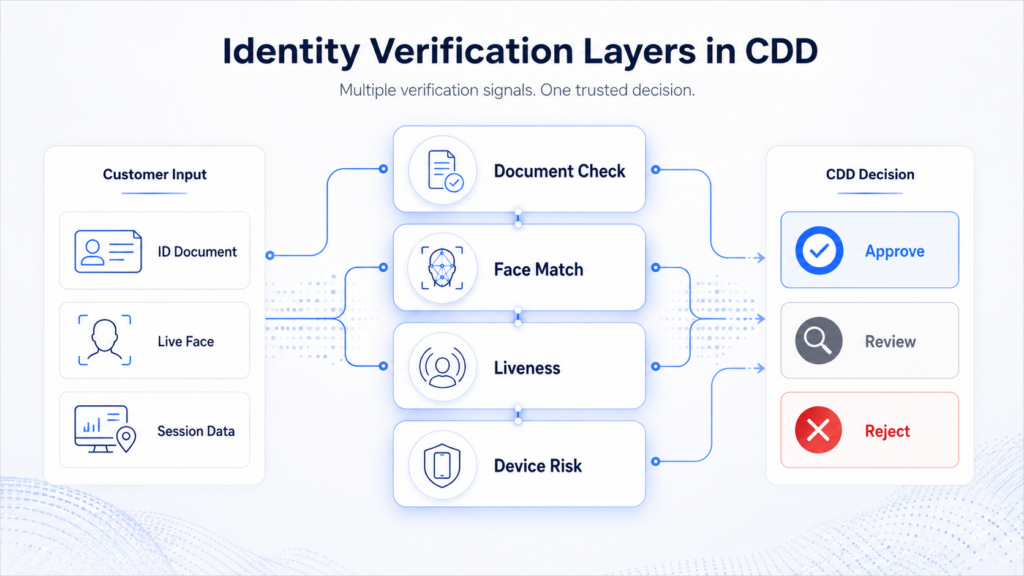
Key Identity Verification Layers in Digital CDD
1. Document Verification
Document verification starts with capturing and analyzing an identity document such as a passport, national ID card, driver’s license, or residence permit. OCR technology extracts key fields, including name, date of birth, document number, nationality, expiry date, and address when available.
However, OCR alone is not enough. A document can be readable but still fraudulent. That is why document authenticity checks are essential. These checks help detect signs of tampering, image manipulation, re-photographed documents, screen captures, inconsistent fonts, abnormal layouts, missing security features, or suspicious field relationships.
For cross-border businesses, document verification also needs to support multiple countries and document formats. A strong CDD workflow should be able to process diverse document types while maintaining consistent verification logic.
2. Face Verification
Face verification confirms whether the live user matches the portrait on the identity document. This usually involves a 1:1 facial comparison between the document photo and a selfie or video frame captured during onboarding.
This layer helps reduce the risk of stolen document use. Even if a fraudster obtains another person’s ID image, they still need to prove that they are the legitimate identity owner. Face verification adds a strong biometric binding between the document and the applicant.
For digital businesses, this is especially important in high-risk scenarios such as financial account opening, loan applications, driver onboarding, merchant registration, and account recovery.
3. Liveness Detection
Liveness detection verifies that the user is physically present during onboarding and not using a spoofing artifact. Common attack methods include printed photos, replayed videos, masks, deepfake media, virtual cameras, and injection-based attacks.
A modern CDD process should include liveness checks that can detect both presentation attacks and digital injection attacks. This is becoming increasingly important as generative AI lowers the cost of creating convincing fake faces and synthetic media.
Liveness detection helps ensure that onboarding is not only linked to a real identity document, but also to a real human presence.
4. Device and Session Risk
Identity checks should not stop at documents and faces. Fraud often leaves signals at the device and session level. These may include emulator use, VPN or proxy connections, abnormal IP locations, device fingerprint reuse, mismatched time zones, suspicious browser environments, or repeated registration attempts from the same device cluster.
Device and session intelligence helps businesses identify organized fraud patterns that may not be visible from a single ID document. For example, one device may be linked to multiple onboarding attempts using different identities. One IP range may repeatedly submit applications with similar behavior. These signals can be used to trigger step-up verification, manual review, or automatic rejection.
5. Risk-Based Decisioning
Not every user presents the same level of risk. A low-risk user with a valid document, successful face match, clean liveness result, and normal device signals should not be forced through unnecessary friction. A high-risk user with inconsistent document fields, poor image quality, suspicious device signals, or liveness anomalies should not be approved automatically.
Risk-based decisioning allows businesses to convert verification results into practical onboarding outcomes. Low-risk users can be approved quickly. Medium-risk users can be routed to additional checks. High-risk users can be rejected or escalated for review.
This adaptive model helps balance compliance, fraud prevention, and user conversion.
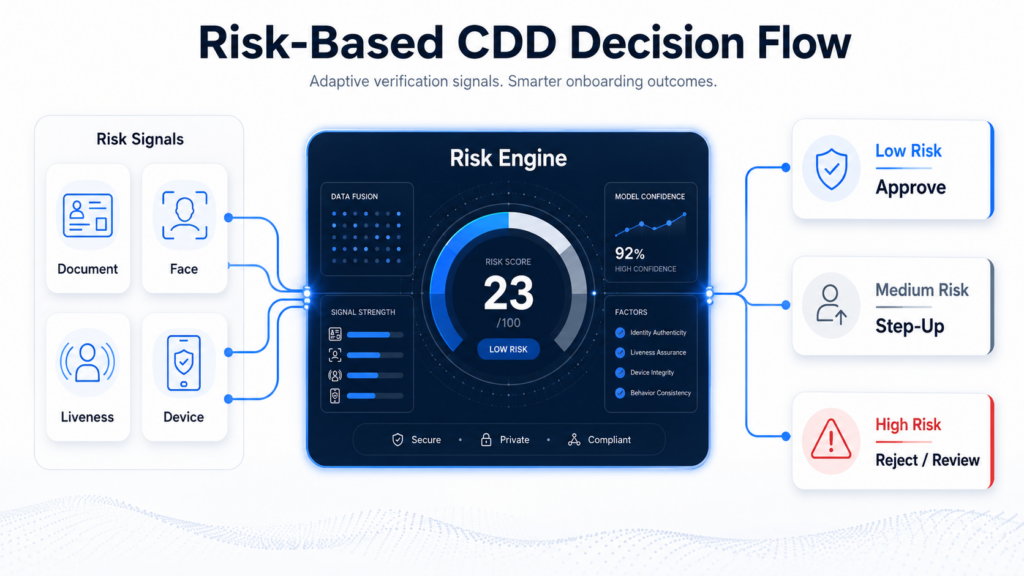
How Digital Businesses Reduce Onboarding Risk
A well-designed CDD workflow reduces onboarding risk in several ways.
First, it blocks fake or manipulated identities before account creation. This prevents fraud from entering the platform and reduces downstream investigation costs.
Second, it improves consistency. Automated checks apply the same verification standards across users, regions, and document types, reducing the variability of manual review.
Third, it creates an auditable verification trail. For regulated industries, maintaining structured records of identity checks, risk scores, review decisions, and evidence is essential for compliance and internal governance.
Fourth, it enables faster onboarding for legitimate users. When risk signals are clean, users can be approved with minimal delay. This improves conversion while maintaining control.
Finally, it strengthens fraud intelligence over time. By linking document, face, device, and behavioral signals, businesses can detect repeated abuse patterns, fraud networks, and identity reuse across accounts.
Building a Scalable CDD Framework
For digital businesses, the goal is not to add more checks for the sake of complexity. The goal is to build a scalable framework where each verification layer contributes to a clearer risk decision.
An effective digital CDD framework should include:
Document OCR and authenticity checks to validate identity data and document integrity.
Face verification to confirm that the applicant matches the identity owner.
Liveness detection to prevent spoofing, deepfake, and injection-based attacks.
Device and session intelligence to identify suspicious environments and repeated abuse.
Risk engine logic to route users into approve, review, step-up, or reject outcomes.
Audit and compliance records to support governance, investigation, and regulatory reporting.
With this structure, CDD becomes a dynamic onboarding control system rather than a static checklist.
FinAuth for Digital Customer Due Diligence
FinAuth helps digital businesses build risk-based CDD workflows by combining identity verification, fraud detection, and decisioning capabilities in one platform. Its verification stack covers document verification, face matching, liveness detection, device and session risk, behavioral signals, and configurable risk policies.
For businesses operating across fast-growing digital markets, FinAuth supports automated onboarding while allowing teams to adapt verification depth based on user risk. This helps reduce fraud exposure, improve operational efficiency, and maintain a smoother experience for legitimate customers.
Conclusion
Customer Due Diligence is becoming a core capability for digital businesses, not just a compliance requirement. As identity fraud becomes more automated and AI-enabled, businesses need onboarding systems that can verify real users, detect suspicious signals, and make risk-based decisions in real time.
Identity verification provides the foundation for this process. When document checks, face verification, liveness detection, device intelligence, and risk scoring work together, digital businesses can reduce onboarding risk without sacrificing user experience.
For companies expanding into digital finance, payments, mobility, marketplaces, or other trust-based services, a modern CDD framework is no longer optional. It is a key layer of business security, compliance readiness, and sustainable growth.