Remote onboarding has become the default entry point for digital financial services, online lending, payments, mobility platforms, marketplaces, and cross-border consumer applications. Users expect to open an account, verify their identity, and start using a service within minutes. For businesses, this creates a powerful growth opportunity. But it also creates a critical risk challenge: not every onboarding attempt carries the same level of identity risk.
A low-risk user with a valid document, consistent device signals, and clean behavioral patterns should not be forced through unnecessary friction. At the same time, a high-risk applicant using a manipulated document, replayed selfie, emulator, VPN, or synthetic identity pattern should not be approved simply because they passed a basic ID upload flow.
This is where risk-based remote identity verification becomes essential. Instead of treating every user the same, digital businesses can evaluate multiple identity and fraud signals in real time, assign a dynamic risk level, and apply the right verification path based on the risk profile of each onboarding attempt.
For high-risk online onboarding, the goal is not only to verify whether a user exists. The goal is to determine whether the person, document, device, session, and behavior are trustworthy enough to support a safe business decision.
Why High-Risk Remote Onboarding Requires a Different Approach
Traditional onboarding workflows often rely on a fixed verification process: the user uploads an identity document, takes a selfie, and waits for approval. This may work for simple scenarios, but it is often insufficient for high-risk digital environments.
Fraudsters now use more advanced methods to bypass basic identity checks. Common attack patterns include re-photographed ID documents, edited document fields, screenshot-based submissions, face replay attacks, deepfake videos, virtual camera injection, device spoofing, emulator usage, proxy networks, and repeated account creation across different identities.
In online lending, these risks can lead to credit losses and organized loan fraud. In digital banking and wallets, they may result in mule accounts, account takeover preparation, and compliance exposure. In mobility, social, and marketplace platforms, weak onboarding can enable fake accounts, impersonation, promotion abuse, and trust & safety incidents.
A high-risk onboarding flow must therefore go beyond single-point verification. It needs layered identity assurance, real-time risk scoring, and adaptive decisioning.
Core Layers of Risk-Based Remote Identity Verification
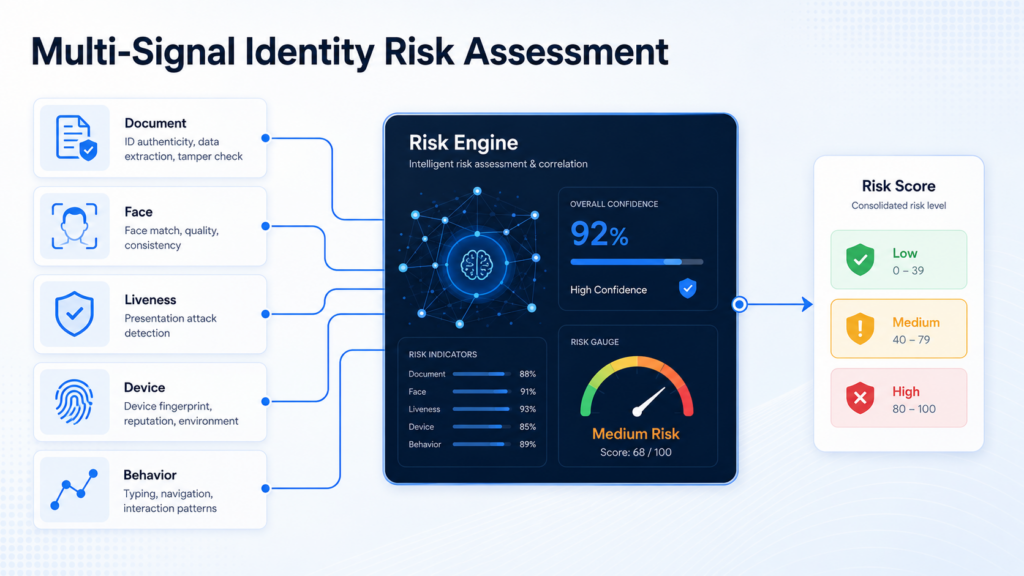
A robust risk-based onboarding framework combines several verification layers. Each layer contributes a different signal, and the final decision is based on the relationship between these signals rather than one isolated result.
1. Document Verification
The identity document remains the foundation of remote onboarding. However, extracting text from a document is not the same as verifying whether the document is authentic.
Document verification should check document structure, field consistency, layout integrity, image quality, security features, and signs of manipulation. This includes detecting cropped documents, screen recaptures, edited fields, abnormal fonts, tampered photos, inconsistent dates, and mismatches between machine-readable zones and visible fields where applicable.
For high-risk onboarding, document checks should also evaluate whether the document is likely to be an original capture or a secondary reproduction. Fraudsters often submit photos of photos, screenshots, or printed copies to bypass basic upload requirements. These signals can indicate a higher probability of synthetic or stolen identity use.
2. OCR and Cross-Field Validation
OCR helps extract key identity fields such as name, date of birth, ID number, expiry date, address, and document type. But OCR alone is not enough. The extracted data must be validated across fields and against document rules.
For example, issue dates and expiry dates should follow the expected format. ID numbers should match known structural patterns where applicable. Names, dates, and document numbers should remain consistent across the visual zone, barcode, MRZ, or other encoded areas when available.
Cross-field validation is especially important in remote onboarding because many manipulated documents contain small inconsistencies that may not be visible during manual review but can be detected through structured comparison.
3. Face Verification
Face verification confirms whether the person presenting the document is the same person shown in the document portrait. This is typically done through 1:1 face matching between the ID portrait and a live selfie or video frame.
In high-risk scenarios, face verification should not be treated as a standalone pass-or-fail check. The system should evaluate image quality, face similarity score, confidence level, lighting conditions, occlusion, and whether the face capture appears suitable for reliable comparison.
A moderate face match score may be acceptable for a low-risk session but should trigger step-up review if other signals also indicate risk, such as suspicious device behavior or document quality issues.
4. Liveness Detection
Liveness detection determines whether the captured face belongs to a real person physically present during onboarding. This layer is critical for defending against printed photos, screen replay, masks, video injection, and deepfake attacks.
Modern liveness detection should support both user experience and security. For mobile-first markets, passive or lightweight liveness can reduce friction for normal users, while stronger liveness checks can be applied when risk is elevated.
For high-risk onboarding, liveness should also be combined with injection attack detection. A realistic face video may still be fraudulent if it is injected through a virtual camera, emulator, or manipulated session environment.
5. Device and Session Risk
Identity fraud does not only appear in the document or face. Many fraud signals come from the device and session environment.
Device and session risk analysis can include device fingerprinting, IP reputation, proxy or VPN detection, geolocation consistency, time zone mismatch, emulator detection, virtual machine indicators, browser or app integrity, repeated device usage, and abnormal session patterns.
For example, multiple new accounts created from the same device cluster, the same IP range, or similar session fingerprints can indicate organized fraud. A single identity may appear legitimate, but the network behavior behind it may reveal a broader risk pattern.
6. Behavioral Risk Signals
Behavioral signals help identify whether the onboarding behavior looks natural or automated. These signals may include input speed, copy-paste behavior, touch patterns, form completion rhythm, repeated retries, abnormal navigation, and inconsistent interaction flows.
Behavioral analysis is valuable because fraudsters often optimize for speed and scale. Even when identity materials appear valid, the way users interact with the onboarding flow can indicate whether the session is genuine, scripted, or part of a coordinated attack.
Adaptive Decisioning: From Verification Results to Risk Outcomes
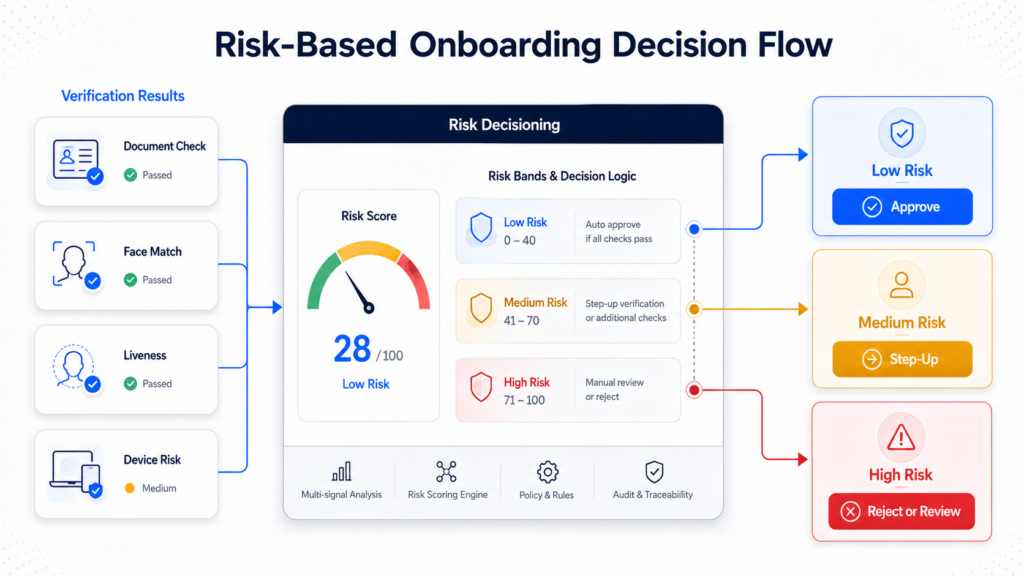
The key advantage of risk-based remote identity verification is adaptive decisioning. Instead of applying the same outcome to every user, the system routes users based on their risk level.
Low-risk users can be approved automatically when document, face, liveness, device, and behavior signals are consistent. This protects conversion and reduces unnecessary manual review.
Medium-risk users can be asked to complete step-up verification. This may include stronger liveness, additional document capture, proof of address, secondary authentication, or manual review.
High-risk users can be rejected, blocked, or escalated for investigation when multiple fraud indicators appear together. For regulated industries, these cases should also be logged with clear evidence for audit and compliance review.
This adaptive approach allows businesses to balance security and conversion. Strong controls are applied where they are needed most, while legitimate users can complete onboarding with minimal friction.
Building a Risk-Based Verification Strategy
To implement risk-based onboarding effectively, businesses should start by mapping their risk scenarios. A digital lending platform may prioritize recaptured document fraud, synthetic identities, and repeated loan applications. A wallet provider may focus on mule account creation and account takeover preparation. A mobility or marketplace platform may care more about fake driver accounts, duplicate users, and document ownership.
Once risk scenarios are defined, verification rules can be configured around signal combinations. For example:
A valid document plus strong face match plus clean liveness plus trusted device may lead to auto-approval.
A valid document plus low image quality plus VPN usage may trigger step-up verification.
A manipulated document plus failed liveness plus emulator usage may lead to rejection.
A repeated device linked to multiple identities may trigger fraud review even if the current document appears valid.
The most effective systems are not built around one rigid threshold. They are built around flexible policies, machine learning signals, configurable rules, and continuous feedback from fraud operations.
How FinAuth Supports High-Risk Online Onboarding
FinAuth is designed to support risk-based remote identity verification through an integrated eKYC and fraud risk framework. It combines document verification, OCR extraction, face verification, liveness detection, device and session risk analysis, behavioral signals, and a configurable risk engine.
Powered by advanced Large Visual Models, FinAuth can analyze identity documents, face captures, document textures, visual inconsistencies, and risk patterns across onboarding sessions. Its dual-engine liveness capability supports both edge-side and cloud-side verification, helping businesses balance real-time user experience with stronger anti-spoofing protection.
The platform also supports adaptive decisioning, allowing businesses to define risk levels, verification paths, manual review triggers, rejection rules, and audit requirements according to their market, industry, and compliance needs.
For enterprises operating in mobile-first and high-growth markets, FinAuth can support SDK and API integration, private or hybrid deployment, and multi-region identity verification strategies.
Conclusion
High-risk online onboarding cannot be secured through a single identity check. Fraud risk is distributed across the document, face, device, session, behavior, and network behind each user. A risk-based approach helps digital businesses understand these signals together and make better onboarding decisions.
By combining layered verification with adaptive risk scoring, businesses can reduce identity fraud, protect compliance workflows, improve approval accuracy, and maintain a smoother experience for legitimate users.
As digital onboarding continues to expand across financial services and other online platforms, risk-based remote identity verification is becoming a core capability for secure and scalable growth.