Expanding a digital business into a new market often creates a false choice: reuse one global KYC workflow that does not fit local requirements, or build a separate verification system for every country.
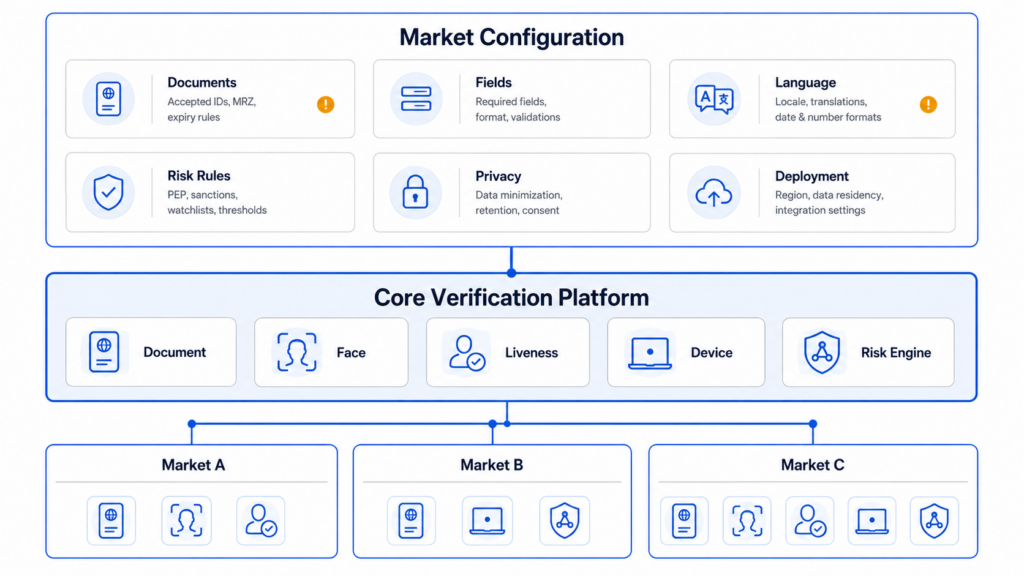
A more scalable approach separates the verification infrastructure from the market-specific configuration. Document verification, facial comparison, liveness detection, device intelligence, and audit logging can remain consistent, while accepted documents, data fields, risk rules, user guidance, and deployment policies are localized by market.
FinAuth supports this model through reusable SDK and API capabilities, configurable verification modules, and a Risk Engine that can apply different workflows without duplicating the underlying technology stack.
1. Start With a Common KYC Control Framework
Most KYC programs share several core objectives:
- Identify the customer.
- Validate identity evidence.
- Confirm that the evidence belongs to the applicant.
- Assess customer and transaction risk.
- Screen relevant parties.
- Maintain records and audit evidence.
- Apply ongoing monitoring or reverification when required.
However, countries implement these objectives through different legal, regulatory, and operational frameworks. FATF provides a common international foundation but explicitly recognizes that jurisdictions have different systems and must adapt the standards to their circumstances. FATF Recommendations
Global businesses should therefore standardize the control objective while localizing how that objective is achieved.
For example, the global requirement may be “validate reliable identity evidence.” A market policy then determines which documents or government digital identity sources are acceptable, which fields must be collected, and what additional evidence is required.
2. Separate the Core Platform From the Market Configuration
A scalable architecture can be divided into three layers.
Core verification layer: Reusable technical capabilities such as OCR, document authenticity analysis, Face Verification, Liveness Detection, injection detection, device intelligence, encryption, logging, and API orchestration.
Market configuration layer: Local document lists, required fields, language rules, risk thresholds, screening scope, retry policies, retention requirements, and escalation conditions.
Business workflow layer: The actions applied to a specific product, customer type, transaction, or risk level.
With FinAuth, businesses can maintain one technical integration while using configuration profiles such as:
- Market A consumer onboarding
- Market A high-value merchant onboarding
- Market B basic account opening
- Market B enhanced due diligence
- Market C account recovery
The modules remain reusable. What changes is the evidence collected, the order of checks, and the decision policy.
3. Localize Documents and Identity Data
Document coverage is one of the most visible differences between markets. A workflow may need to support national identity cards, passports, driving licences, residence permits, tax documents, or government-issued digital credentials.
Localization should define:
- Accepted document types and versions
- Mandatory front, back, or data-page capture
- Required OCR fields
- Local date and address formats
- Document-number structure
- MRZ, barcode, or chip validation
- Transliteration and native-script handling
- Document expiry and validity policies
- Authoritative data sources, where available
A standardized response schema should map local fields into common business attributes such as legal name, date of birth, document number, nationality, and address. The original local-language value should also be preserved when necessary for audit and screening.
FinAuth combines multi-market document classification, OCR, and authenticity analysis so businesses can expand document coverage without redesigning the complete onboarding journey.
4. Localize Language and Capture Experience
Translation alone does not create a localized verification experience.
Names may follow different ordering conventions, addresses may not use the same components, and some writing systems require transliteration. Users may also rely on different document types, camera capabilities, network conditions, and accessibility patterns.
The workflow should localize:
- Field labels and instructions
- Name order and character support
- Examples of acceptable documents
- Capture guidance for local document formats
- Error and retry messages
- Consent and privacy notices
- Accessibility and fallback pathways
- Network and image-upload behavior
FinAuth can return structured quality results for blur, glare, cropping, obstruction, orientation, and other capture problems. The customer interface can then present market-appropriate guidance rather than a generic verification failure.
This improves completion rates without changing document authenticity or biometric security controls.
5. Configure Risk-Based Verification by Market
Not every market, product, or customer should follow the same verification path.
Local risk configuration may consider:
- Customer and entity type
- Product access and transaction limits
- Geographic exposure
- Document and identity risk
- Sanctions, PEP, and watchlist requirements
- Device and session anomalies
- Remote onboarding risk
- Fraud history and linked accounts
- Events requiring enhanced due diligence or reverification
The FATF risk-based approach expects controls to be proportionate to identified risk and encourages simplified measures in lower-risk scenarios where local rules permit. FATF risk-based approach update
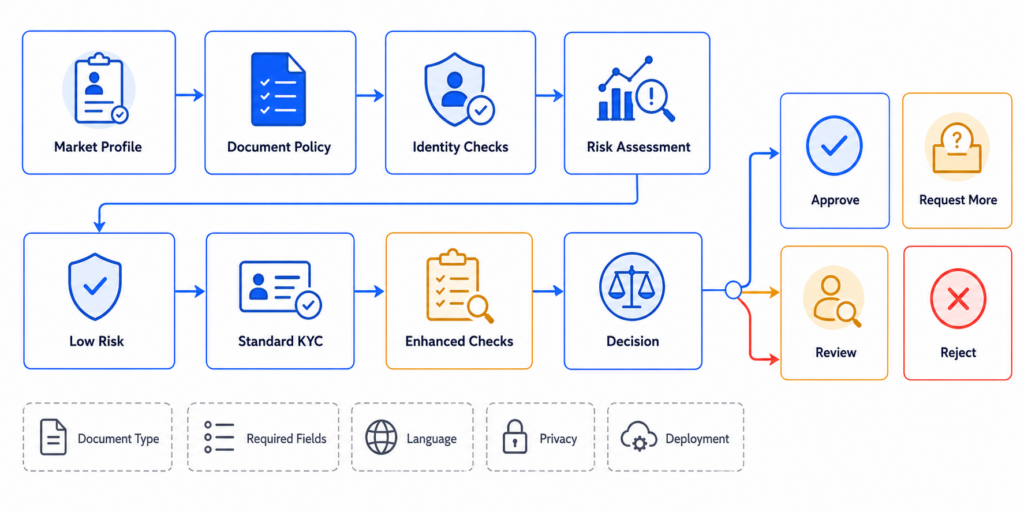
FinAuth’s Risk Engine can combine document, face, liveness, device, session, and behavioral signals to route users through different actions:
- Low risk: Streamlined onboarding
- Medium risk: Recapture or additional evidence
- High risk: Stronger liveness, full KYC, or enhanced due diligence
- Critical risk: Manual review, restriction, or rejection
The verification capabilities remain consistent, while the thresholds and actions are configured for the relevant market and use case.
6. Localize Privacy, Records, and Deployment
Markets may impose different requirements for biometric processing, customer consent, record retention, cross-border transfers, audit evidence, and data residency.
A localization profile should define:
- What data can be collected
- The purpose and legal basis for processing
- Which notices or consents are required
- Where data is processed and stored
- How long evidence and results are retained
- Who can access raw images and decisions
- What information must appear in an audit record
- When data must be deleted or anonymized
FinAuth supports private, hybrid-cloud, and edge deployment models, allowing businesses to align verification architecture with market-specific security and data-governance requirements.
Local legal and compliance teams should confirm the applicable obligations before launch and whenever regulations or regulatory guidance change.
7. Build a Repeatable Market Launch Process
A controlled rollout process reduces the risk of creating inconsistent country implementations.
First, map local requirements. Document the regulated entity, product, customer segment, accepted evidence, mandatory checks, and recordkeeping obligations.
Second, create a market profile. Configure documents, fields, languages, verification steps, risk policies, and deployment rules.
Third, test representative users. Evaluate local documents, scripts, devices, network conditions, demographics, and common capture environments.
Fourth, validate security and conversion. Measure completion, retry, false rejection, manual review, processing time, and confirmed fraud.
Fifth, maintain version control. Record which market policy was active for each decision and update configurations when documents, threats, or regulations change.
This converts localization into a governed product capability rather than a sequence of one-off engineering projects.
8. KYC Localization Q&A
Do KYC requirements vary by country?
Yes. Markets may differ in accepted identity evidence, required customer attributes, remote onboarding controls, screening obligations, recordkeeping, privacy rules, and risk-treatment requirements.
Does each country need a separate KYC system?
No. Businesses can reuse a common verification platform and apply market-specific configuration profiles for documents, fields, languages, workflows, and decision rules.
Which parts of a KYC workflow should remain standardized?
Core security capabilities—document authenticity, facial comparison, liveness, device intelligence, encryption, audit logging, and normalized API outputs—should generally remain consistent.
How does FinAuth support multi-market KYC?
FinAuth provides reusable document, biometric, device, and risk capabilities through SDKs and APIs. Businesses can configure local document coverage, workflow steps, risk thresholds, outcomes, and deployment models without rebuilding the full verification process.
How should businesses manage regulatory changes?
Store market rules as versioned configurations, assign local compliance ownership, monitor official updates, regression-test affected workflows, and preserve the policy version used for every decision.
9. Conclusion
Global KYC does not require one rigid workflow or a separate platform for every country. The scalable model is a shared verification foundation with configurable market policies.
By separating core security capabilities from local document, language, risk, privacy, and workflow requirements, FinAuth helps digital businesses enter new markets faster while maintaining consistent identity assurance and auditability.