Politically exposed person (PEP) screening helps businesses identify customers whose public functions, relationships, or financial exposure may require additional assessment. However, a possible PEP match is not proof of corruption, money laundering, or other wrongdoing.
When every name similarity becomes a manual case, screening queues expand quickly. Common names, incomplete watchlist profiles, transliteration differences, outdated records, and family or associate relationships can all generate alerts that lack sufficient context.
Effective automation should not simply suppress alerts. It should enrich possible matches with verified identity data, evaluate the customer’s actual risk, and send reviewers only the cases that require human judgment.
1. Why PEP Screening Creates Too Many Alerts
PEP screening commonly begins by comparing a customer’s name against external data sources. Name matching alone is imprecise because:
- Different people may share the same name.
- Names may appear in multiple scripts or transliterations.
- Middle names and surname order may vary.
- Dates of birth or nationalities may be incomplete.
- Watchlist records may contain aliases or historical positions.
- Family members and close associates may have indirect relationships.
Broad fuzzy-matching rules improve recall but can sharply increase false positives. Tightening the rules globally may reduce review volume, but it can also miss genuine matches.
The better approach is to preserve appropriate name matching while automatically using additional attributes to determine whether the alert is plausible.
2. Start with Reliable Customer Identity Data
PEP screening quality depends on the quality of the customer data entering the process. Incorrect OCR, manipulated documents, incomplete onboarding forms, or mismatched identities can make both matching and alert resolution less reliable.
FinAuth can establish a stronger identity foundation by:
- Extracting names, dates of birth, nationality, document numbers, and addresses through OCR.
- Assessing document type, layout, field consistency, and authenticity.
- Comparing the applicant’s face with the document portrait.
- Confirming genuine presence through Liveness Detection.
- Evaluating device and capture-integrity risks.
The screening engine can then compare PEP records against verified identity attributes rather than relying only on user-entered information.
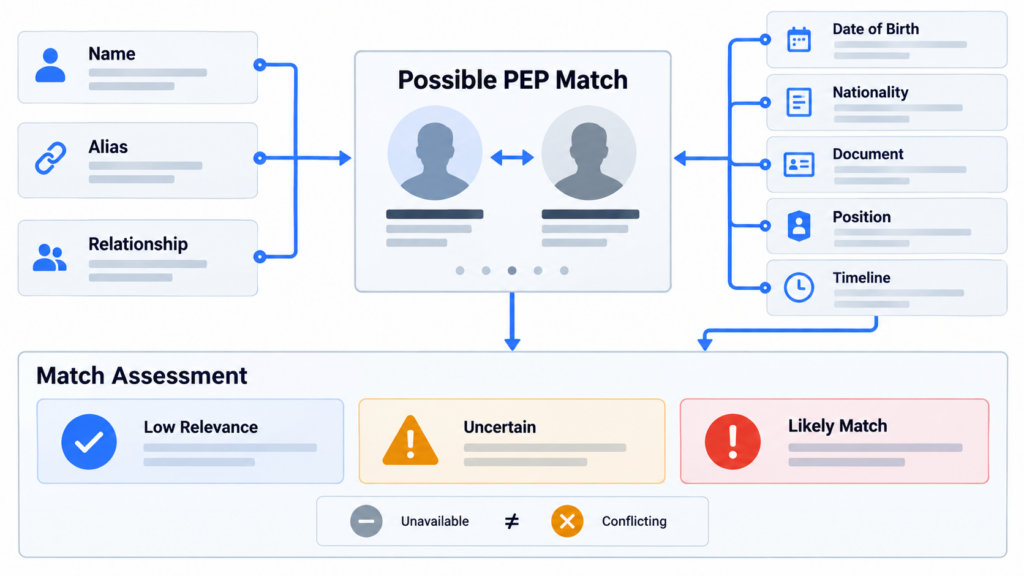
3. Resolve Possible Matches with Multiple Attributes
Automated matching should evaluate several attributes independently and preserve the evidence behind the result.
Name: Exact, phonetic, alias, transliteration, and reordered-name similarities.
Date of birth: Full match, partial match, conflict, or unavailable.
Nationality and geography: Consistency with the PEP profile and relevant political exposure.
Position: Current or former public function, seniority, institution, and applicable jurisdiction.
Relationship: Direct PEP, family member, close associate, or connected entity.
Timeline: Whether the position and relationship overlap with the customer’s history.
A close name match combined with conflicting birth date and nationality may be suitable for automated resolution under the organization’s policy. A moderate name match supported by aligned biographical data may require priority review.
“Unavailable” should remain distinct from “mismatched.” Missing evidence does not disprove a possible match.
4. Separate PEP Status from Customer Risk
PEP status should trigger risk assessment, not an automatic assumption of criminal activity.
FATF states that PEP requirements are preventive and should not be interpreted as implying that every PEP is involved in criminal activity. Its guidance also distinguishes the treatment of foreign, domestic, and international-organization PEPs and emphasizes appropriate risk-management systems. FATF Guidance on Politically Exposed Persons
The broader customer assessment may consider:
- Nature and seniority of the public function
- Geographic and institutional exposure
- Product and transaction risk
- Source of wealth and source of funds
- Beneficial ownership and connected parties
- Adverse information
- Expected account activity
- Device, behavioral, and network risk
- Internal investigation history
This separation prevents a screening label from becoming the final decision.
5. Build Risk-Based Automation Bands
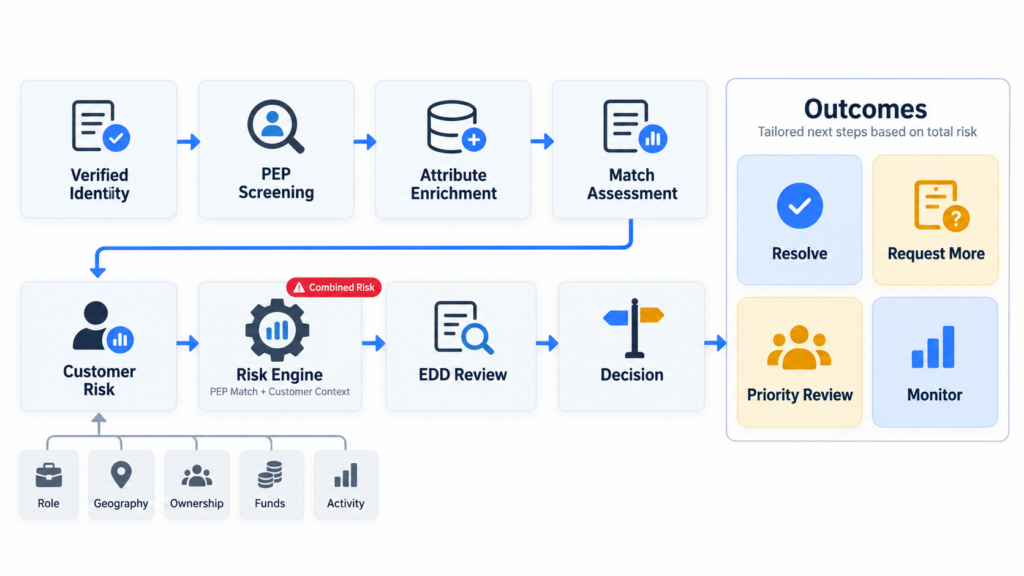
A practical workflow can divide alerts into decision bands.
Low relevance: Weak name similarity with strong conflicting attributes. Resolve automatically where policy permits and retain the explanation.
Uncertain: Plausible name match but insufficient supporting data. Request another attribute or route the case to a standard review queue.
Elevated: Multiple identity attributes align, or the relationship and public function create meaningful exposure. Perform enhanced due diligence and obtain appropriate approval.
Critical: Strong match combined with suspicious ownership, transactions, documents, devices, or adverse information. Prioritize investigation and consider restrictions according to policy and law.
FinAuth’s Risk Engine can combine identity-verification results with external PEP-screening outcomes, ownership information, device intelligence, behavioral signals, and transaction context. No single name score should determine the outcome alone.
6. Reduce Repeat Work Without Creating Blind Spots
The same false-positive alert may reappear during every screening cycle. Controlled reuse of previous decisions can reduce duplicate work, but it must account for change.
A reusable resolution record should include:
- The matched profile and customer identity
- Attributes compared
- Reason for resolution
- Reviewer or automated rule
- Decision date
- Data-source version
- Conditions requiring reopening
A case should be reopened when relevant PEP data changes, the customer updates identity information, ownership changes, new adverse information emerges, or account activity becomes inconsistent with the original assessment.
Automation should suppress only the duplicate work—not the detection of new risk.
7. Apply Ongoing and Event-Driven Screening
PEP exposure can change after onboarding. A customer may obtain a public function, become connected to another PEP, change beneficial ownership, or present new financial activity.
Ongoing controls can include:
- Periodic rescreening based on customer risk
- Screening after profile or ownership changes
- Event-driven checks before higher-risk transactions
- Monitoring of new PEP relationships
- Review after material adverse information
- Reassessment when source-of-funds patterns change
FinAuth can trigger proportionate reverification when screening risk changes, using document checks, Face Verification, Liveness Detection, additional evidence, or manual review as required.
8. PEP Screening Q&A
Is every PEP customer high risk?
No. PEP status indicates potential exposure that must be assessed under applicable rules and company policy. The customer’s role, geography, relationships, products, funds, and behavior determine the wider risk.
Can PEP screening be fully automated?
Data extraction, matching, enrichment, prioritization, and some false-positive resolution can be automated. Material or ambiguous matches may still require human judgment, enhanced due diligence, and approval.
How can businesses reduce PEP false positives?
Use verified identity attributes, document-aware name normalization, multi-field comparison, documented decision rules, and controlled reuse of prior resolutions.
How does FinAuth support automated PEP screening?
FinAuth strengthens the identity evidence entering the screening process and combines external PEP results with document, face, liveness, device, ownership, behavioral, and transaction signals through its Risk Engine.
9. Conclusion
Automating PEP screening should improve evidence and prioritization rather than weaken matching controls. Reliable identity data, multi-attribute resolution, risk-based decision bands, and controlled ongoing monitoring can reduce unnecessary review while preserving meaningful alerts.
FinAuth helps businesses connect PEP screening with verified identity and contextual risk, allowing lower-relevance alerts to be handled efficiently and higher-risk cases to receive appropriate scrutiny.