In digital onboarding, OCR is often viewed as a simple data extraction step: capture an identity document, recognize the text, and populate fields such as name, date of birth, document number, nationality, and expiry date. But in high-risk financial and digital service scenarios, OCR should not stop at reading text. It also needs to help determine whether the information on a document is internally consistent.
This is where cross-field OCR validation becomes important.
Cross-field OCR validation compares multiple extracted fields from the same document, and sometimes across multiple documents, to detect logical conflicts, formatting issues, and hidden signs of manipulation. Instead of checking each field in isolation, it evaluates whether the document data makes sense as a whole.
For eKYC workflows, this capability helps businesses identify suspicious documents, reduce manual review workload, and prevent fraudsters from passing onboarding with manipulated or inconsistent identity information.
Why Standard OCR Is Not Enough
Traditional OCR focuses on recognition accuracy. Its primary goal is to convert images into machine-readable text. For example, it may extract:
- Full name
- ID number
- Date of birth
- Gender
- Nationality
- Address
- Issue date
- Expiry date
This is necessary, but not sufficient.
A document may contain text that is readable, while still being suspicious. A fraudster may modify one field but forget to update another related field. They may alter the date of birth, document number, expiry date, or address to meet platform requirements. In some cases, they may use a template or edited image where individual fields look normal, but the overall document contains inconsistencies.
If the eKYC system only checks whether each field can be read, these cases may be missed. Cross-field validation adds another layer by asking a more important question: do all extracted fields align with the rules and logic of this document type?
What Cross-Field OCR Validation Means
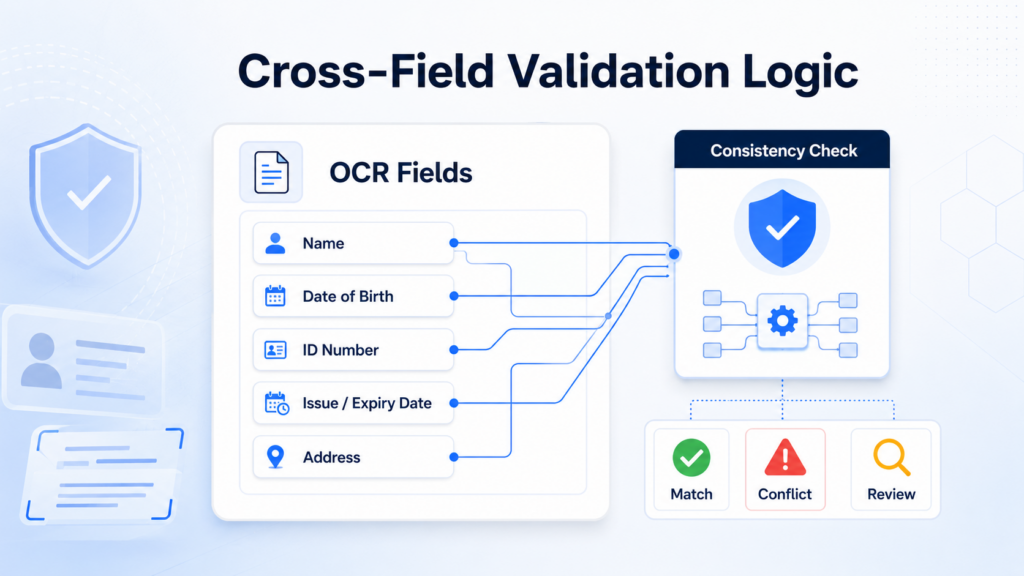
Cross-field OCR validation is the process of checking relationships between different OCR-extracted fields. It combines document structure knowledge, country-specific ID rules, field-level OCR confidence, and business logic to detect inconsistencies.
For example, the system may check whether:
- The date of birth matches the age implied by the ID number
- The expiry date is later than the issue date
- The document number follows the correct format for that country
- The gender field aligns with encoded information in the document number
- The nationality field matches the document type
- The name format is consistent across the visual zone and MRZ
- The address fields follow expected administrative divisions
- The same identity information remains consistent across ID card, driver’s license, and other supporting documents
These checks help turn OCR from a data entry tool into a risk control layer.
Common Document Inconsistencies Detected During eKYC
1. Date Conflicts
Date fields are among the most common sources of inconsistency. A valid document usually contains a date of birth, issue date, and expiry date. Cross-field validation can detect impossible or suspicious combinations.
For example, an expiry date that appears earlier than the issue date is clearly invalid. A date of birth that indicates the applicant is underage may conflict with business onboarding rules. A document issued before the applicant was born, or issued at an impossible age, may indicate tampering or OCR misread.
In some markets, document numbers may also encode birth date information. If the visible date of birth does not match the encoded date, the system can flag the document for review.
2. Document Number Format Issues
Many identity documents follow structured numbering rules. These rules may vary by country, region, document type, and issuing authority. A strong OCR validation system can check whether the extracted document number matches the expected format.
For example, certain IDs may require a fixed number of digits, specific prefix letters, checksum rules, or embedded regional codes. If the OCR result produces a document number that violates these rules, the issue may come from poor image quality, OCR error, or document manipulation.
Instead of accepting the extracted number directly, cross-field validation can assign a risk signal and trigger a retry, secondary recognition, or manual review.
3. Name Mismatch Across Zones
Some documents display the holder’s name in multiple zones, such as a printed visual inspection zone and a machine-readable zone. In other cases, a user may submit both an ID document and another document such as a driver’s license or proof of address.
Cross-field validation can compare these names and detect mismatches caused by editing, spelling differences, missing middle names, or reordered name components.
Not every mismatch means fraud. Different countries use different name structures, transliteration rules, and ordering conventions. The key is to distinguish acceptable variation from suspicious inconsistency. Advanced systems can normalize names before comparison, reducing false positives while still detecting meaningful conflicts.
4. Gender, Age, and Encoded Field Conflicts
In some document systems, gender, age, or region may be encoded in the ID number. Cross-field validation can compare these encoded values with visible fields.
For example, if the gender field says “Male” but the document number pattern indicates “Female,” the system can flag the inconsistency. If the applicant’s date of birth indicates one age, but the encoded data implies another, the document may require additional review.
These checks are especially useful because fraudsters often modify visible text but overlook hidden logic embedded in document numbers.
5. Address and Region Inconsistencies
Address validation can also reveal document issues. Some documents include province, city, district, postal code, or issuing authority information. These fields should usually align with each other.
For example, a postal code may not match the stated city. An issuing authority may not correspond to the region code in the document number. A district may not belong to the province shown on the document.
For businesses operating across Southeast Asia, Latin America, and other mobile-first markets, regional document rules can be complex. Cross-field validation helps standardize risk detection across different document formats and languages.
How Cross-Field OCR Validation Works in an eKYC Flow
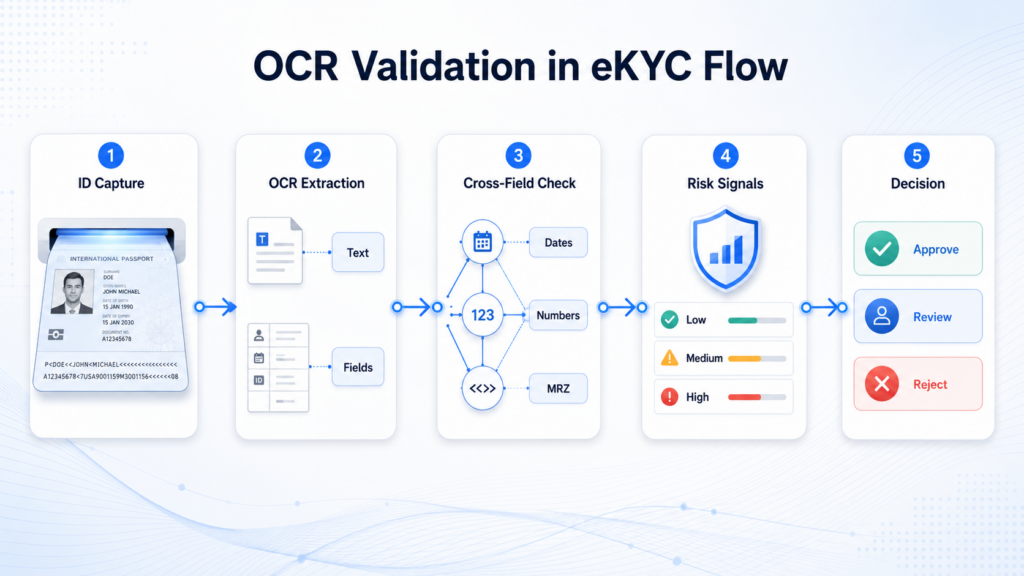
A typical eKYC workflow starts with document image capture. The system first checks image quality, including blur, glare, cropping, reflection, and screen recapture risks. Once the image is usable, OCR extracts key fields from the document.
After extraction, cross-field validation begins.
The system maps the extracted fields to the document type and country. It then applies validation rules, including format checks, date logic, checksum verification, field relationship checks, and cross-zone comparison. If the document includes an MRZ, barcode, QR code, or chip-derived data, the system can compare these structured data sources against visible text.
Each validation result becomes a risk signal. Low-risk documents can proceed automatically. Medium-risk cases may require user retry, additional document upload, or step-up verification. High-risk cases can be sent to manual review or rejected, depending on the business policy.
This creates a layered decisioning process rather than a binary OCR result.
Cross-Field Validation and Fraud Prevention
Cross-field validation is valuable because document fraud is rarely limited to one field. Fraudsters may use edited templates, synthetic identity data, reused documents, or partially manipulated images. In many cases, the manipulated field may look visually normal, but it does not align with other information on the document.
For example, a fraudster may change the date of birth to meet an age requirement. The text may be clear, and the image may pass basic quality checks. But if the ID number still encodes the original birth date, cross-field validation can detect the inconsistency.
Similarly, a user may submit a document where the name was edited on the front side, but the MRZ or barcode still contains the original name. Cross-field validation can compare these zones and expose the mismatch.
This is why cross-field validation is an important complement to document authenticity checks, face verification, and liveness detection. It does not replace these layers. Instead, it adds a logic-based document intelligence layer that helps identify risks that may not be visible from OCR confidence alone.
Reducing Manual Review Without Increasing Risk
Manual review is expensive and slow. But fully automated onboarding can create risk if the system accepts documents based only on OCR readability.
Cross-field validation helps balance automation and control. Clear and consistent documents can pass faster. Documents with minor OCR uncertainty can be routed to retry or secondary recognition. Documents with serious logical conflicts can be escalated for review.
This improves both conversion and fraud prevention. Legitimate users are less likely to be delayed by unnecessary manual checks, while suspicious submissions receive appropriate scrutiny.
For financial institutions, fintech platforms, digital lenders, e-wallets, mobility platforms, and online marketplaces, this balance is critical. Onboarding needs to be fast, but not blind.
What Businesses Should Look For
When evaluating OCR for eKYC, businesses should look beyond basic extraction accuracy. A production-ready document OCR system should support:
- Country- and document-specific field rules
- Date and format validation
- MRZ, barcode, or QR code comparison when available
- Cross-document consistency checks
- OCR confidence scoring at field level
- Risk-based decision outputs
- Integration with document authenticity checks, face matching, liveness detection, and device risk
The goal is not just to read documents, but to understand whether the identity data is reliable.
Conclusion
Cross-field OCR validation turns document OCR into a stronger eKYC risk control capability. By checking relationships between names, dates, document numbers, addresses, MRZ data, and other extracted fields, it helps detect inconsistencies that standard OCR may miss.
As digital onboarding expands across markets with different document formats and fraud patterns, businesses need more than accurate text recognition. They need document intelligence that can evaluate whether extracted information is complete, consistent, and trustworthy.
For modern eKYC, OCR is no longer just about reading fields. It is about validating identity data in context.