For years, fintech companies treated identity verification as a compliance checkpoint. The goal was simple: verify the ID document, compare the selfie with the ID portrait, and pass the user through onboarding as quickly as possible.
That model is no longer enough.
Generative AI has changed the economics of identity fraud. Fraudsters no longer need to rely only on printed photos, screen replays, or low-quality spoofing attempts. They can now use AI-generated faces, deepfake videos, synthetic identity packages, virtual cameras, emulators, and injection tools to attack the onboarding process at scale.
This is why identity fraud prevention is moving from basic KYC verification to AI-powered trust decisioning. Gartner has predicted that by 2026, attacks using AI-generated deepfakes on face biometrics will make 30% of enterprises no longer consider identity verification and authentication solutions reliable in isolation.
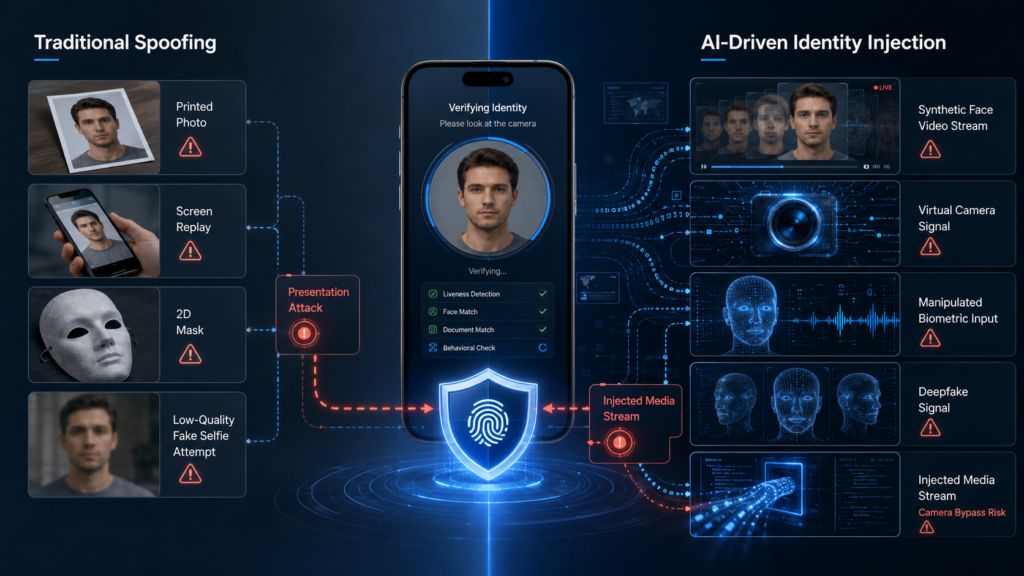
For fintech platforms, the issue is not only whether a face matches an ID. The more important question is whether the biometric input, device environment, document evidence, and session behavior can be trusted together.
Why Identity Injection and Deepfakes Are Harder to Stop
Traditional spoofing attacks are usually visible at the presentation layer. A fraudster may hold up a printed photo, replay a video from another screen, or use a mask in front of the camera. These attacks can often be addressed by liveness detection and presentation attack detection.
Identity injection attacks are different.
Instead of presenting fake content to the camera, attackers may try to bypass the live capture process and feed manipulated images or videos directly into the verification system. Entrust describes injection attacks as a technique that allows fraudsters to bypass live capture by feeding manipulated images or videos directly into verification systems.
That means fraud prevention must cover more than the face itself. A resilient system should assess whether the capture channel is genuine, whether the session is occurring in a trusted device environment, whether biometric signals are live and consistent, and whether the identity evidence aligns with broader fraud patterns.
Below are five AI fraud detection and identity verification platforms that are relevant for fintech companies evaluating deepfake and identity injection defense.
1. iProov
iProov is one of the most recognized biometric identity verification providers focused on high-assurance remote verification. Its positioning is strongly centered on protecting organizations against deepfakes, replay attacks, and real-time video injection attacks.
The company highlights threats such as deepfake-driven fraud and real-time video injection attacks in its threat intelligence messaging, emphasizing that AI has industrialized deception and changed the speed and scale of identity attacks. iProov has also reported on emerging video injection tools designed for sophisticated deepfake attacks, showing how fraud is moving beyond simple spoofing into more advanced biometric manipulation.
iProov is particularly relevant for organizations that require strong assurance that the person being verified is real, present, and not using digitally manipulated media. Its technology is often discussed in the context of government, financial services, travel, and other high-security identity use cases.
Best fit:
iProov is a strong option for regulated financial institutions, banks, government-linked identity programs, and high-assurance authentication scenarios.
Key strengths:
Its main advantage is depth in biometric assurance. For fintech companies that need stronger protection against deepfake video and injection risks, iProov provides a specialized biometric layer rather than a broad compliance-only KYC workflow.
2. Jumio
Jumio is a well-established identity verification provider serving fintech, financial services, travel, gaming, and online marketplaces. Its platform combines ID verification, biometric verification, risk signals, and compliance workflows.
Jumio’s Liveness Premium solution is positioned for advanced liveness detection, using patented active illumination technology to help protect against deepfakes, injection attacks, and presentation attacks. Jumio also states that its liveness solution has achieved ISO/IEC 30107-3 Level 2 PAD conformance through iBeta testing.
This makes Jumio relevant for fintech companies that need a mature identity verification provider with broad onboarding coverage and enhanced biometric fraud detection.
Best fit:
Jumio is suitable for fintech companies looking for a mature global identity verification provider with broad document coverage, established compliance workflows, and enhanced liveness capabilities.
Key strengths:
Jumio’s strength is enterprise maturity. For organizations that need global KYC coverage, onboarding workflow support, and risk-based decisioning, Jumio is a strong candidate.
3. Sumsub
Sumsub is an all-in-one verification platform covering identity verification, business verification, AML screening, transaction monitoring, case management, and fraud prevention. For fintech companies, this makes Sumsub relevant when identity risk needs to be managed across the full user lifecycle, not only at onboarding.
Its deepfake detection solution is positioned around AI-powered liveness and biometric verification. Sumsub states that its technology can detect up to 99.98% of deepfakes on the first try and supports integration through Web SDK, Mobile SDK, API, and no-code onboarding links.
This full-stack positioning is useful for fintech companies that need more than biometric fraud detection. Many fraud cases involve a combination of forged documents, synthetic identities, suspicious device behavior, mule accounts, and transaction anomalies. A broader verification and monitoring platform can help connect these risk signals.
Best fit:
Sumsub is a good fit for fintech, crypto, marketplace, gaming, and payment platforms that need an integrated compliance and fraud prevention stack.
Key strengths:
Its advantage is breadth. Sumsub can support identity verification, AML workflows, fraud signals, and ongoing monitoring in one platform, which is useful for companies that want to reduce vendor fragmentation.
4. Entrust IDV / Onfido
Entrust IDV, strengthened by its Onfido identity verification capabilities, is another major player in digital identity verification. It focuses on document verification, biometric verification, liveness detection, fraud prevention, and identity orchestration.
Entrust’s 2026 Identity Fraud Report highlights global identity fraud threats including GenAI, deepfakes, document fraud, synthetic identities, and fraud-as-a-service. Entrust has also reported that injection attacks enable fraudsters to bypass live capture processes by feeding manipulated images or videos directly into verification systems.
Entrust’s Motion Liveness technology uses iBeta PAD Level 2 compliant liveness technology and is positioned to protect against sophisticated digital spoofs, display attacks, and 2D and 3D masks.
Best fit:
Entrust IDV is suitable for enterprises, banks, fintech companies, and regulated platforms that need identity verification as part of a broader identity security and trust infrastructure.
Key strengths:
Its strength is enterprise-grade identity infrastructure. For organizations that already think in terms of identity lifecycle, compliance, and security architecture, Entrust IDV can fit into a broader digital trust strategy.
5. FinAuth
FinAuth is designed for financial-grade identity verification, with a focus on AI-powered onboarding fraud prevention. For fintech companies, its value lies in combining document verification, face comparison, liveness detection, device risk detection, deepfake attack detection, and AML screening into a unified eKYC workflow.
A typical FinAuth-powered verification flow can verify the user’s identity document, compare the live face against the document portrait, assess liveness, and detect abnormal biometric inputs that may indicate spoofing, deepfake manipulation, or injection attacks. These signals can support risk-based decisions such as approve, reject, retry, or escalate for manual review.
This makes FinAuth especially relevant for fintech scenarios where onboarding needs to balance fraud control, compliance, and conversion rate. Instead of treating identity verification as a single pass-or-fail step, FinAuth positions identity checks as part of a broader anti-fraud decision layer.
For banks, lending platforms, e-wallets, payment companies, and digital financial services providers, this approach is important because deepfake-era fraud cannot be solved by face comparison alone. Identity verification needs to connect document authenticity, biometric matching, liveness, device risk, and business rules into one coordinated trust decision.
Best fit:
FinAuth is suitable for fintech platforms, digital banks, lending apps, e-wallets, payment platforms, and other financial onboarding scenarios that need stronger protection against AI-generated identity fraud.
Key strengths:
FinAuth supports a multi-signal identity verification approach, combining document intelligence, face matching, liveness analysis, device risk detection, and deepfake-aware biometric risk control. This makes it a practical option for fintech teams looking to strengthen onboarding security without adding unnecessary friction to legitimate users.
What Fintech Companies Should Evaluate Before Choosing a Platform
The best AI fraud detection platform depends on risk exposure, market, compliance requirements, onboarding volume, and internal risk operations. However, fintech companies should avoid evaluating vendors only by selfie match accuracy or document coverage.
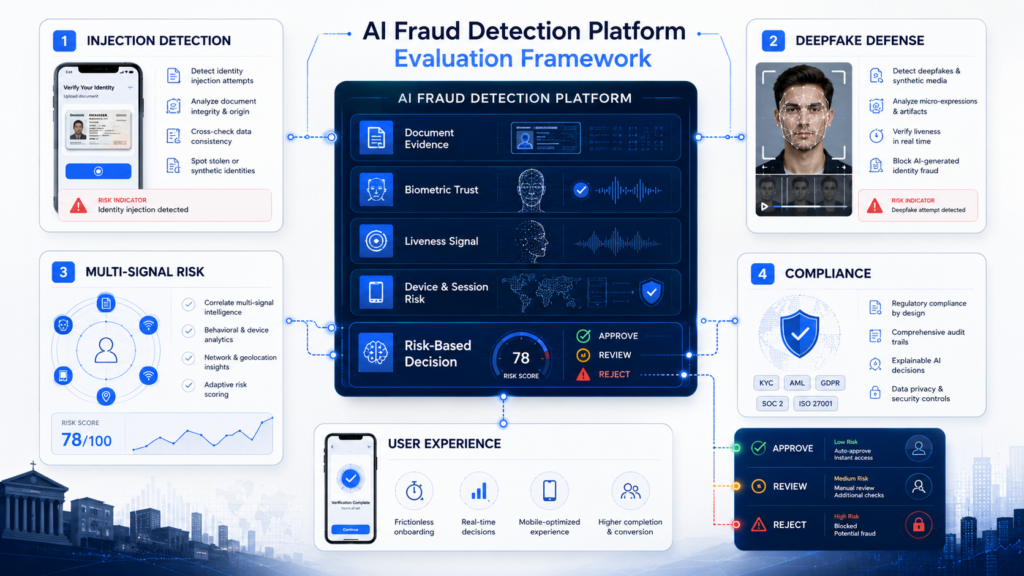
A more practical evaluation framework should include five questions.
First, can the platform detect both presentation attacks and injection attacks? Liveness detection is important, but injection attacks may bypass the camera layer entirely.
Second, does the system analyze multiple signals? Strong identity fraud prevention should combine document authenticity, face comparison, liveness, device risk, session integrity, and behavioral anomalies.
Third, can the workflow support risk-based decisions? Not every suspicious attempt should create the same response. Some cases should be rejected immediately, while others may require retry, step-up verification, or manual review.
Fourth, does the platform support fintech-grade compliance and auditability? Financial institutions need explainable decision logs, configurable policies, and evidence that can support internal risk review.
Fifth, can the solution maintain user experience? Fraud prevention that creates excessive friction can increase onboarding drop-off, especially in mobile-first fintech markets.
Final Thoughts
Deepfakes and identity injection attacks are forcing fintech companies to rethink digital onboarding. The old model of document OCR plus selfie comparison is no longer sufficient when attackers can generate realistic faces, manipulate video streams, and industrialize onboarding fraud.
Platforms such as iProov, Jumio, Sumsub, Entrust IDV, and FinAuth reflect the direction of the market: identity verification is becoming a multi-layer trust engine.
For fintech companies, the winning approach is not to add one more liveness check. It is to build an identity fraud defense system that can verify the person, validate the document, protect the capture channel, detect synthetic media, and make risk-based decisions in real time.
In the AI fraud era, identity verification is no longer just a compliance requirement. It is a core layer of financial risk infrastructure.