Deepfake fraud is no longer a future-facing risk for KYC teams. It is becoming a practical onboarding threat: fake faces, synthetic videos, injected camera streams, and manipulated identity documents are now being used to attack digital account opening at scale.
For banks, fintech platforms, e-wallets, lending apps, and digital payment providers, the challenge is not simply whether a user can pass a face match. The real question is whether the entire onboarding session can prove three things at the same time: the document is valid, the face belongs to the document holder, and the person completing verification is a real human physically present in the session.
That is why deepfake fraud prevention in KYC needs to move beyond isolated liveness checks. It requires AI identity verification built as a multi-layer trust architecture.
Why deepfake fraud is reshaping KYC risk
Traditional KYC workflows were designed for a different fraud environment. Many systems were built to detect fake documents, simple photo spoofing, replayed videos, or inconsistent identity information. These controls still matter, but they are no longer enough.
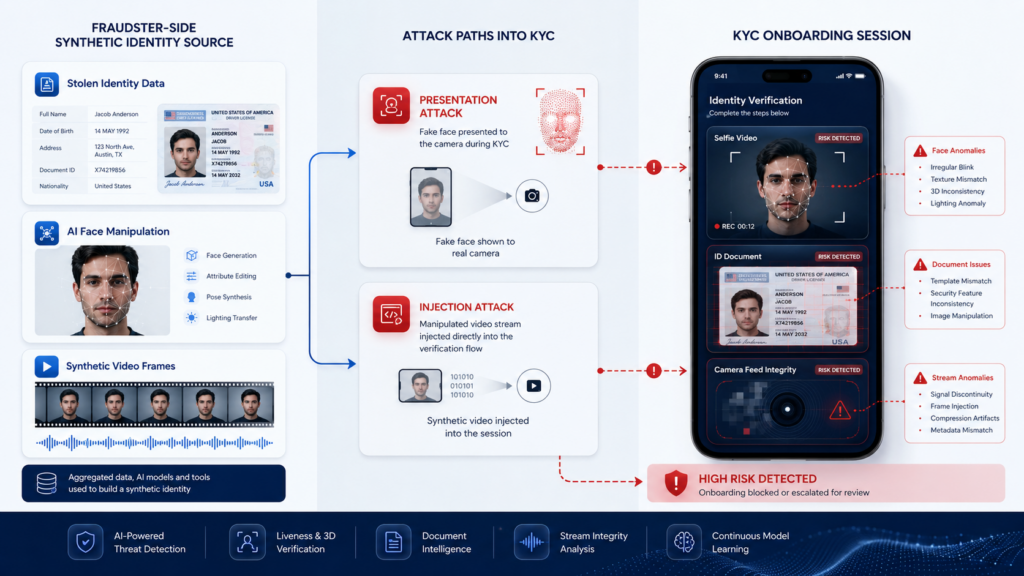
Generative AI has lowered the barrier for attackers. A fraudster may no longer need to physically possess a high-quality fake ID or film a live impersonator. With stolen identity data, profile images, and AI face manipulation tools, they can generate realistic onboarding materials that look legitimate to basic verification systems.
Deloitte has warned that generative AI could significantly increase deepfake-driven banking fraud, with U.S. fraud losses potentially reaching $40 billion by 2027, up from $12.3 billion in 2023. Sumsub’s 2025 identity fraud report also shows that global identity fraud remains elevated, with online media, financial services, and crypto among the sectors under continued pressure.
The attack surface is also expanding from presentation attacks to injection attacks. Instead of showing a fake face to a real camera, attackers can attempt to bypass the camera pipeline itself and inject synthetic video directly into the verification flow. iProov’s 2026 threat intelligence update reported a sharp rise in digital injection attacks, including a 741% annual increase and a 1,151% surge in iOS-targeted injection attacks in the second half of 2025.
This shift changes the KYC problem. The system can no longer ask only, “Does this face match the ID photo?” It must also ask, “Is this biometric signal real, live, untampered, and consistent with the full identity context?”
The weakness of single-point KYC controls
A fragmented KYC stack often creates blind spots. One vendor may handle document OCR. Another may perform face comparison. A separate tool may check liveness. Risk scoring may happen later, outside the verification session.
This structure can work for basic compliance, but it is vulnerable to AI-enabled fraud because each control sees only part of the attack.
A deepfake attack does not always fail at the face match layer. In many cases, that is the attacker’s goal: to create a synthetic face that appears similar enough to the real document holder. A basic match result may therefore become a false signal of trust if it is not evaluated together with liveness, injection detection, document authenticity, device behavior, and risk context.
Similarly, a basic liveness check may not be enough if it only detects simple photo or screen replay attacks. Deepfake fraud can involve real-time face swaps, synthetic motion, manipulated video streams, or camera feed tampering. In this environment, “live-looking” is not the same as “trusted.”
KYC teams should treat identity verification as a decisioning system, not a single checkpoint.
What AI identity verification should do differently
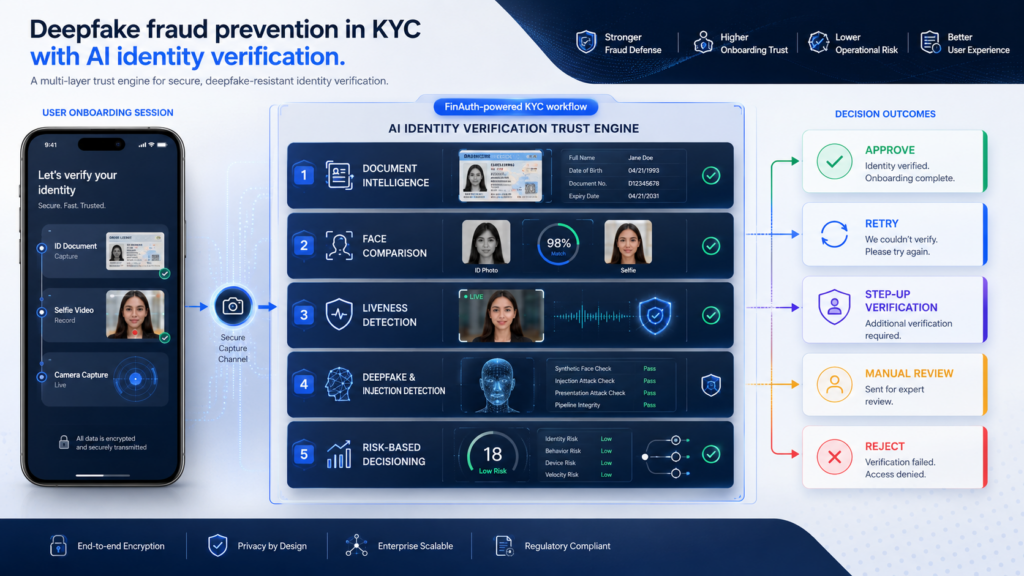
AI identity verification improves deepfake fraud prevention by combining multiple signals into one coordinated workflow. Instead of relying on a single pass/fail result, the system evaluates whether the identity, biometric input, session behavior, and risk profile are consistent.
A strong KYC architecture should include five layers.
First, document intelligence verifies whether the submitted ID is readable, complete, and structurally valid. This includes OCR extraction, document classification, field consistency checks, and tamper detection.
Second, face comparison checks whether the selfie or video face matches the portrait on the identity document. This remains a core biometric step, but it should not operate alone.
Third, liveness detection determines whether the user is physically present. Modern KYC systems increasingly need passive or low-friction liveness methods that reduce user drop-off while still defending against spoofing.
Fourth, deepfake and injection detection examine whether the biometric input has been synthetically generated, manipulated, replayed, or injected into the camera stream.
Fifth, risk-based decisioning connects identity signals with business rules. A low-risk user may complete onboarding smoothly, while suspicious sessions can trigger step-up verification, manual review, or rejection.
This layered model matters because deepfake fraud is adaptive. Attackers test systems, learn which checks are weak, and optimize their materials accordingly. Static rules and isolated checks are easier to bypass. Multi-signal AI verification raises the cost of attack.
From compliance workflow to fraud prevention engine
For many businesses, KYC started as a regulatory requirement. The goal was to collect user identity information, verify documents, and satisfy onboarding rules.
That mindset is no longer sufficient. KYC is now part of the fraud prevention infrastructure.
A digital bank may use KYC to prevent mule accounts. An e-wallet may use it to stop bonus abuse or account farming. A lending platform may use it to reduce synthetic identity applications. A crypto platform may use it to protect withdrawals, account recovery, and high-risk transactions. In each case, the cost of weak identity verification is not limited to onboarding. It can affect transaction risk, credit loss, compliance exposure, and user trust.
AI identity verification enables KYC teams to make more precise decisions. Instead of applying the same verification friction to every user, platforms can use risk-based flows. Legitimate users receive a smoother experience. Suspicious users face stronger checks. High-risk cases are escalated before they become financial losses.
This is where deepfake fraud prevention becomes a business advantage. A better KYC system does not only block more fraud. It also protects conversion rates, reduces manual review pressure, and creates a more scalable foundation for digital growth.
How FinAuth supports deepfake-resistant KYC
FinAuth is designed for financial-grade identity verification across KYC, onboarding, and risk control scenarios. It combines document OCR, facial recognition, liveness detection, and real-time identity authentication into an end-to-end verification workflow.
For deepfake fraud prevention, the key is not adding one more isolated detection module. The key is connecting identity evidence into a unified trust decision.
In a typical FinAuth-powered KYC flow, the platform can verify the user’s identity document, compare the live face against the ID portrait, assess liveness, and detect abnormal biometric inputs that may indicate spoofing, deepfake manipulation, or injection attacks. These signals can then support a risk-based result: approve, reject, retry, or escalate for manual review.
This helps businesses address two competing priorities at the same time. On one side, fraud teams need stronger defense against AI-generated attacks. On the other side, product teams need a smooth onboarding experience that does not create unnecessary friction for legitimate users.
FinAuth’s approach is built around that balance: stronger identity trust without turning every onboarding session into a high-friction review process.
Yuanli Technology has also continued to invest in deepfake liveness research. A FinAuth algorithm team paper on AIGC deepfake liveness detection was accepted by the 2025 International Joint Conference on Neural Networks and indexed by IEEE, reflecting ongoing R&D focus on AI-generated face attack defense.
What KYC leaders should prioritize in 2026
The most important step is to stop treating deepfake detection as a narrow add-on. Deepfake fraud affects the full identity lifecycle, from onboarding to account recovery and high-risk transactions.
KYC leaders should review whether their current stack can detect both presentation attacks and injection attacks. They should also evaluate whether document verification, face comparison, liveness, and risk scoring operate as one coordinated system or as disconnected checkpoints.
Another priority is user experience. Stronger security should not automatically mean more friction. Passive liveness, adaptive verification, and risk-based orchestration can help platforms protect high-risk sessions while keeping trusted users moving.
Finally, businesses should build for continuous model improvement. Deepfake tools will keep evolving. A KYC system that performs well today must also be able to adapt to new attack patterns tomorrow.
Deepfake fraud prevention is not a one-time compliance upgrade. It is an ongoing identity intelligence capability.
Conclusion
Deepfake fraud has changed the rules of KYC. Verifying a document and matching a face are still necessary, but they are no longer sufficient on their own.
Modern KYC needs AI identity verification that can understand the full context of an onboarding session: document authenticity, biometric match, liveness, media integrity, injection risk, and business-level risk signals.
For financial institutions and digital platforms, the goal is not simply to detect fake faces. The goal is to establish identity trust at scale.
FinAuth helps businesses move toward that model by combining AI-powered document verification, facial recognition, liveness detection, and deepfake-resistant risk control into a unified KYC workflow.
In the AI fraud era, identity verification must become more than a gate. It must become a real-time trust engine.
FAQ
What is deepfake fraud in KYC?
Deepfake fraud in KYC refers to the use of AI-generated or AI-manipulated facial images, videos, or camera streams to impersonate a real person during identity verification. It can be used to open fake accounts, bypass onboarding checks, or take over existing accounts.
Why are traditional KYC systems vulnerable to deepfakes?
Traditional KYC systems often rely on isolated checks such as document OCR, face matching, or basic liveness detection. Deepfake attacks can exploit gaps between these controls, especially when biometric signals are not evaluated together with media integrity, injection risk, and broader identity context.
Is liveness detection enough to prevent deepfake fraud?
Liveness detection is essential, but it should not be the only defense. Effective deepfake fraud prevention also requires face comparison, document verification, injection detection, risk scoring, and adaptive decisioning.
How does AI identity verification improve KYC security?
AI identity verification combines multiple signals across the onboarding journey. It can detect suspicious documents, compare faces, assess whether the user is live, identify manipulated biometric inputs, and support risk-based decisions in real time.
How can businesses reduce fraud without hurting onboarding conversion?
Businesses can use risk-based verification. Low-risk users can complete onboarding with minimal friction, while suspicious sessions can trigger stronger checks, retries, or manual review. This helps balance fraud prevention with customer experience.