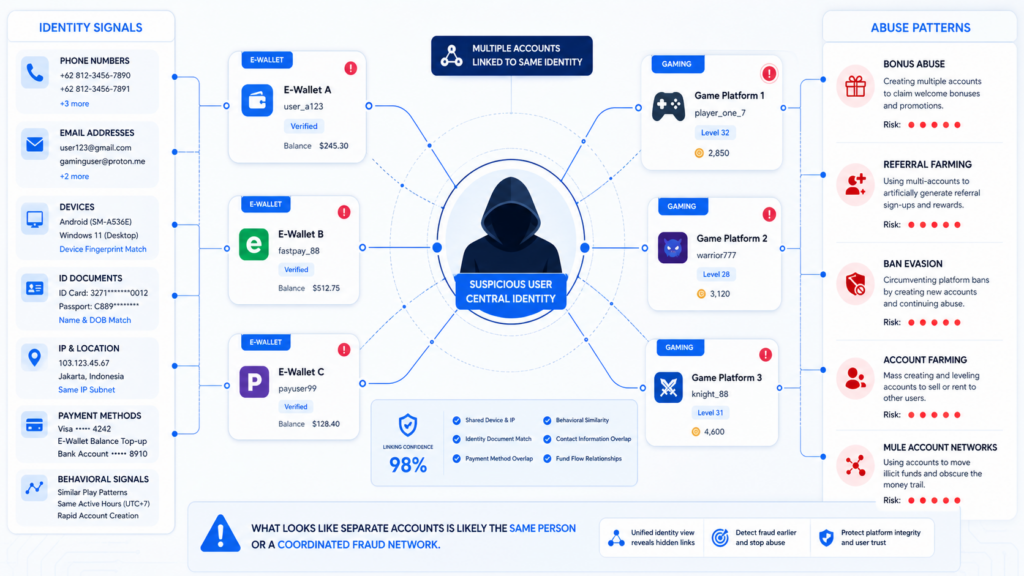
Multi-account abuse has become one of the most persistent risk challenges for digital platforms. In e-wallets, it often appears as promotion abuse, referral farming, bonus exploitation, mule account networks, and repeated onboarding under different identities. In gaming platforms, it can take the form of bonus abuse, smurfing, ban evasion, account farming, payment fraud, and real-money trading operations.
At first glance, these activities may look like isolated user behavior. One user signs up with a new phone number. Another creates a new account after a device reset. A third submits a different document or slightly modified profile information. However, when these signals are connected, they often reveal a broader pattern: the same individual or organized group operating multiple accounts to bypass platform rules, monetize incentives, or avoid risk controls.
Traditional account security tools were not designed for this level of identity manipulation. Phone number verification, email verification, password controls, and device fingerprinting can all help, but each signal has limitations when used alone. Fraudsters can rotate phone numbers, spoof devices, use emulators, modify IP addresses, or submit synthetic identity materials. As digital fraud becomes more industrialized, platforms need a stronger identity layer that can connect users, documents, faces, devices, and behaviors into a more reliable risk decisioning framework.
This is where AI identity verification becomes critical.
Why Multi-Account Abuse Is Hard to Detect
Multi-account abuse is difficult because it usually does not start with an obvious attack. In many cases, each account appears to pass basic onboarding checks. The user may have a valid-looking phone number, a new email address, a clean device environment, and a plausible document image. The risk only becomes visible when the platform compares this account against a broader identity context.
For e-wallet platforms, the financial impact can be direct. Multiple accounts can be used to collect sign-up rewards, exploit promotional campaigns, split transaction limits, move funds through layered account networks, or create mule accounts for fraud operations. When these accounts remain undetected, the platform may face higher fraud losses, compliance pressure, and reputational risk.
For gaming platforms, the abuse pattern is different but equally damaging. Fraudsters may create multiple accounts to bypass bans, manipulate rankings, farm in-game assets, abuse free trials, exploit payment systems, or support real-money trading networks. These activities undermine platform fairness, damage player trust, and increase operational costs for moderation and risk teams.
The common challenge across both industries is that account-level controls are not enough. Platforms need to understand whether a “new account” is truly a new user, or simply another node in an existing identity network.
From Account Verification to Identity Verification
A platform account is easy to create. A real-world identity is much harder to replicate at scale.
This distinction is the foundation of modern identity risk control. Instead of only asking whether an account has passed basic registration requirements, platforms need to ask deeper questions:
Is this user linked to another previously verified identity?
Has this face appeared across multiple accounts or documents?
Does the submitted document match the user’s live face?
Is the onboarding process showing signs of injection, replay, emulator, or deepfake activity?
Does the user’s behavior match normal onboarding patterns, or does it resemble a coordinated fraud operation?
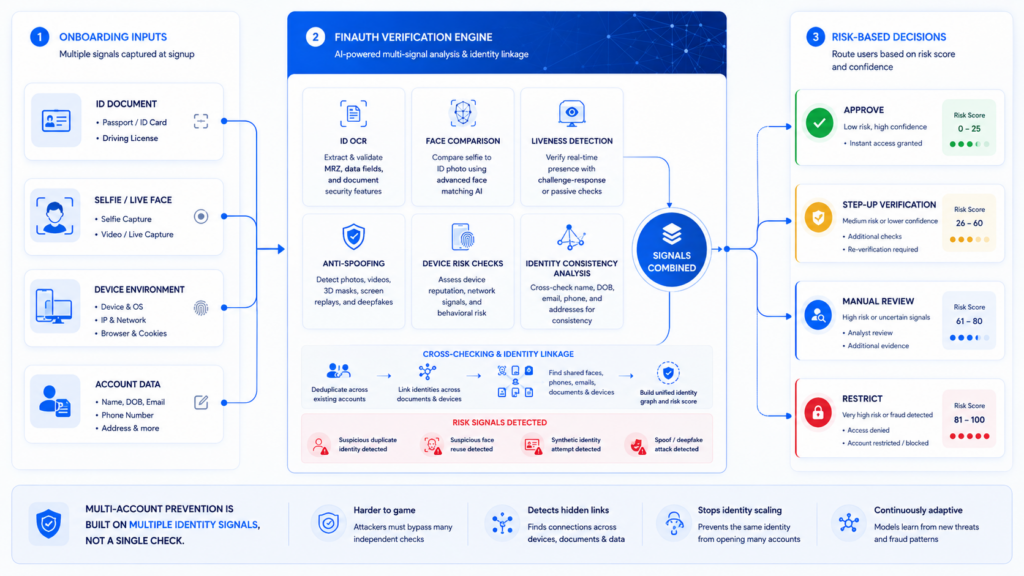
AI identity verification helps answer these questions by combining several capabilities: ID document recognition, liveness detection, face comparison, device risk checks, and identity consistency analysis. Rather than relying on a single signal, the system evaluates whether the user, document, face, and interaction environment are consistent with a real and unique person.
For high-growth platforms, this approach is especially important because fraud controls must scale without creating unnecessary friction for legitimate users. A good identity verification strategy should not block every suspicious signal automatically. Instead, it should classify risk, trigger step-up verification when needed, and support manual review for complex cases.
The Role of AI in Multi-Account Risk Detection
AI identity verification improves multi-account defense in three major ways: it strengthens user uniqueness, detects presentation and injection attacks, and connects identity signals across the user lifecycle.
The first layer is user uniqueness. During onboarding, AI-based ID OCR can extract structured information from identity documents, while face comparison checks whether the face on the document matches the live user. This helps prevent basic impersonation and document misuse. However, the value goes beyond one-time verification. When the same face, document, or identity attributes appear repeatedly across different accounts, the platform can identify potential duplicate registrations or coordinated abuse.
The second layer is liveness and anti-spoofing. Multi-account fraud is often supported by attack tools such as printed photos, screen replays, face masks, video injection, virtual cameras, and increasingly AI-generated facial content. Basic selfie checks are no longer sufficient. Modern liveness detection needs to evaluate whether the user is a real person physically present in front of the camera, while also detecting signals from deepfake, replay, and injection-based attacks.
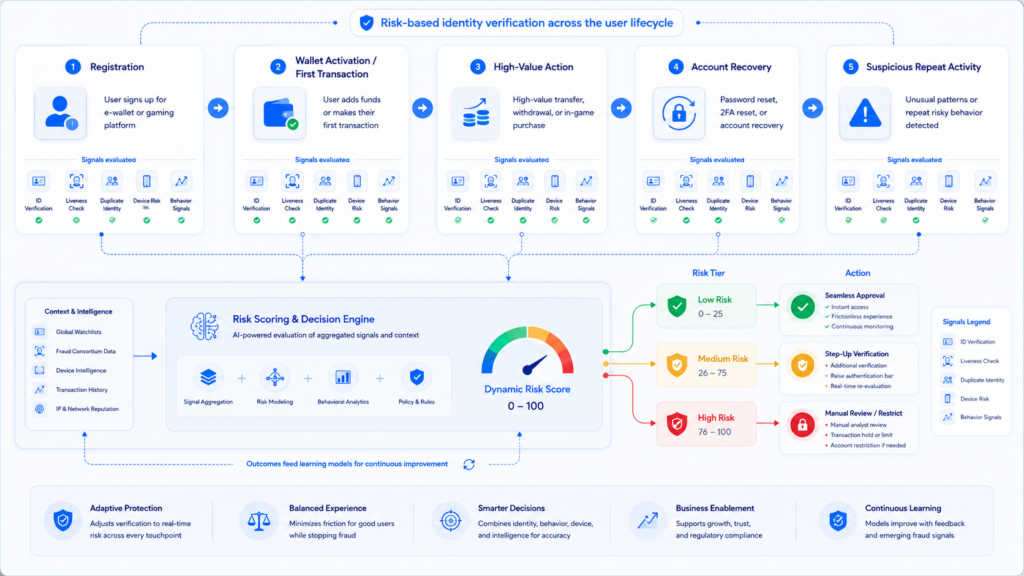
The third layer is identity intelligence across the full user journey. Multi-account abuse does not only happen during onboarding. It may appear during wallet activation, limit increases, withdrawals, account recovery, high-value transactions, or reactivation after a ban. By applying identity verification at key risk points, platforms can build a continuous defense model rather than treating KYC as a one-time gate.
This risk-based approach is particularly useful for e-wallets and gaming platforms because user volume is high, transaction frequency is high, and fraud tactics evolve quickly. Low-risk users can move through a streamlined process, while suspicious users can be routed into stronger verification flows.
E-Wallet Scenario: Stopping Bonus Abuse and Mule Account Networks
E-wallet platforms often operate in highly competitive markets where sign-up incentives, referral campaigns, cashback programs, and transaction rewards are important for user acquisition. These mechanisms also create opportunities for abuse.
A fraud group may register hundreds or thousands of accounts using different phone numbers, modified devices, synthetic identity materials, or borrowed documents. Some accounts are created only to collect rewards. Others are used to move funds, receive fraudulent transfers, or support downstream scams.
In this environment, identity verification must do more than confirm that a document image is readable. It must help determine whether the person behind the account is real, whether the document belongs to the user, and whether the same identity is being reused across multiple accounts.
FinAuth supports this by combining document parsing, liveness detection, and face comparison into a unified verification flow. ID document recognition extracts key fields from submitted documents. Face comparison verifies whether the live user matches the document portrait. Liveness detection helps ensure that the user is physically present and not using a replay, injection, or AI-generated attack.
When integrated with platform risk rules, these signals can support more precise decisions. A clean user can be approved quickly. A user with repeated face matches across multiple accounts may be routed to step-up verification. A user showing both duplicate identity signals and abnormal device behavior may be sent to manual review or restricted from high-risk actions.
This prevents the platform from relying on binary “pass or fail” logic. Instead, identity becomes a contextual risk signal that helps the platform separate legitimate users from organized abuse.
Gaming Scenario: Reducing Ban Evasion, Account Farming, and Fraud Rings
Gaming platforms face a different version of the same problem. A player who is banned for cheating or fraud may return with a new account. A fraud group may create large numbers of accounts to farm rewards, manipulate ranking systems, or support real-money trading. Some accounts may also be used for payment fraud, chargebacks, or stolen payment instruments.
In many gaming environments, requiring full identity verification for every user at registration may be too heavy. However, risk-based verification can be applied at specific moments: high-value withdrawals, tournament participation, account recovery, marketplace trading, suspicious login patterns, or repeated abuse behavior.
AI identity verification allows gaming platforms to introduce stronger controls without applying the same level of friction to every player. For example, a casual player may only need basic account registration. A user attempting to withdraw high-value in-game assets or participate in a competitive event may be asked to complete identity verification. A player repeatedly linked to banned accounts can be required to pass liveness and face comparison before reactivation.
This creates a more balanced model. The platform protects fairness and security while preserving a smooth experience for normal users.
Building a Risk-Based Identity Verification Architecture
A mature anti-abuse architecture does not treat identity verification as a standalone module. It connects identity signals with device intelligence, transaction monitoring, behavioral analytics, and internal risk rules.
At onboarding, the system should verify that the user is real, the document is valid, and the face matches the document. During account activity, the system should monitor whether new risk signals emerge. At high-risk moments, the platform should be able to trigger step-up verification automatically.
For e-wallets, high-risk moments may include wallet activation, limit upgrades, large transfers, repeated failed verification attempts, unusual withdrawal patterns, or account recovery. For gaming platforms, they may include marketplace trading, tournament registration, reward redemption, payment disputes, or suspicious account linkage.
The key is not to create a rigid verification process. The key is to build an adaptive risk engine where identity verification provides high-confidence signals for decisioning.
FinAuth is designed for this type of architecture. It supports ID document recognition, liveness detection, face comparison, and anti-spoofing capabilities that can be integrated into onboarding and risk workflows. By combining these capabilities with platform-defined rules, businesses can build verification processes that are both secure and operationally scalable.
Managing Friction Without Weakening Security
One of the biggest concerns for e-wallet and gaming platforms is user friction. If verification is too strict, legitimate users may abandon onboarding. If verification is too loose, fraudsters exploit the gap.
The solution is not to verify less. The solution is to verify more intelligently.
Risk-based identity verification allows platforms to apply different verification levels based on the risk profile of each user or action. Low-risk users can complete onboarding with minimal friction. Medium-risk users can be asked for additional checks. High-risk users can be routed to manual review or restricted from sensitive actions.
This approach improves both security and conversion. It avoids treating every user as a fraud risk, while still giving the platform the tools to respond when suspicious patterns appear.
For multi-account abuse, this is especially important. A single duplicate signal should not always result in immediate rejection. There may be legitimate reasons for shared devices, family accounts, or document resubmission. But when duplicate identity signals appear together with abnormal behavior, suspicious device patterns, or repeated incentive exploitation, the platform can make a more confident risk decision.
Identity Verification as a Strategic Risk Layer
Multi-account abuse is not just an onboarding problem. It is a business risk, a compliance risk, and a platform trust issue. As fraud operations become more automated and AI-assisted, platforms need identity systems that can detect both individual deception and coordinated abuse patterns.
For e-wallets, this means protecting financial incentives, transaction integrity, and regulatory trust. For gaming platforms, it means protecting fair play, digital assets, and community health. In both cases, AI identity verification provides a stronger foundation for understanding who is behind each account.
FinAuth helps platforms move beyond simple account checks by introducing a more reliable identity layer. Through ID document recognition, liveness detection, face comparison, and AI-powered anti-spoofing, platforms can identify duplicate users, reduce fake account creation, and make more accurate risk decisions across the user lifecycle.
In a digital environment where creating a new account is easy, proving a real and trustworthy identity becomes a competitive advantage.