Digital onboarding has become the default entry point for financial services, digital wallets, lending platforms, insurance providers, mobility apps, and other online businesses. Users expect to open an account, verify their identity, and start using services within minutes. At the same time, businesses are facing increasingly sophisticated fraud tactics, including fake IDs, synthetic identities, account farms, deepfake faces, virtual camera injection, device emulators, and coordinated fraud networks.
This creates a difficult trade-off. If the onboarding process is too strict, legitimate users may abandon the journey before completing verification. If the process is too relaxed, fraudsters may exploit weak controls to create fake accounts, launder funds, abuse promotions, or bypass compliance requirements.
Risk-based digital onboarding offers a more practical answer. Instead of applying the same verification flow to every user, adaptive eKYC evaluates identity, device, behavior, and session signals in real time, then dynamically adjusts the verification requirements based on risk level. This allows digital businesses to maintain strong fraud prevention while reducing friction for trustworthy users.
The Problem with One-Size-Fits-All Onboarding
Traditional digital onboarding workflows often follow a fixed process. Every applicant is asked to submit the same identity document, complete the same face verification step, pass the same liveness check, and wait for the same review logic.
This model is easy to implement, but it does not reflect the real risk distribution of digital users.
A low-risk returning user applying from a trusted device should not face the same level of friction as a new user registering with a high-risk device, mismatched location signals, suspicious behavior, and a recently edited identity document. Similarly, a user with clean identity signals should not be delayed by unnecessary manual review, while a suspicious user should not be allowed to pass simply because they completed a basic document upload.
The result is operational inefficiency on both sides. Good users experience more friction than necessary. Fraud teams receive too many low-value alerts. High-risk cases may still slip through because the system is not context-aware enough to detect deeper risk patterns.
Risk-based onboarding changes this model by making verification decisions more adaptive, data-driven, and proportional to the actual level of risk.
What Is Risk-Based Digital Onboarding?
Risk-based digital onboarding is an identity verification approach that adjusts the user journey according to real-time risk assessment. Rather than treating onboarding as a linear checklist, it treats each user session as a risk event that needs to be evaluated across multiple dimensions.
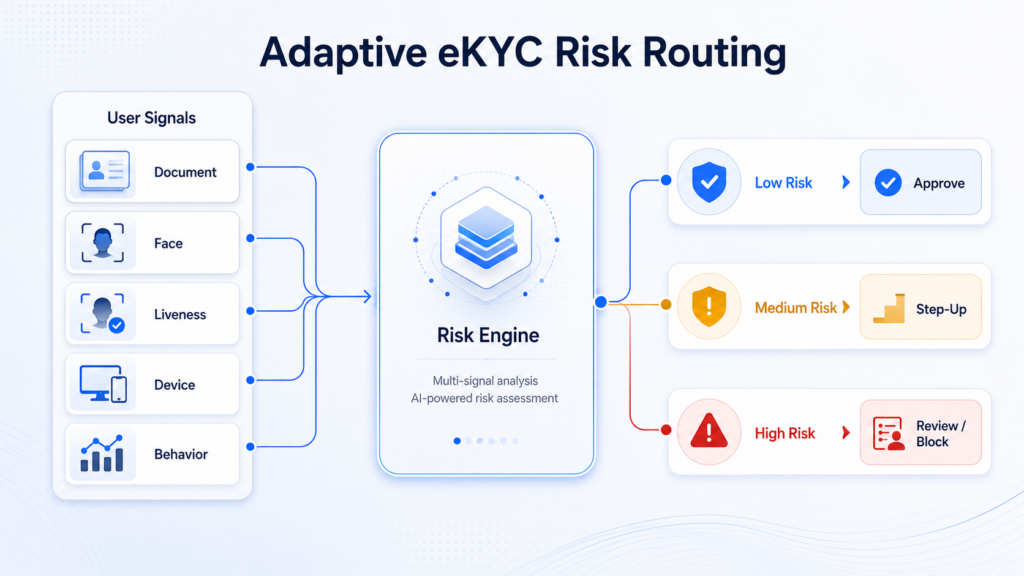
A modern adaptive eKYC system typically analyzes signals such as:
- Document authenticity and OCR confidence
- Face-to-ID matching score
- Liveness detection result
- Device fingerprint and emulator indicators
- IP, VPN, proxy, and geolocation consistency
- Behavioral patterns during the session
- Repeated identity, face, device, or contact information
- Historical risk records and account-linking signals
These signals are combined into a unified risk score or decision framework. Based on the result, the system can route users into different paths: instant approval, additional verification, manual review, restricted access, or rejection.
The key principle is simple: apply less friction to low-risk users and stronger controls to high-risk users.
How Adaptive eKYC Improves Conversion
In digital onboarding, every additional step can create user drop-off. Long forms, repeated document uploads, unclear failure messages, and unnecessary manual reviews all reduce conversion. For consumer-facing businesses, especially in mobile-first markets, onboarding speed directly affects user acquisition efficiency.
Adaptive eKYC improves conversion by reducing unnecessary verification friction.
For example, if a user submits a clear document image, passes OCR extraction with high confidence, completes liveness detection successfully, and uses a normal device session with consistent geolocation, the system can approve the onboarding quickly. There is no need to send this user through multiple redundant checks or manual review.
This helps businesses create a smoother onboarding experience for legitimate users. Faster approvals can support higher completion rates, lower customer acquisition costs, and better first-time user experience.
At the same time, adaptive onboarding does not mean weakening security. It means applying security controls more intelligently. The system preserves strong verification for users who need deeper checks while allowing trusted users to move forward with less friction.
How Adaptive eKYC Strengthens Fraud Prevention
Fraudsters rarely rely on a single attack method. A fake account may involve a manipulated ID document, a synthetic face, a virtual camera injection, a suspicious device environment, and repeated use of the same network infrastructure. Basic onboarding systems may only check one or two of these elements, leaving gaps between verification layers.
Adaptive eKYC strengthens fraud prevention by combining identity verification with risk intelligence.
Document verification can detect image quality issues, OCR inconsistencies, tampering traces, screenshot submissions, re-photographed documents, and abnormal document structures. Face verification can compare the live user with the document portrait and determine whether the same person is present. Liveness detection can help defend against presentation attacks, replay attacks, deepfake videos, and injection-based attacks.
Beyond identity checks, device and session intelligence add another layer of context. A user may submit a real-looking ID and pass a basic face check, but the session may still show high-risk signals such as device emulation, abnormal browser attributes, proxy usage, time zone inconsistency, or repeated registrations from linked devices.
Behavioral analysis can further identify unusual input patterns, automated activity, copy-paste behavior, or repeated application flows that suggest organized fraud.
When these signals are analyzed together, businesses gain a more complete view of onboarding risk. This makes it easier to detect suspicious users before they enter the platform, rather than reacting after fraud losses occur.
A Practical Risk-Based Onboarding Framework
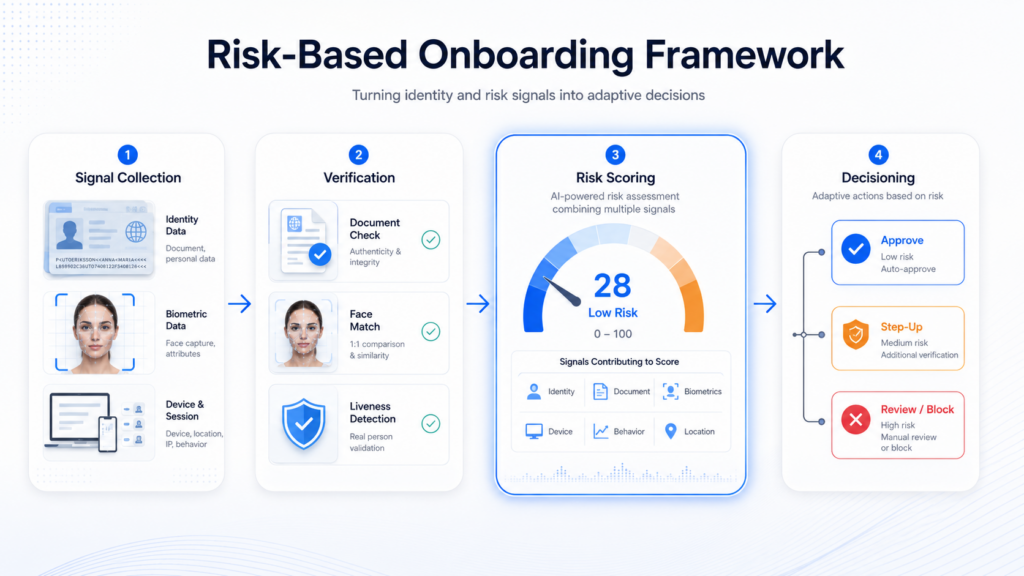
A risk-based digital onboarding framework usually includes four stages.
The first stage is signal collection. The system captures identity documents, face images or videos, liveness data, device information, session context, and behavioral signals during the onboarding process.
The second stage is verification. The platform checks whether the document is authentic, whether OCR data is reliable, whether the user’s face matches the document portrait, and whether the user is physically present during the verification session.
The third stage is risk scoring. The system combines verification results with device, behavior, location, network, and historical signals. Instead of relying on one binary result, it generates a more nuanced risk profile.
The fourth stage is adaptive decisioning. Based on the risk profile, the user is routed into the appropriate outcome.
Low-risk users can be approved instantly. Medium-risk users may be asked to complete step-up verification, such as an additional liveness check or document recapture. High-risk users can be sent to manual review. Critical-risk users can be rejected or blocked automatically.
This framework allows businesses to control risk without forcing every user into the most restrictive process.
Common Adaptive Onboarding Decisions
In a mature eKYC workflow, onboarding decisions should not be limited to “approve” or “reject.” A more flexible decision framework can include multiple outcomes.
Approve is suitable for users with consistent identity, face, liveness, device, and session signals.
Step-up verification is useful when the user is mostly legitimate but certain signals require additional confidence. For example, the document image may be slightly unclear, the device may be new, or the session location may be unusual.
Manual review is appropriate for complex cases where automated systems detect risk but human judgment is still needed. This may include borderline document authenticity issues, face match uncertainty, or conflicting identity information.
Reject or block should be used when there is strong evidence of fraud, such as document tampering, failed liveness, injection attack indicators, known risky devices, or repeated abuse patterns.
By creating more decision layers, businesses can avoid both over-rejection and under-protection.
Why Risk-Based Onboarding Matters for Regulated Industries
For financial institutions, payment platforms, digital lenders, and other regulated businesses, onboarding is not only a user acquisition process. It is also a compliance and risk control function.
Businesses must verify user identities, prevent fraud, support AML requirements, maintain audit trails, and protect customer data. However, they also need to compete on speed, convenience, and digital experience.
Adaptive eKYC helps align these goals. It enables businesses to apply stronger controls where risk is higher, while keeping onboarding efficient for normal users. It also creates a clearer audit trail by recording which signals were evaluated, why a decision was made, and what action was taken.
This is especially important for organizations operating across multiple markets, document types, languages, and risk environments. A static onboarding process may not scale well across regions. A risk-based framework gives teams more flexibility to configure policies by market, customer segment, product type, and transaction risk.
How FinAuth Supports Adaptive eKYC
FinAuth is designed as a next-generation eKYC identity verification platform powered by advanced Large Visual Models. It helps digital businesses build adaptive onboarding workflows by combining document verification, OCR, face matching, liveness detection, device intelligence, behavioral risk analysis, and decision engine capabilities.
With FinAuth, businesses can evaluate multiple identity and fraud signals within a unified onboarding framework. Low-risk users can move through a faster path, while suspicious users can be routed to step-up verification, manual review, or rejection based on configurable policies.
This helps organizations improve onboarding conversion without compromising security, compliance, or fraud prevention.
Conclusion
Digital businesses no longer need to choose between strict security and smooth onboarding. The better approach is to make onboarding adaptive.
Risk-based digital onboarding allows companies to identify trustworthy users faster, apply stronger checks to suspicious sessions, reduce manual review pressure, and build a more scalable identity verification process. As fraud tactics become more sophisticated, adaptive eKYC is becoming a core capability for any digital platform that needs to grow securely.
By combining identity verification with real-time risk intelligence, businesses can protect the platform, improve user experience, and make better onboarding decisions from the first interaction.