Remote eKYC has become a standard onboarding model for digital banks, e-wallets, lending platforms, crypto exchanges, mobility platforms and many other digital businesses. A user uploads an identity document, captures a selfie or short video, completes liveness verification, and receives an onboarding decision within seconds.
But as onboarding becomes more automated, fraud attacks are also moving upstream. Deepfakes are no longer limited to fake videos shown in front of a camera. Attackers are increasingly using deepfake injection attacks, where synthetic or manipulated biometric data is inserted directly into the verification workflow.
This creates a critical challenge for identity verification teams: a face may look realistic, liveness may appear normal, and the onboarding journey may still be fraudulent.
To detect deepfake injection attacks effectively, businesses need to move beyond single-point liveness checks and adopt a layered eKYC defense strategy that verifies not only the user’s face, but also the capture channel, device environment, session integrity and behavioral risk.
What Is a Deepfake Injection Attack?
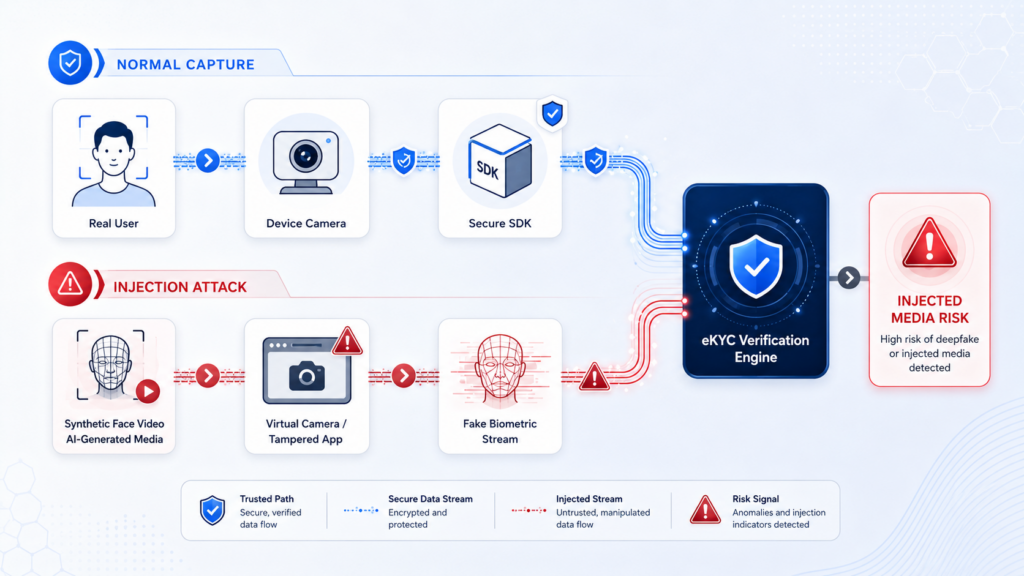
A deepfake injection attack occurs when an attacker bypasses the normal camera capture process and feeds fake biometric media into the eKYC system. Instead of presenting a printed photo, replaying a video on another screen, or wearing a 3D mask, the attacker manipulates the digital input stream itself.
Common injection methods include:
- Virtual camera software that replaces the real camera feed
- Emulator-based onboarding sessions
- Hooking or tampering with mobile SDK functions
- Man-in-the-middle manipulation of image or video data
- API-level media replacement
- Synthetic face videos generated by AI tools
- Replayed biometric samples inserted into the capture pipeline
This is why deepfake injection is more dangerous than traditional presentation attacks. In a presentation attack, the fraud object is placed in front of the camera. In an injection attack, the fraud object may never touch the camera at all.
ENISA’s remote identity proofing guidance identifies biometric data injection attacks as a specific risk area for remote identity proofing, including attacks against enrolment and verification processes. NIST’s digital identity guidance also emphasizes the need to determine the integrity of the sensor and endpoint when biometrics are used remotely, because compromised endpoints and sensor emulators can increase injection risk.
Why Traditional Liveness Alone Is Not Enough
Liveness detection remains essential, but it should not be treated as the only line of defense.
Traditional liveness checks are designed to answer one core question: Is there a live human present in front of the camera? This works well against many common spoofing methods, such as printed photos, screen replays, masks and simple video attacks.
However, injection attacks challenge a different part of the system. The issue is not only whether the image looks live. The issue is whether the image was genuinely captured from the expected device, camera, SDK and session.
For example, a fraudster may generate a realistic moving face video and inject it into the onboarding flow through a virtual camera. The face may blink, move naturally and respond to prompts. A basic liveness model may focus on visual clues inside the video, but it may not know that the video stream did not originate from a trusted camera path.
This means the detection strategy must expand from face-level analysis to session-level trust verification.
Key Signals for Detecting Deepfake Injection Attacks
1. Camera and Capture Integrity
The first layer is to verify whether the biometric media is captured through an expected and trusted camera channel.
A strong eKYC system should inspect capture metadata, SDK runtime signals and camera source behavior. It should look for inconsistencies such as abnormal frame timing, missing sensor metadata, virtual camera indicators, suspicious media encoding, or mismatch between device capabilities and submitted media characteristics.
For mobile onboarding, this layer should also check whether the capture process is happening through the official SDK workflow rather than an altered or bypassed path.
The goal is not only to confirm that a face is visible. The goal is to confirm that the face was captured through a legitimate acquisition process.
2. Device and Runtime Risk
Deepfake injection attacks often depend on a manipulated device environment. Attackers may use rooted or jailbroken devices, emulators, app cloning tools, remote control software, instrumentation frameworks or debugging environments.
Device intelligence can help identify these risks before the biometric result is even evaluated.
Useful signals include:
- Root or jailbreak status
- Emulator and virtual environment detection
- App tampering or repackaging indicators
- Debugging and hooking framework detection
- Proxy, VPN and suspicious network usage
- Device fingerprint reputation
- Repeated device usage across multiple identities
- Abnormal OS, browser or SDK environment signals
If a session shows both biometric anomalies and device manipulation indicators, the risk level should increase significantly.
3. Media Forensics and Deepfake Detection
The next layer is media-level analysis. Even when injected content appears realistic, deepfake media may still leave detectable artifacts.
A robust model can analyze:
- Facial texture consistency
- Skin detail and lighting coherence
- Eye reflection and gaze behavior
- Lip movement and facial landmark stability
- Temporal consistency across frames
- Compression and generation artifacts
- Background-face boundary abnormalities
- Unnatural motion patterns
Unlike simple image quality checks, deepfake detection must evaluate both spatial and temporal features. A single frame may look convincing, while the full video sequence may reveal inconsistencies in motion, lighting or facial geometry.
For eKYC onboarding, this analysis should be optimized for real-world capture conditions, including low-end devices, unstable networks, poor lighting and diverse user demographics. Otherwise, the system may either miss advanced attacks or create excessive false rejections for genuine users.
4. Challenge-Response and Active Liveness
Active liveness can increase attack difficulty by requiring the user to perform randomized actions, such as turning the head, following on-screen instructions, blinking, reading numbers, or responding to dynamic prompts.
For deepfake injection attacks, the key is unpredictability. If the attacker can prepare a video in advance, static liveness checks become weaker. Dynamic challenge-response makes it harder to use pre-generated content.
However, active liveness should be carefully designed. Too much friction can reduce completion rates, especially in emerging markets where users may have lower-end devices or inconsistent network conditions.
The best approach is risk-based: use passive liveness for low-risk sessions and trigger active liveness only when risk signals indicate potential spoofing or injection.
5. Face Matching and Identity Consistency
Deepfake injection attacks are often used to impersonate a real identity or hide the attacker’s true identity. Therefore, face matching remains a core control.
During onboarding, the system should compare the live selfie or video face against the portrait extracted from the identity document. But the comparison should not be evaluated in isolation.
A high face match score does not automatically mean the session is trustworthy. The system should also assess whether the document is authentic, whether the document portrait has been manipulated, whether the selfie media is live and genuine, and whether the session environment is clean.
This is where multi-signal fusion becomes critical. Face match should be one input into a broader risk decision, not the entire decision.
6. Cross-Account and Network Analysis
Many deepfake injection attacks are not isolated. Fraudsters often test multiple identities, devices, documents and face assets across different onboarding attempts.
Cross-account analysis can reveal patterns that are invisible at the single-session level:
- One device used to register many identities
- One face linked to multiple documents
- Multiple faces sharing the same device or network
- Repeated failed liveness attempts across accounts
- Similar document templates or manipulated images
- Suspicious onboarding bursts from the same environment
For financial institutions, this is especially important because deepfake injection may be part of larger fraud operations, such as mule account creation, synthetic identity fraud, account takeover or loan fraud.
A Risk-Based Detection Workflow
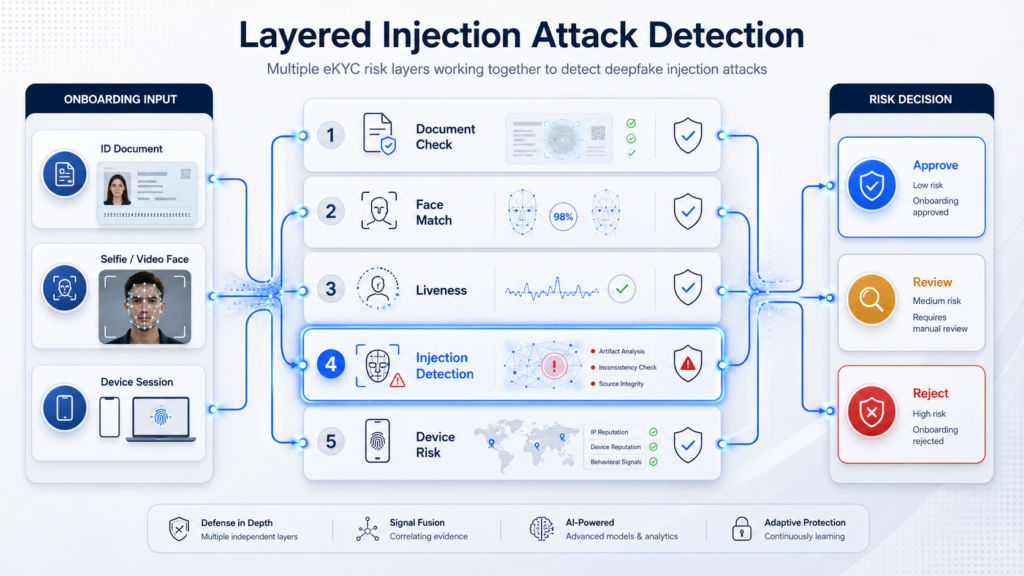
A practical detection workflow should combine multiple layers:
- Document Verification
Check document authenticity, OCR consistency, tampering traces and data validity. - Face Verification
Compare the onboarding face against the document portrait. - Liveness and Deepfake Detection
Detect presentation attacks, AI-generated media and temporal inconsistencies. - Injection Attack Detection
Verify camera integrity, SDK runtime integrity, endpoint trust and media source authenticity. - Device and Session Intelligence
Analyze device fingerprint, emulator risk, network risk and environment anomalies. - Behavioral and Cross-Account Risk
Detect repeated patterns, scripted behavior and linked fraud networks. - Risk Engine Decision
Route users to approve, step-up verification, manual review or reject based on risk score.
This approach aligns with a broader industry shift: remote identity proofing should not depend on one biometric model alone. It should evaluate the full chain of trust from document to face, from device to session, and from individual attempt to fraud network. NIST SP 800-63A-4 also requires presentation attack detection when collecting and comparing biometrics remotely, reinforcing the importance of PAD in remote identity proofing workflows.
How FinAuth Helps Detect Deepfake Injection Attacks
FinAuth provides a multi-layer eKYC identity verification platform designed for modern onboarding threats, including deepfakes, injection attacks, emulator abuse and synthetic identity fraud.
Its detection framework combines:
- Global ID verification and OCR
- Document authenticity analysis
- 1:1 face matching
- Liveness detection
- Deepfake and spoofing detection
- Device fingerprinting
- Session risk analysis
- Behavioral risk signals
- Cross-account relationship analysis
- Configurable risk decision engine
- Full audit trail for compliance and review
Instead of treating liveness as a standalone checkpoint, FinAuth evaluates the entire onboarding session. This helps businesses identify suspicious cases where the face appears realistic, but the device, capture channel or session behavior does not match a trusted user journey.
For low-risk users, FinAuth can support a smooth automated onboarding flow. For medium-risk users, it can trigger step-up verification. For high-risk users, it can route the case to manual review or block the attempt before account creation.
Conclusion
Deepfake injection attacks represent a new stage in eKYC fraud. They do not simply challenge whether a face looks real. They challenge whether the entire biometric capture process can be trusted.
To defend against this threat, businesses need layered protection across document verification, face matching, liveness detection, deepfake analysis, device intelligence, session integrity and cross-account risk.
The future of eKYC security will not be defined by one model or one checkpoint. It will be defined by how effectively identity platforms combine multiple signals into a real-time risk decision.
For digital banks, fintech platforms and online businesses, detecting deepfake injection attacks is no longer an advanced security option. It is becoming a core requirement for safe, scalable and trustworthy digital onboarding.