A customer who cleared sanctions screening during onboarding may become higher risk later. A person or entity can be newly designated, an existing list record can gain additional identifiers, beneficial ownership can change, or new customer activity can reveal a previously hidden sanctions connection.
Real-time sanctions rescreening helps organizations respond to these changes without waiting for the next scheduled customer review. The objective is not simply to generate alerts faster. It is to identify affected customers and connected parties, enrich possible matches with verified evidence, and apply the correct compliance action.
FinAuth supports this process by combining sanctions results with identity, ownership, device, behavioral, and transaction signals through its Risk Engine.
1. What Is Real-Time Sanctions Rescreening?
Real-time sanctions rescreening means reassessing existing customers and related parties when relevant risk information changes.
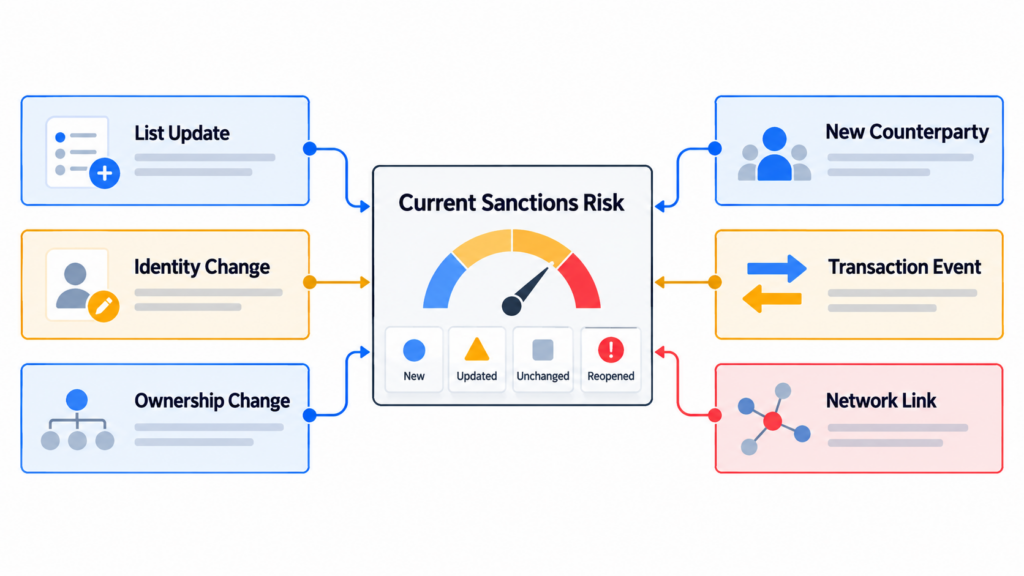
Common triggers include:
- A sanctions authority adds or removes a list entry.
- Identifiers, aliases, addresses, or ownership information are updated.
- A customer changes their name, nationality, address, or identity document.
- A new beneficial owner, director, beneficiary, or counterparty is added.
- A transaction creates exposure to a sanctioned person, entity, activity, or jurisdiction.
- New identity or network evidence connects the customer to another account.
“Real time” does not always mean that every customer must be fully screened every second. It means list changes and material customer events enter an automated workflow quickly enough to support the organization’s legal obligations and risk controls.
OFAC advises organizations to consider screening when sanctions lists are updated and at other points where sanctions exposure may arise. It also states that screening frequency should reflect the organization’s business, customers, products, and relevant risk factors.
2. Why Onboarding Screening Is Not Enough
Initial screening provides a point-in-time assessment. It cannot protect against changes that occur after account approval.
A customer may pass onboarding because:
- They were not designated at that time.
- The list record contained insufficient identifying information.
- Their ownership structure did not yet create sanctions exposure.
- Their submitted identity differed from the information later added to a list.
- The relevant counterparty or beneficiary had not entered the relationship.
Watchlist updates can also affect previously resolved alerts. A possible match dismissed because the date of birth was unavailable may need reassessment if the authority later publishes that date.
For this reason, organizations need both periodic screening and event-driven rescreening. Periodic screening provides broad coverage, while event-driven controls respond to material changes as they happen.
3. Who and What Should Be Rescreened?
Rescreening should reflect the parties and relationships relevant to the product and applicable sanctions regime. Depending on policy, this may include:
- Individual and business customers
- Beneficial owners and controlling persons
- Directors and authorized representatives
- Beneficiaries and counterparties
- Connected accounts and related entities
- Parties involved in payments or other regulated events
The workflow should preserve the identity information used in the original decision while incorporating newer verified attributes. This makes it possible to determine whether a list update creates a genuinely new match or merely repeats a previously resolved false positive.
Ownership is particularly important. A company may not appear directly on a sanctions list but could still require restrictions because of its ownership or control. The applicable regulations and official guidance must determine how such relationships are evaluated.
4. How to Assess a New Sanctions Alert
A name match alone is not a final sanctions decision. Common names, aliases, transliteration, incomplete records, and spelling variations can generate large numbers of possible matches.
A structured assessment should compare available attributes such as:
- Full name and aliases
- Date and place of birth
- Nationality and address
- Identity document information
- Business registration data
- Ownership and control
- Customer activity and counterparties
Unavailable data must not be treated as conflicting data. If a list record has no date of birth, the absence of that field cannot disqualify the match. The workflow may need to request additional evidence or escalate the case.
OFAC recommends reviewing the complete list record and comparing all available details with the party that generated the alert. Exact or close matches supported by multiple similarities should be handled according to the organization’s sanctions procedures and the applicable regulations.
5. Building an Automated Rescreening Workflow
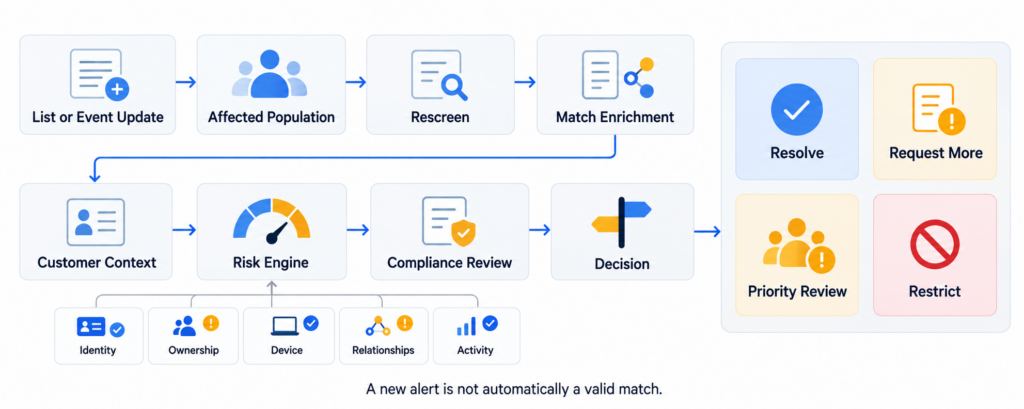
A scalable workflow can follow five stages.
Detect the change. Ingest authoritative list updates and relevant customer, ownership, or transaction events.
Identify the affected population. Determine which customers, connected parties, or unresolved alerts require reassessment. Incremental matching can reduce unnecessary processing compared with repeatedly screening the entire population.
Enrich possible matches. Compare the alert with verified identity attributes, document evidence, ownership records, account relationships, and recent activity.
Calculate combined risk. FinAuth can combine the external screening result with Document Verification, Face Verification, Liveness Detection, device intelligence, behavioral patterns, and network relationships. A weak name similarity and a strong multi-attribute match should not receive the same priority.
Apply the required action. Outcomes may include resolving a false positive, requesting more information, placing the case in priority review, restricting activity, or taking another action required by the applicable sanctions program.
6. How to Control False Positives and Review Volume
Faster screening can create operational problems if every list update sends thousands of low-quality alerts to investigators.
Effective controls include:
- Normalizing names across scripts and formats
- Comparing stable identity attributes
- Separating new alerts from unchanged historical matches
- Reopening resolved alerts only when relevant evidence changes
- Prioritizing exact and multi-attribute matches
- Grouping related alerts into one customer or network case
- Recording the evidence and rationale behind each resolution
FinAuth’s Risk Engine can prioritize alerts using both match quality and customer context. A possible match associated with suspicious ownership, connected devices, unusual transactions, or identity-integrity concerns can move ahead of an isolated low-confidence similarity.
Automation should support—not replace—compliance judgment where applicable law or internal policy requires review.
7. Sanctions Rescreening Q&A
What triggers sanctions rescreening?
Triggers can include watchlist updates, changes to customer or ownership information, new beneficiaries, unusual transactions, and newly identified account relationships.
Does every sanctions alert require account closure?
No. An alert is a possible match. The organization must assess identifying details, the applicable sanctions program, ownership or control, relevant authorizations, and its legal obligations before deciding what action is required.
How quickly should customers be rescreened after a list update?
The required timing depends on the applicable legal regime, risk exposure, and organizational policy. The operating model should ingest and process relevant updates without avoidable delay.
How does FinAuth support sanctions rescreening?
FinAuth can combine external screening results with verified identity, document, biometric, device, behavioral, ownership, and transaction evidence. This helps prioritize stronger matches and route them to proportionate actions.
8. Conclusion
Sanctions risk does not end when onboarding is complete. Watchlists, customer attributes, ownership structures, relationships, and activity can all change throughout the customer lifecycle.
An effective real-time rescreening program detects relevant changes, reassesses affected parties, enriches possible matches, and applies actions based on the full evidence. By connecting sanctions results with ongoing identity and risk signals, FinAuth helps compliance teams respond faster while concentrating review capacity on the most credible exposure.