Synthetic identities combine fabricated information with real or stolen identity elements to create profiles that appear legitimate. Some are designed to pass onboarding with limited activity, build credibility over time, and only reveal their purpose after gaining access to higher limits, credit, payments, or account privileges.
This makes onboarding verification necessary but insufficient. Businesses also need ongoing monitoring that compares new activity with the trusted identity baseline and detects relationships across accounts, devices, faces, documents, and transactions.
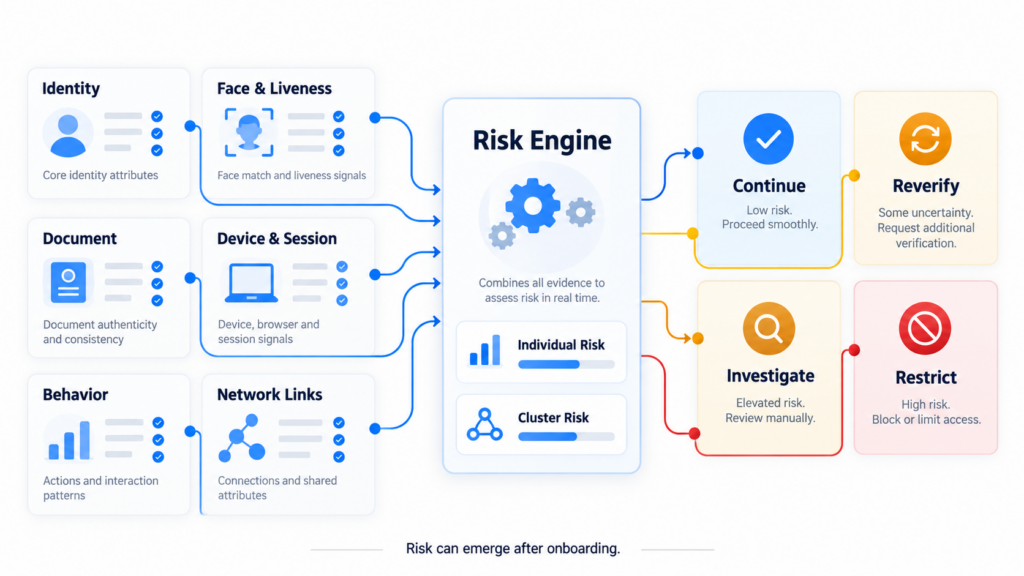
FinAuth supports this lifecycle approach by combining identity verification, biometric signals, device intelligence, behavioral analytics, network links, and event-level risk within a unified Risk Engine.
1. Why Synthetic Identities May Pass Initial Verification
A synthetic profile may contain enough internally consistent information to avoid immediate detection. Fraudsters may use:
- A real identifier combined with a fabricated name or address.
- A genuine identity document belonging to another person.
- An altered or AI-generated document.
- A recruited person acting on behalf of the fraudster.
- A reused face, device, address, contact detail, or beneficiary.
- Gradually developed account activity designed to appear normal.
Some inconsistencies are not visible when the account is assessed in isolation. A device may appear ordinary until it is later connected to several identities. A face may look genuine until 1:N comparison reveals that it has been used across unrelated profiles.
NIST recommends fraud-management programs that reflect an organization’s services, risks, systems, and regulatory environment. Its identity-proofing guidance also identifies device fingerprinting as a control against scaled attacks and enrollment duplication.
2. Preserve a Trusted Onboarding Baseline
Ongoing monitoring requires a reliable point of comparison. Businesses should retain structured verification outcomes from onboarding, subject to applicable privacy and retention requirements.
The baseline may include:
- Verified identity attributes.
- Document type and authenticity results.
- Extracted document fields and consistency checks.
- Reference portrait and face-match outcome.
- Liveness and capture-integrity results.
- Initial device and session characteristics.
- Declared account purpose and expected activity.
- Known relationships between customers, businesses, and beneficial owners.
FinAuth creates structured outputs across Document Verification, Face Verification, Liveness Detection, and Device & Session Intelligence. These signals can be reused for future risk assessments without repeating the entire onboarding journey after every event.
3. Monitor Identity Changes After Onboarding
Synthetic identity risk can become visible when account details evolve.
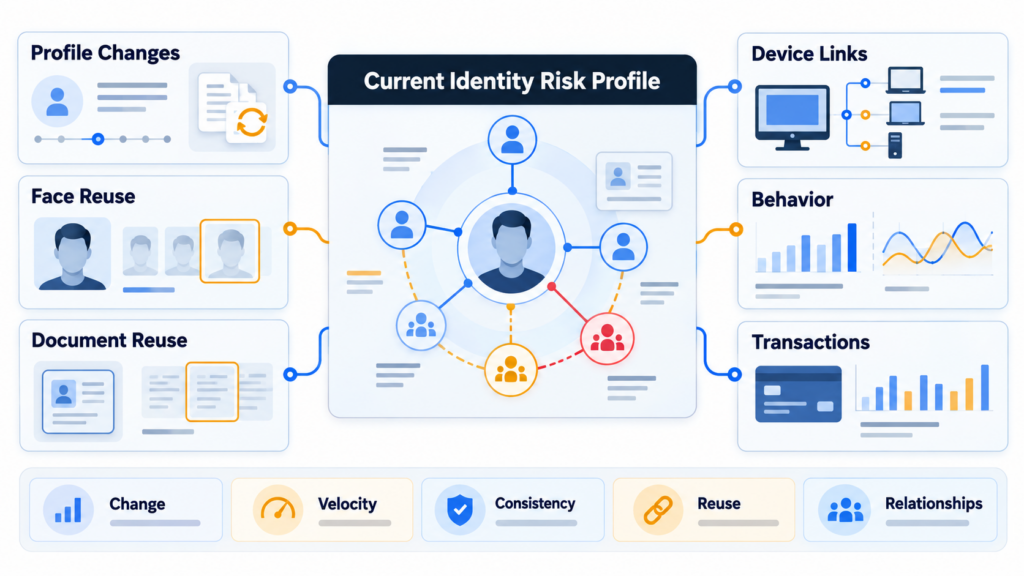
Relevant changes include:
Profile instability: Frequent updates to names, addresses, contact details, occupation, or business information.
Evidence replacement: Repeated document uploads, unexplained changes in document numbers, or newly submitted documents with authenticity concerns.
Biometric inconsistency: A current face no longer matches the trusted portrait, or one face appears across multiple identity profiles.
Recovery activity: Password recovery, authenticator replacement, and contact-detail changes occurring within a short period.
Ownership changes: New controllers, directors, or beneficial owners who introduce additional risk or conflict with previous records.
Not every change indicates fraud. A risk-based workflow should assess whether the update is plausible, supported by reliable evidence, and consistent with the customer’s previous activity.
4. Detect Device and Network Relationships
Synthetic identity schemes often reuse infrastructure even when the submitted customer information differs.
FinAuth can evaluate relationships such as:
- One device accessing multiple unrelated accounts.
- Multiple devices repeatedly submitting the same identity.
- Shared contact information or recovery channels.
- Reused documents or document images.
- Similar facial identities across separate profiles.
- Common beneficiaries or counterparties.
- Coordinated login or transaction timing.
- Devices previously associated with confirmed fraud.
A single shared device may have a legitimate explanation, such as a household or workplace environment. Risk increases when reuse is combined with identity inconsistencies, unusual velocity, coordinated behavior, or suspicious transaction flows.
Graph analysis is especially valuable because it can identify multi-hop relationships that are difficult to detect through account-level rules alone.
5. Compare Behavior With the Expected Profile
The account’s behavior should remain reasonably consistent with its stated purpose and established baseline.
Potential indicators include:
- Long periods of low activity followed by sudden high-value usage.
- Rapid credit utilization after a limit increase.
- Transactions inconsistent with declared occupation or business activity.
- Multiple accounts sending funds to the same beneficiary.
- Circular or pass-through fund movements.
- Sudden changes in device, location, contact details, and transaction pattern.
- Repeated attempts to access promotional, lending, or payment benefits.
- Activity occurring in coordinated sequences across linked accounts.
FATF Recommendation 10 calls for ongoing due diligence and transaction scrutiny to determine whether activity remains consistent with the institution’s knowledge of the customer, business, risk profile, and—where necessary—source of funds. fatf-gafi.org
Behavioral deviation is a signal, not a conclusion. FinAuth’s Risk Engine can evaluate the severity, timing, and relationship of multiple changes before selecting an action.
6. Use Event-Driven Reverification
Periodic reviews alone may leave long gaps between checks. Event-driven reverification responds when new evidence materially changes the account’s risk.
Possible triggers include:
- Significant profile or ownership changes.
- Suspicious account recovery.
- A high-value or unusual transaction.
- A new high-risk device relationship.
- A face or document linked to another account.
- A sanctions, PEP, or adverse media update.
- Activity inconsistent with the account’s stated purpose.
- An investigation outcome affecting related entities.
FinAuth can select a proportionate response:
- Continue: Allow activity when combined risk remains low.
- Confirm: Reauthenticate or confirm through a trusted channel.
- Step Up: Require Face Verification, Liveness Detection, or document evidence.
- Investigate: Route linked accounts and supporting evidence for review.
- Restrict: Limit activity when strong coordinated-risk indicators remain unresolved.
7. Combine Individual and Cluster Risk
Traditional monitoring often assesses each customer independently. Synthetic identity detection also requires cluster-level analysis.
An account may appear low risk individually while belonging to a network with:
- Reused identity elements.
- Shared high-risk devices.
- Related facial identities.
- Common beneficiaries.
- Coordinated application velocity.
- Similar behavioral sequences.
- Previous confirmed fraud.
FinAuth can calculate both individual account risk and cluster risk. This helps prevent one apparently normal profile from escaping review when its surrounding network shows coordinated activity.
FATF guidance describes ongoing monitoring as identifying changes in customer behavior, product use, value, and risk profile that may trigger enhanced due diligence.
8. Measure Monitoring Effectiveness
Teams should track:
- Confirmed synthetic identities detected after onboarding.
- Accounts, devices, faces, and documents linked per cluster.
- Time from first risk signal to intervention.
- Reverification and investigation outcomes.
- False-positive rates for shared-device and behavioral rules.
- Fraud losses prevented.
- Legitimate-customer impact and appeal outcomes.
Thresholds should be recalibrated as fraud methods, products, markets, and customer behavior change. Data collection should also follow clear privacy, access, and retention controls.
9. Synthetic Identity Monitoring Q&A
Can synthetic identities pass digital onboarding?
Yes. A profile may initially appear consistent or use enough genuine identity elements to pass individual checks. Cross-account and post-onboarding signals may reveal the wider fraud pattern.
What signals reveal synthetic identity risk after onboarding?
Important signals include identity changes, reused devices, related faces, repeated documents, shared beneficiaries, abnormal velocity, and transactions inconsistent with the expected customer profile.
How does FinAuth support ongoing synthetic identity detection?
FinAuth combines identity, document, face, liveness, device, behavioral, transaction, and network-link evidence within its Risk Engine to assess both individual and cluster risk.
Should every anomaly trigger reverification?
No. Reverification should reflect combined risk and event sensitivity. Low-risk deviations may continue, while connected or high-impact anomalies may require stronger identity evidence or investigation.
10. Conclusion
Synthetic identity detection should continue throughout the customer lifecycle. The strongest signals often emerge only after accounts begin changing details, sharing infrastructure, building relationships, or conducting transactions.
By connecting onboarding evidence with ongoing identity, device, behavioral, and network analysis, FinAuth helps businesses identify hidden synthetic identity clusters and apply proportionate action before losses escalate.