Account Security Does Not End After Onboarding
Many fintech companies invest heavily in digital onboarding.
They verify identity documents, compare selfies against ID photos, apply liveness detection, and screen users before allowing them to open an account.
These controls are essential. However, they only answer one question:
Was the user legitimate when the account was created?
Account takeover fraud introduces a different problem.
A legitimate account can become compromised days, months, or even years after onboarding. The original user may have passed every verification step successfully. The fraud risk appears later, when an attacker gains control of the account and attempts to use its existing trust history.
For digital wallets, payment platforms, lending apps, and other fintech services, this means that onboarding verification alone is not enough.
Identity assurance must continue throughout the user lifecycle.
What Is Account Takeover Fraud?
Account takeover fraud occurs when an unauthorized person gains access to an existing user account and attempts to operate it as if they were the legitimate owner.
Attackers may obtain access through phishing, credential stuffing, malware, SIM swap attacks, compromised email accounts, or social engineering.
Once inside the account, they may:
- Change the registered phone number or email address
- Reset security settings
- Add a new payment destination
- Initiate a withdrawal or transfer
- Apply for credit
- Access personal information
- Use the account as part of a broader fraud network
The risk is particularly serious because the compromised account may already have a trusted history. It may have completed KYC checks, passed previous fraud reviews, and performed legitimate transactions.
From the platform’s perspective, the account appears valid. The person controlling it is not.
Why Traditional Authentication Controls Are Not Enough
Passwords and one-time passwords remain useful, but they have structural limitations.
A password proves that the user knows a secret. An SMS code proves that the user can access a phone number. A device token proves that the session is associated with a recognized device.
None of these controls independently prove that the legitimate account owner is present.
Attackers increasingly exploit this gap.
They do not always attempt to bypass security controls directly. Instead, they compromise the credentials, devices, or recovery channels that the security system already trusts.
A stronger account protection strategy must therefore evaluate identity continuously rather than treating login success as final proof of legitimacy.
Continuous Identity Verification: A Risk-Based Model
Continuous identity verification does not mean requiring users to repeat the full onboarding process every time they open an app.
It means evaluating identity risk throughout the account lifecycle and applying additional verification only when the context justifies it.
A continuous identity verification framework combines several layers:
| Layer | Purpose |
|---|---|
| Device and session intelligence | Detect new devices, unusual environments, abnormal access patterns, and suspicious session changes |
| User behavior analysis | Identify unexpected actions, rapid profile edits, and transaction anomalies |
| Face comparison | Confirm whether the current user matches the verified account owner |
| Liveness detection | Determine whether the facial input comes from a real person in real time |
| Risk scoring | Combine multiple signals into a decision |
| Adaptive verification | Approve, challenge, reject, or escalate based on risk level |
The key principle is simple:
Verification depth should increase when risk increases.
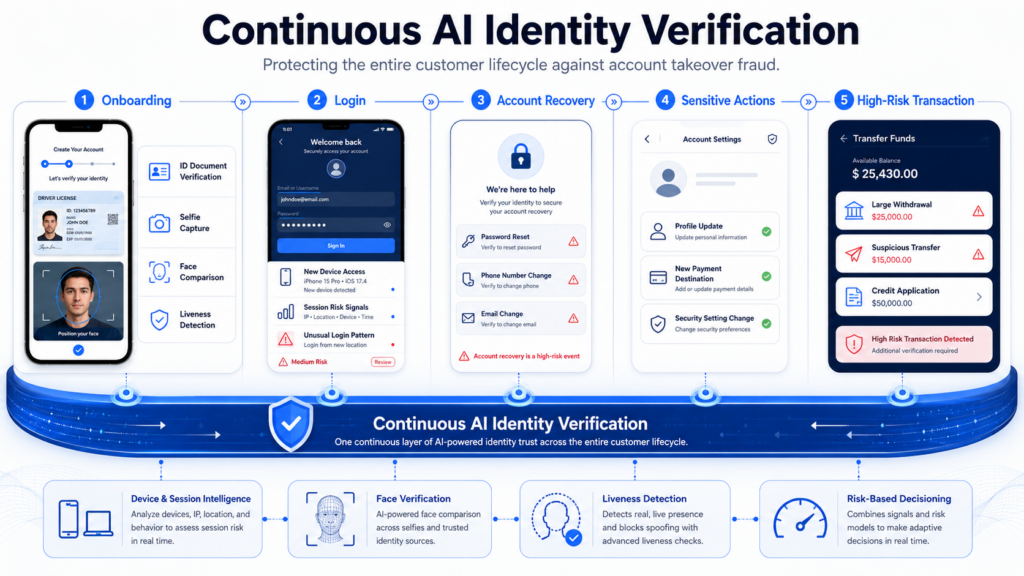
High-Risk Moments That Require Additional Verification
Not every user action carries the same level of risk.
Checking an account balance is not equivalent to changing a phone number. Viewing a transaction history is not equivalent to withdrawing funds to a newly added bank account.
Fintech platforms should identify the actions that can materially change account ownership, transaction exposure, or recovery control.
Typical step-up verification triggers include:
New Device Login
A user logs in from an unfamiliar mobile device or a new operating environment.
The platform should evaluate whether the device change is consistent with the user’s history. For elevated-risk sessions, a face verification challenge can provide stronger confirmation before allowing access to sensitive functions.
Account Recovery
Password resets and account recovery flows are common attack targets.
Fraudsters may exploit weak recovery procedures to take control of a legitimate account. Requiring facial verification against the previously verified identity can reduce reliance on phone numbers and email accounts alone.
Sensitive Profile Changes
Changing a phone number, email address, payment destination, or security setting can enable future fraud.
These actions should trigger additional verification, particularly when multiple changes occur within a short period.
High-Value Transactions
A transfer or withdrawal may appear legitimate at the credential level but still be inconsistent with the user’s normal behavior.
Platforms can use adaptive verification to request facial confirmation before approving high-risk transactions.
Suspicious Session Signals
Device changes, emulator usage, unusual IP patterns, abnormal navigation behavior, and rapid action sequences can indicate that a session requires additional review.
A face-based step-up check can help confirm whether the legitimate user remains in control.
Why Face Verification Should Be Combined with Liveness Detection
Face comparison helps determine whether two facial images belong to the same person.
However, face comparison alone cannot determine whether the current image comes from a live user.
An attacker may attempt to use a photo, replayed video, digital injection, or AI-generated media. This is why liveness detection remains an important supporting layer.
In an account takeover workflow, liveness detection is not the entire solution. It is one component of a larger trust engine.
The verification decision should consider:
- Whether the user appears to be live
- Whether the face matches the verified account owner
- Whether the device and session are trustworthy
- Whether the requested action is consistent with historical behavior
- Whether the overall risk score exceeds the platform’s threshold
This multi-signal model is more resilient than relying on any single control.
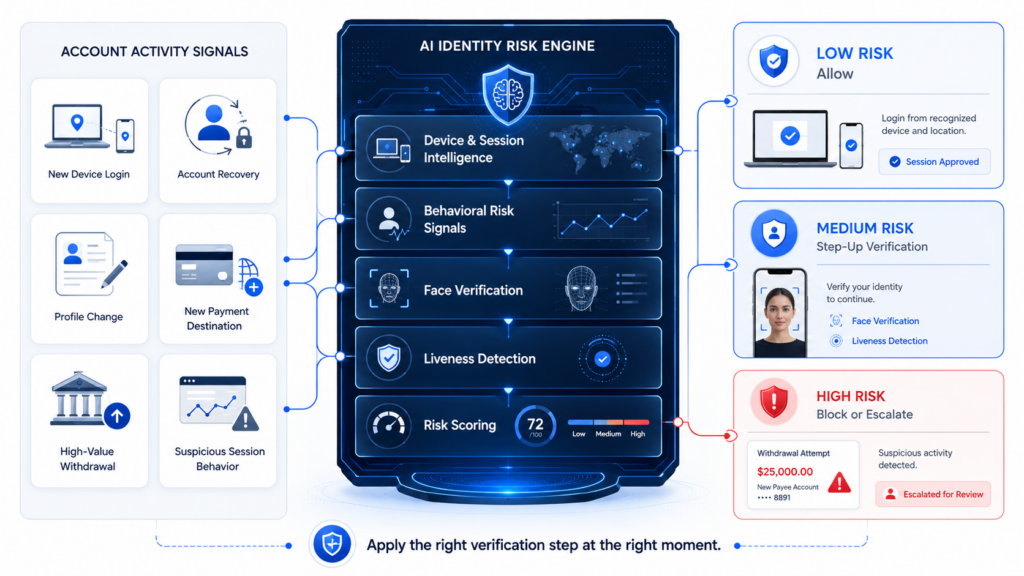
A Practical Risk-Based Decision Framework
Fintech platforms can structure account protection around three risk tiers.
| Risk Tier | Example Scenario | Recommended Action |
|---|---|---|
| Low risk | Familiar device, routine account activity, normal transaction pattern | Allow the user to continue |
| Medium risk | New device, unusual session behavior, sensitive profile change | Trigger face verification and liveness detection |
| High risk | Multiple risk signals, failed verification, high-value withdrawal to a new destination | Block, delay, or escalate for manual review |
This approach helps control fraud without disrupting every legitimate user.
The goal is not to maximize the number of verification steps. The goal is to apply the right verification step at the right moment.
How FinAuth Supports Continuous Identity Verification
FinAuth helps businesses build identity verification workflows that extend beyond initial onboarding.
The platform combines identity document verification, facial comparison, liveness detection, device and session risk signals, and risk-based decisioning.
For account takeover prevention, FinAuth can support step-up verification during high-risk account events, such as:
- New device access
- Account recovery
- Sensitive profile updates
- High-value withdrawals
- Unusual transaction patterns
- Suspicious session behavior
Instead of forcing every user through the same process, businesses can configure verification rules according to their risk exposure and customer journey.
This allows fintech platforms to strengthen account security while minimizing unnecessary friction.
From One-Time KYC to Lifecycle Identity Assurance
KYC is often treated as a checkpoint at the beginning of the customer relationship.
That model is no longer sufficient for modern digital financial services.
Fraud risk changes over time. Devices change. Credentials leak. Recovery channels become compromised. Transaction patterns evolve.
A trusted account can become risky without any change to its original KYC status.
The more effective approach is to treat identity verification as a continuous control layer.
Onboarding establishes the trusted identity. Device intelligence and session monitoring detect risk changes. Adaptive verification confirms the user again when necessary.
This creates a more resilient framework for preventing account takeover fraud without turning every interaction into a high-friction process.
Conclusion
Account takeover fraud is difficult to detect because the attacker often operates through a legitimate account with valid credentials.
For fintech platforms, the solution is not simply to add more login steps. The solution is to evaluate identity risk throughout the customer lifecycle.
Continuous AI identity verification helps businesses combine face verification, liveness detection, device intelligence, session signals, and risk-based decisioning into a unified account protection strategy.
The result is a more adaptive security model: low friction for normal users, stronger controls for suspicious sessions, and better protection for high-risk actions.