Fraudsters rarely operate through a single account. They often create networks of accounts to exploit promotions, submit repeated loan applications, move stolen funds, test compromised identities, or return after an earlier account has been blocked.
Detecting these linked fraud accounts requires more than checking whether two users share the same name, IP address, or device ID. Businesses need to combine device, identity, behavioral, and session signals to determine whether multiple accounts are controlled by the same person or fraud group.
FinAuth brings these signals into a unified identity risk workflow, helping businesses identify suspicious relationships while reducing false positives for legitimate customers.
1. What Are Linked Fraud Accounts?
Linked fraud accounts are multiple user profiles connected through shared devices, identities, network environments, behavioral patterns, or transaction relationships.
A fraudster may create accounts using different names and documents while repeatedly using the same device. In other cases, a fraud ring may operate many devices but reuse the same identity document, face, address, network infrastructure, or interaction pattern.
Typical linked-account risks include:
- Promotion and referral abuse
- Repeated loan applications
- Synthetic identity networks
- Account takeover and fund transfers
- Mule account operations
- Re-entry after account suspension
- Coordinated registration campaigns
The challenge is that individual signals may appear legitimate. The connection often becomes visible only when signals are evaluated across accounts.
2. Device Signals That Reveal Account Connections
Device intelligence provides an important layer for detecting repeated or coordinated account activity. Instead of relying on one customer-provided device ID, businesses should create a probabilistic device profile from multiple technical attributes.
Useful device and session signals include:
- Device fingerprint and operating system
- Browser and user-agent characteristics
- Screen, language, and timezone settings
- IP address and network reputation
- Proxy or VPN usage
- Emulator or virtual-machine indicators
- Geolocation consistency
- App or browser environment changes
- Repeated registration frequency
FinAuth evaluates device fingerprints together with proxy, VPN, emulator, IP, location, timezone, and user-agent signals. If several accounts repeatedly appear within the same device or session environment, the relationship can contribute to a higher risk score.
However, a shared device does not automatically indicate fraud. Families, company employees, internet cafés, and shared financial-service agents may legitimately use common infrastructure. Device evidence should therefore be treated as one part of a wider decision.
3. Identity Signals That Connect Multiple Accounts
Identity signals help determine whether different accounts represent the same person, reused identity evidence, or coordinated fraud attempts.
Important relationships may include:
- One face associated with multiple identity documents
- One document reused across different accounts
- Similar documents with altered names or numbers
- Repeated addresses or contact information
- The same portrait appearing in multiple documents
- Similar document backgrounds or manipulation patterns
- Different identities submitted with the same live face
FinAuth combines multilingual OCR, document verification, face matching, and liveness detection to analyze these relationships. Its Large Visual Model-based document analysis can identify Photoshop traces, splicing, recapture, screen display, and screenshots, while face verification compares live facial captures with document portraits.
Dual-engine Edge and Cloud liveness detection also helps determine whether a repeated face signal comes from a genuine person or from photos, replayed videos, deepfakes, masks, or virtual-camera injection.
4. Build Connections Across Accounts
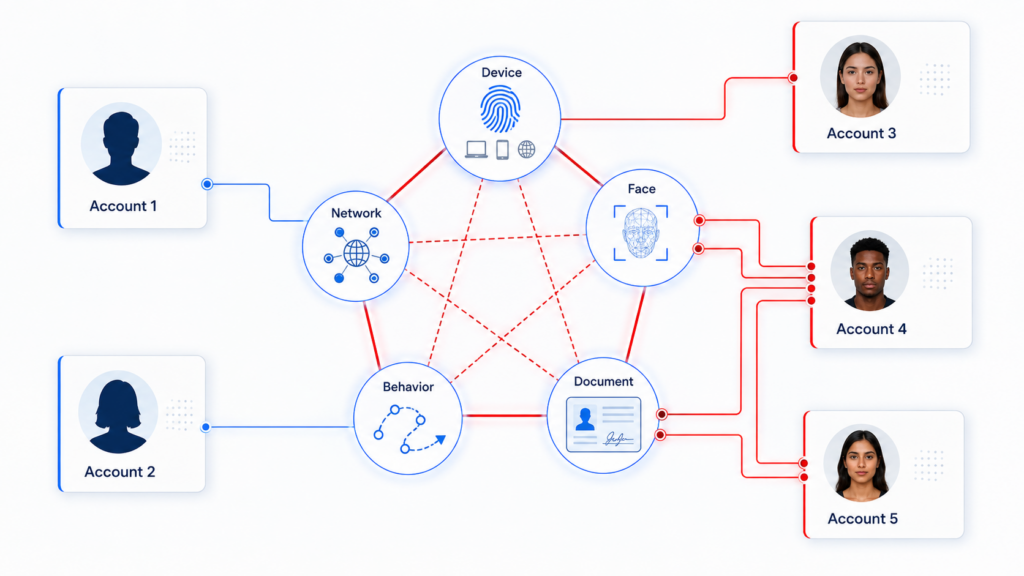
The strongest detection approach represents accounts, devices, faces, documents, addresses, IPs, and sessions as connected entities.
For example, five accounts may use different names and document numbers. Viewed separately, each application may appear normal. When analyzed together, the system may discover that all five accounts share the same device environment, facial identity, network cluster, or registration pattern.
Businesses can build an account-link model using:
- Account-to-device links: Which devices have accessed each account?
- Account-to-face links: Has the same face appeared under other identities?
- Account-to-document links: Has a document or portrait been reused?
- Account-to-network links: Do accounts share suspicious IP infrastructure?
- Account-to-behavior links: Do registrations follow similar timing and interaction patterns?
- Account-to-account links: Do accounts share recipients, addresses, or contact details?
A strong connection is usually supported by several signals. One shared IP may be weak evidence, while the same face, device profile, and behavioral pattern appearing across multiple accounts creates much higher confidence.
5. Use Risk-Based Linked-Account Detection
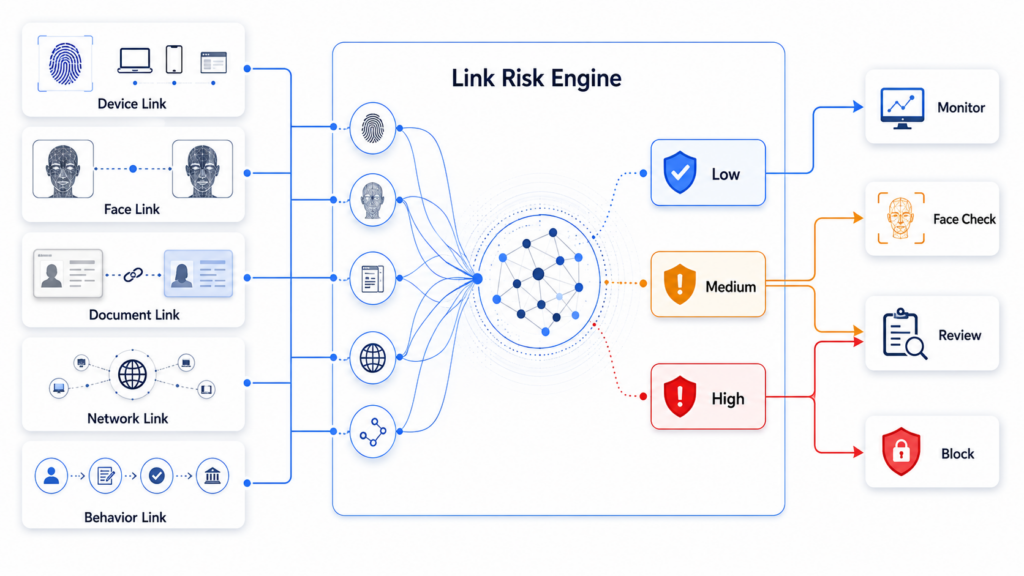
FinAuth can combine identity, device, session, and behavioral evidence through configurable rules and machine learning. Rather than applying a universal block rule, the risk engine can evaluate the strength, frequency, and context of each relationship.
5.1 Low-Risk Relationships
Weak connections, such as a shared public network without identity overlap, may be recorded without interrupting the customer journey.
5.2 Medium-Risk Relationships
Multiple accounts connected through device and behavioral similarities may trigger step-up verification, such as a fresh face and liveness check.
5.3 High-Risk Relationships
Strong links involving reused faces, manipulated documents, emulators, injection attacks, or previously suspicious sessions may be routed to manual review or blocked according to business policy.
This proportional approach helps prevent fraud controls from rejecting legitimate users based on one ambiguous attribute.
6. Reduce False Positives With Multi-Signal Context
Linked-account detection must distinguish fraud networks from legitimate shared environments. Businesses should avoid treating a device fingerprint as a permanent, universal identifier because devices, browsers, and network conditions can change.
A practical strategy is to:
- Assign confidence levels to each connection
- Apply time windows to repeated activity
- Give stronger weight to biometric and document reuse
- Separate household sharing from large account clusters
- Require multiple signals before blocking
- Use step-up verification for uncertain cases
- Record decision evidence for investigation and audit
FinAuth supports multi-signal risk decisioning so that device intelligence does not operate in isolation. Face verification, liveness, document authenticity, session consistency, and behavioral analysis provide the context needed to make more reliable decisions.
7. Frequently Asked Questions
7.1 Can device fingerprinting alone detect linked fraud accounts?
No. Device fingerprinting can reveal shared environments, but legitimate users may share devices or networks. Combining device signals with identity, face, document, and behavioral evidence produces more reliable results.
7.2 How does FinAuth identify the same person across different accounts?
FinAuth can compare live facial captures with identity document portraits and evaluate face-match confidence alongside liveness, document, device, and session signals. Businesses can use these results to identify suspicious identity reuse across accounts.
7.3 What should happen when linked accounts are detected?
The action should depend on relationship strength and business risk. Possible responses include monitoring, step-up face verification, document resubmission, manual review, or blocking.
7.4 Can fraudsters avoid detection by changing devices?
Changing a device may remove one connection, but identity documents, facial signals, network infrastructure, behavior, addresses, and transaction relationships may still link the accounts. This is why layered fraud intelligence is more resilient than a single device identifier.
8. Detect Networks, Not Just Individual Applications
Linked-account fraud becomes difficult to hide when device, identity, biometric, document, and behavioral signals are evaluated together.
FinAuth enables digital businesses to connect these signals throughout onboarding, login, account recovery, and high-risk transactions. By combining multi-account relationships with risk-based identity verification, businesses can detect coordinated fraud earlier while maintaining a low-friction experience for legitimate customers.