Age-restricted services need confidence that a user meets the applicable age requirement. Asking for a date of birth or ticking an “I am over 18” box offers limited assurance because the information is easy to misrepresent.
Document-based age verification provides stronger evidence by deriving age from a government-issued identity document and checking whether that document appears authentic and belongs to the person presenting it. However, the process should remain proportionate: many services need an eligibility result, not the user’s complete identity.
1. Age Assurance, Verification, and Estimation
These terms describe different concepts:
- Age assurance is the broad set of methods used to establish confidence in a user’s age or age range.
- Age verification checks age against reliable evidence, such as a date of birth extracted from an identity document.
- Age estimation predicts an approximate age or age band from signals such as facial characteristics. It does not confirm an exact date of birth or identity.
- Self-declaration asks users to state their age without independent evidence.
The appropriate method depends on the service, applicable regulation, potential harm, and required level of confidence. Document verification is particularly useful when the business must establish an exact age or apply a defined threshold such as 18 or 21.
2. How Identity Documents Support Age Verification
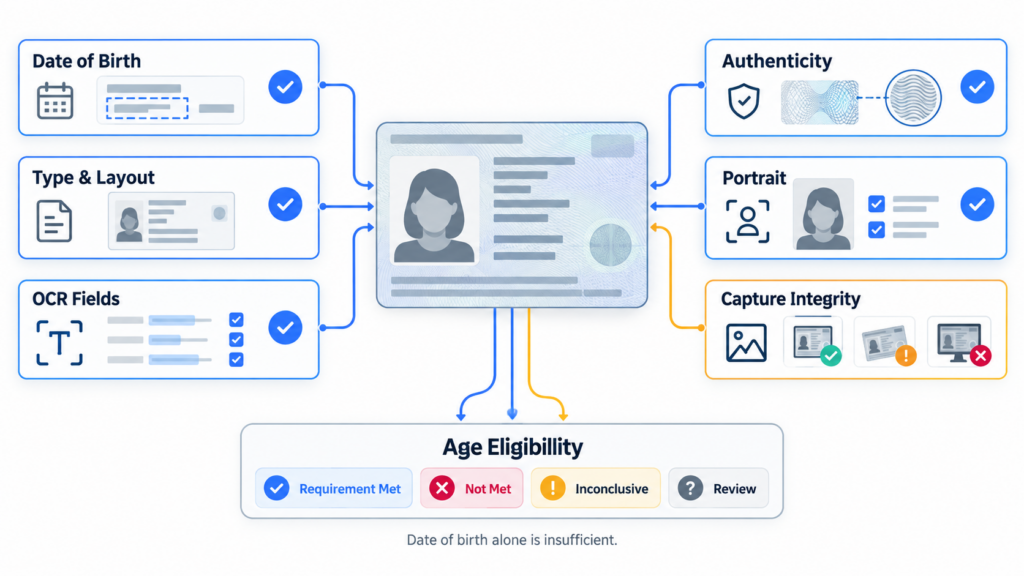
A secure document-based workflow involves more than reading a date of birth.
Document capture: The user submits an image of an accepted identity document. Quality controls check for blur, glare, cropping, obstruction, and insufficient resolution.
Type and layout validation: The system identifies the document type, issuing jurisdiction, and version before checking whether expected fields and visual structures are present.
Data extraction: OCR extracts the date of birth, expiry date, document number, and other permitted fields. Machine-readable data can be compared with visible fields when available.
Authenticity analysis: Document Verification evaluates template consistency, security features, image integrity, portrait replacement, data editing, and recapture indicators.
Age calculation: The verified date of birth is compared with the relevant date and policy threshold. The calculation should handle local date formats and boundary cases consistently.
Holder verification: Where the risk warrants it, Face Verification compares the user with the document portrait, while Liveness Detection helps establish genuine presence.
FinAuth can coordinate these checks and return an age-eligibility result together with confidence and risk signals.
3. Why OCR Alone Is Not Sufficient
Accurately extracting a date of birth does not prove that the document is genuine. A forged or digitally altered document may contain perfectly readable text, and a genuine document may be presented by someone else.
A stronger workflow cross-checks:
- Date of birth across available visual and machine-readable fields
- Document type, layout, and field positions
- Expiry and issuance logic
- Typography and background-pattern continuity
- Portrait integrity and document-face similarity
- Evidence of screen recapture, printing, or digital composition
- Device, session, and repeated-attempt signals
FinAuth combines OCR with Document Verification, Face Verification, Liveness Detection, and contextual risk analysis. This helps distinguish a correctable capture problem from deliberate age misrepresentation.
4. Minimize the Personal Data Returned
An age check should not automatically become full identity collection. If a service only needs to know whether someone meets a threshold, the preferred output may be:
- Age requirement met
- Age requirement not met
- Verification inconclusive
- Additional evidence required
This approach can prevent downstream systems from receiving the user’s name, full date of birth, document number, or document image unless those attributes are independently necessary.
The European Data Protection Board states that age-assurance measures should be risk-based, proportionate, effective, and as least intrusive as possible. It also emphasizes data minimization and warns against using age assurance to identify, locate, profile, or track people unnecessarily. EDPB Statement 1/2025 on Age Assurance
Organizations should define lawful processing grounds, access controls, retention periods, deletion rules, and protections for sensitive identity and biometric data according to the markets in which they operate.
5. Build a Risk-Based Age Assurance Workflow
Not every user or service requires the same verification journey. A proportionate workflow may use lower-friction measures for lower-risk interactions and request document evidence when greater confidence is necessary.
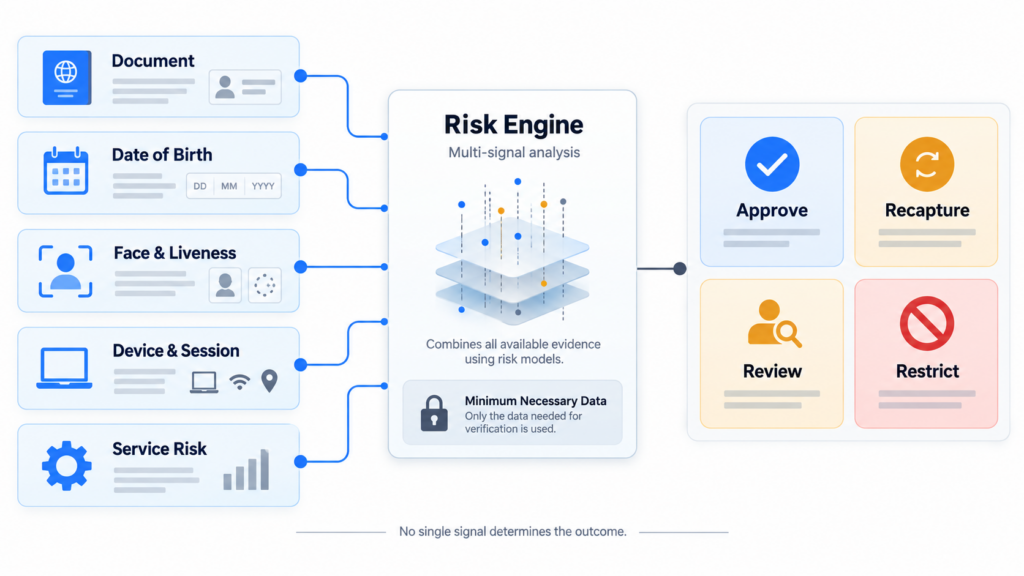
FinAuth’s Risk Engine can combine:
- Service and product risk
- Claimed age or age band
- Document authenticity
- Cross-field consistency
- Face and liveness results
- Device and session integrity
- Repeated or coordinated attempts
A trusted session with a genuine document and consistent holder evidence may be approved automatically. Poor image quality can trigger recapture, while data inconsistencies or manipulation indicators can lead to review or rejection.
Alternative verification paths should also be considered for users who lack supported documents or cannot complete the standard biometric flow. Any fallback should provide assurance appropriate to the same risk rather than becoming an easier bypass.
6. Measure Security, Privacy, and Completion Together
Teams should evaluate more than the number of users who pass. Useful measures include:
- First-attempt and eventual completion rates
- Document capture and OCR failure rates
- Recapture frequency by document type and device
- Age-threshold decision accuracy
- Manual-review volume and resolution time
- Suspected document and impersonation fraud
- Amount of data collected, shared, and retained
- Performance across supported user populations
Monitoring these outcomes helps identify whether the workflow is stopping underage access without creating disproportionate exclusion or unnecessary data exposure.
7. Document-Based Age Verification Q&A
Is document verification the same as age estimation?
No. Document verification derives age from identity evidence and evaluates that evidence. Age estimation predicts an approximate age or band without confirming an exact date of birth.
Does an extracted date of birth prove the user’s age?
Not by itself. The document may be forged, altered, expired, or presented by another person. Authenticity, holder, liveness, and capture-integrity checks provide stronger assurance.
Must a business retain the identity document?
Not necessarily. Retention depends on the purpose, legal requirements, and system design. Where appropriate, businesses can minimize downstream exposure by returning an eligibility result instead of retaining the complete document or extracted identity.
How does FinAuth support age verification?
FinAuth combines document capture, OCR, authenticity analysis, Face Verification, Liveness Detection, device intelligence, and risk-based decisioning. It can help businesses determine whether an age requirement is met while routing uncertain or suspicious cases appropriately.
8. Conclusion
Identity documents can provide strong evidence for age assurance when the workflow verifies more than the printed date of birth. Document authenticity, data consistency, holder verification, liveness, and session integrity must contribute together.
FinAuth enables businesses to apply these controls through a risk-based workflow and return proportionate age decisions—supporting safer access without turning every age check into unnecessary identity collection.