Generative AI is changing document fraud. Instead of manually editing a stolen identity document, fraudsters can use AI tools to create realistic portraits, reproduce document layouts, generate plausible personal information, and assemble complete identity documents at scale.
These documents may appear convincing during a quick visual review. Text can be sharp, fields can be internally consistent, and portraits may look like real people. Some synthetic documents can even pass basic OCR because the extracted information is readable and correctly formatted.
Digital identity verification therefore needs to look beyond text extraction. Detecting AI-generated documents requires a layered approach that evaluates document structure, visual authenticity, data consistency, capture conditions, biometric relationships, and the wider verification session.
What Is an AI-Generated Identity Document?
An AI-generated document is an identity artifact created wholly or partly with generative technology. It may include:
- A synthetic identity document built from an artificial template
- A genuine document layout populated with fabricated personal data
- An AI-generated portrait inserted into a stolen or reconstructed document
- Synthetic signatures, stamps, holograms, or background patterns
- A manipulated document generated from multiple real identities
- A virtual document submitted through screenshots or injected media
Unlike basic image editing, generative AI can create new visual content that does not directly copy an existing source. This can make traditional duplicate detection or simple manipulation rules less effective.
However, a document that looks realistic is not necessarily structurally or forensically authentic. AI-generated documents often contain subtle inconsistencies that become visible when multiple detection methods are combined.
Why OCR Alone Cannot Detect Synthetic Documents
OCR is designed to locate and extract text. It can identify names, dates, document numbers, addresses, and other fields, but it does not automatically establish whether the source document is genuine.
A synthetic document can contain perfectly readable text. It may also use valid date formats, realistic document numbers, and correctly spelled issuing authorities. If the verification process only checks whether data can be extracted, the document may appear legitimate.
Document authenticity analysis must answer additional questions:
- Does the document match an official template?
- Are the fonts, spacing, and field positions correct?
- Are security features visually plausible?
- Does the portrait belong naturally in the document?
- Are there signs of generation, compositing, or recapture?
- Do the visible fields agree with machine-readable information?
- Is the document linked to a real person completing the session?
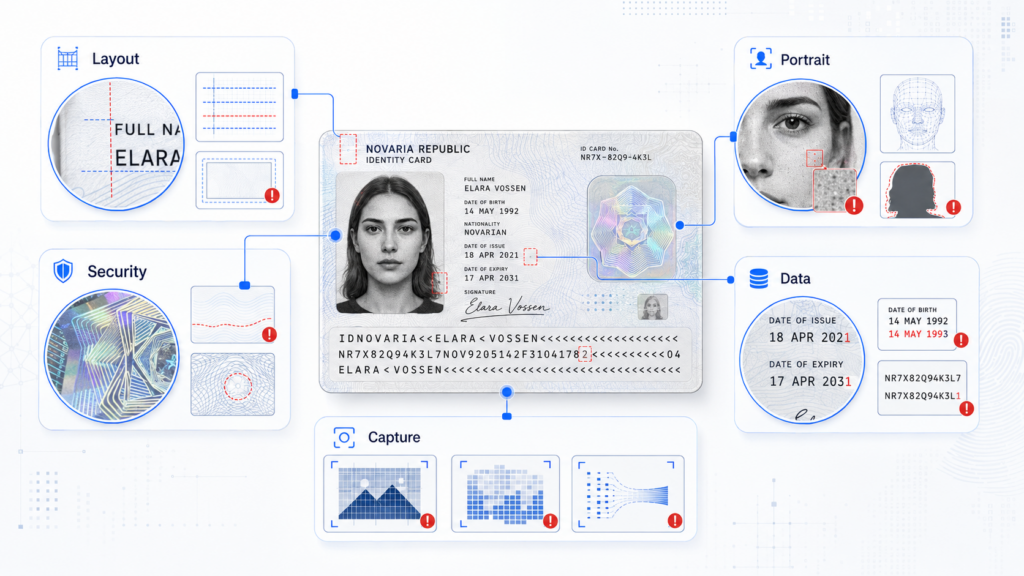
Key Signals of AI-Generated Document Fraud
Template and Layout Inconsistencies
Official documents follow controlled design specifications. Field positions, margins, font styles, background patterns, and security elements usually appear within expected ranges.
AI-generated documents may contain slightly misplaced text, incorrect spacing, distorted emblems, inconsistent line thickness, or security features that resemble the original but do not follow the correct structure.
Template analysis can compare the submitted document with known document formats for the relevant country, document type, and version.
Unrealistic Security Features
Holograms, guilloche patterns, microtext, optically variable elements, and other security features are difficult to reproduce accurately from a standard image.
Generative models may create visually attractive substitutes that lack the expected geometry, layering, repetition, or interaction with lighting. Security elements may also merge unnaturally with portraits or text fields.
Authenticity detection should analyze these features independently rather than treating the document as one flat image.
Image Generation Artifacts
Synthetic content can contain irregular facial details, inconsistent shadows, repeated textures, malformed characters, or unnatural boundaries around the portrait and signature.
These signals may be difficult for a human reviewer to notice, especially in compressed images. Visual models can evaluate local texture, frequency patterns, pixel relationships, and inconsistencies across different document regions.
Detection must also adapt as generation models improve. Rules designed for obvious AI artifacts may lose effectiveness when new tools produce cleaner outputs.
Cross-Field and Cross-Side Mismatches
Fraudsters may create fields that look valid individually but fail when compared with one another.
The date of birth may conflict with the encoded document number. The expiry date may not match the issuing rules. Names may differ between the front, back, barcode, MRZ, or other machine-readable area.
Cross-field validation can compare visible text, document logic, and machine-readable data to identify these inconsistencies.
Portrait and Identity Inconsistencies
An AI-generated portrait may not correspond to a real person. Even when the portrait resembles the applicant, facial geometry, age, lighting, or image characteristics may be inconsistent with the live capture.
Face verification can compare the document portrait with the person completing the session, while liveness detection helps confirm that the applicant is physically present. Injection detection is also necessary to prevent synthetic face media from being submitted alongside a synthetic document.
Capture and Recapture Signals
Synthetic documents are often submitted as screenshots, screen recaptures, or virtual media rather than photographed as physical documents.
The system can analyze glare, perspective, edge behavior, moiré, screen pixels, metadata, image dimensions, and capture-channel integrity. An image that appears too digitally clean may also require additional review when a physical document capture is expected.
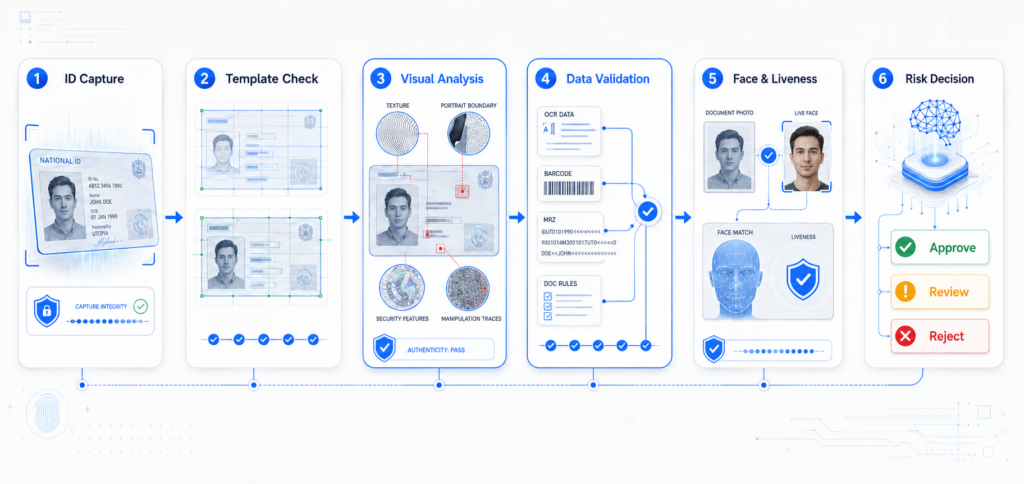
A Layered Detection Workflow
No single check can reliably identify every AI-generated document. Effective verification combines several layers.
The process begins with capture-quality and channel-integrity checks. Document classification then identifies the country, type, and version so the image can be compared with the correct template.
OCR extracts the visible information, while authenticity models analyze layout, texture, portrait boundaries, security features, and manipulation traces. Cross-field validation compares the extracted fields with document rules and machine-readable data.
Face verification and liveness detection connect the document to a real person. Device, network, and behavioral signals provide additional context about the session.
Finally, a risk engine combines the results and determines whether to approve the user, request another capture, trigger stronger verification, route the case for review, or reject the application.
Balancing Detection with Customer Experience
Stronger document checks should not create unnecessary friction for legitimate users. Many anomalies result from poor lighting, camera limitations, compression, document wear, or unfamiliar document versions rather than fraud.
Instead of rejecting every unusual submission, businesses can use risk-based actions. Low-risk users can continue automatically. Medium-risk cases may be asked to recapture the document or complete face and liveness verification. High-risk cases can receive deeper document checks or manual review.
Monitoring false positives, recapture rates, review outcomes, and confirmed attacks helps improve thresholds over time.
Detecting Synthetic Documents with FinAuth
FinAuth combines document OCR, document authenticity verification, face matching, Edge and Cloud liveness detection, injection attack detection, device intelligence, behavioral risk analysis, and configurable risk decisioning.
Powered by advanced Large Visual Models, FinAuth can analyze document structure, texture, security features, field relationships, and visual manipulation signals across the complete verification session.
As generative AI makes document fraud more scalable, identity verification must move beyond readable text and surface-level appearance. The objective is to establish whether the document is authentic, whether its data is trustworthy, and whether it belongs to the real person completing the verification.