Digital financial platforms make it possible to transfer funds, withdraw balances, add beneficiaries, and change payment settings within seconds. This convenience also creates opportunities for account takeover, credential theft, social engineering, and unauthorized transactions.
Passwords, one-time codes, and device recognition can confirm access to an account, but they do not always confirm that the legitimate account owner is authorizing a sensitive action. When transaction risk rises, face verification can provide a stronger link between the current user and the verified identity behind the account.
The most effective strategy is not to apply face verification to every transaction. It is to trigger biometric step-up verification when transaction, device, session, or behavioral signals indicate elevated risk.
What Makes a Transaction High Risk?
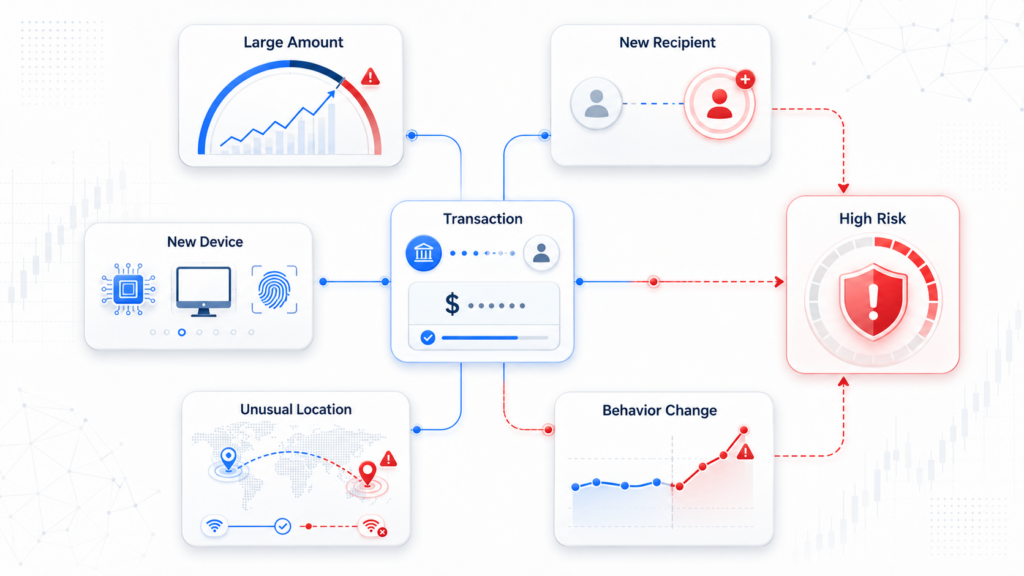
Transaction risk depends on context. A payment amount that is normal for one customer may be unusual for another. A new device may be legitimate, but the same device combined with account recovery and an immediate withdrawal can indicate an account takeover attempt.
Common high-risk events include:
- A large withdrawal or transfer
- A payment to a new beneficiary
- A sudden increase in transaction frequency
- Rapid movement of funds after account access
- A transaction from a new device or location
- Activity through a proxy, emulator, or virtual machine
- A recent password, phone number, or email change
- Changes to withdrawal or payment settings
- Behavior that differs significantly from the customer’s history
- Multiple failed authentication or verification attempts
These events should not always result in an automatic rejection. Instead, they can increase the transaction risk score and trigger additional identity verification.
Why Traditional Authentication May Not Be Enough
Passwords and one-time passwords can be stolen through phishing, malware, credential stuffing, or social engineering. SIM-swap attacks can compromise SMS-based authentication, while compromised email accounts can be used to reset credentials.
Device recognition adds useful context, but trusted devices can also be stolen or remotely controlled. An attacker may gain access to both account credentials and the customer’s normal device.
Face verification introduces an identity-based control. Instead of asking only whether the user knows a password or possesses a device, it assesses whether the person authorizing the transaction matches the verified account owner.
This makes face verification particularly valuable for step-up authentication during sensitive financial activity.
How Face Verification Works for Transaction Authorization
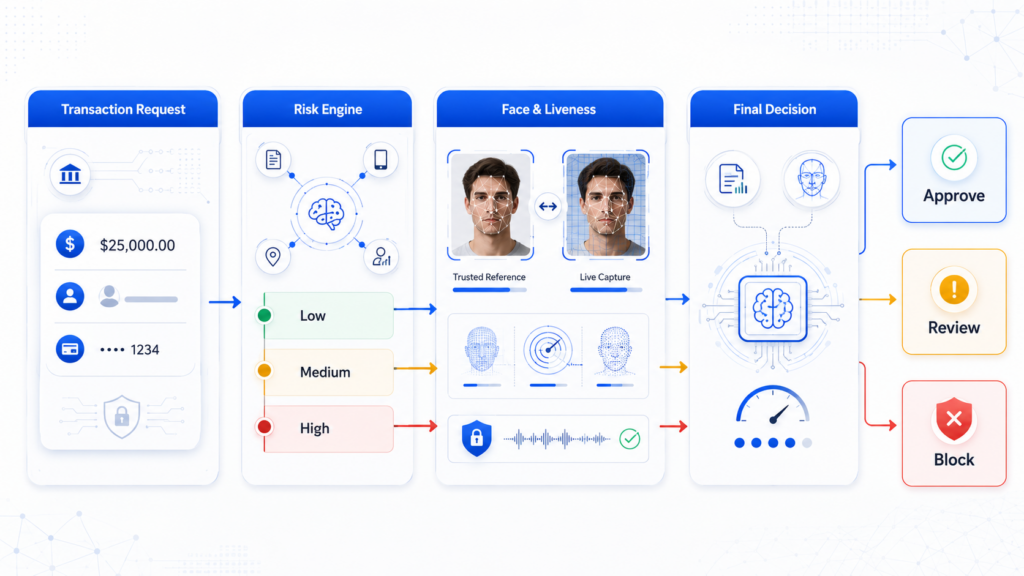
When a transaction is classified as high risk, the platform can pause execution and request a fresh facial capture. The verification process usually includes several connected checks.
Face Matching
The current facial image is compared with a trusted reference, such as the portrait captured during onboarding or extracted from a verified identity document.
The system generates a similarity score and evaluates whether the current user is likely to be the same person who originally opened or verified the account.
Liveness Detection
Face matching alone cannot determine whether the submitted image comes from a real person present during the session. An attacker may use a printed photo, replayed video, mask, face swap, or generated deepfake.
Liveness detection analyzes visual and temporal signals such as texture, depth, lighting, facial geometry, reflection, and motion. Injection detection can also identify manipulated media entering the verification pipeline through virtual cameras or altered capture channels.
Device and Session Analysis
The platform should assess whether the facial capture is taking place in a trustworthy environment. Device fingerprint, IP reputation, location, operating system, emulator status, proxy usage, and session consistency provide additional context.
A successful face match from a suspicious or compromised environment may still require review.
Transaction Context
Biometric results should be evaluated together with the transaction itself. Important factors include value, recipient, transaction type, customer history, account balance, time, location, and recent profile changes.
By combining these signals, the platform can determine whether the transaction should proceed, require another check, or be blocked.
Building a Risk-Based Step-Up Workflow
A risk engine can evaluate the transaction before deciding whether face verification is necessary.
For example:
- Low risk: Process the transaction without additional action.
- Medium risk: Request face verification with passive liveness.
- High risk: Apply stronger liveness, device checks, or additional identity verification.
- Critical risk: Pause, block, or route the transaction to manual investigation.
This approach avoids adding biometric friction to routine activity. Trusted customers can continue with minimal interruption, while stronger controls are concentrated on sensitive or anomalous events.
The verification result should then return to the transaction decision engine. A successful face and liveness check may reduce risk sufficiently for approval. A mismatch, liveness failure, or injection indicator should increase risk and may lead to rejection or review.
Where Face Verification Adds the Most Value
Face verification is especially useful when the potential impact of unauthorized access is high.
Large Withdrawals and Transfers
A large transaction that differs from the customer’s normal activity can trigger verification before funds leave the account.
New Beneficiaries
Fraudsters often add a new recipient after taking over an account. Face verification can confirm the account owner before the first transfer is completed.
Account and Payment Setting Changes
Changes to withdrawal accounts, payment limits, security settings, or contact information can enable future fraud. Verifying the user before these changes take effect reduces account risk.
Activity After Account Recovery
Account recovery is a high-risk stage because attackers may use stolen identity information to reset access. Transactions immediately following recovery should receive stronger monitoring and step-up verification.
Suspicious Cross-Border Activity
A transaction from an unfamiliar region, device, or network may require biometric confirmation, especially when combined with unusual value or beneficiary information.
Protecting Security, Privacy, and Customer Experience
Face verification should be implemented with clear purpose limitations, encryption, access controls, retention policies, and auditable consent processes. Businesses should store only the information required for verification and protect biometric data throughout its lifecycle.
Customer experience is equally important. Capture guidance should be simple, verification should be fast, and failed attempts should provide clear recovery options. Manual review should be available for legitimate customers who cannot complete automated verification.
Businesses should monitor completion rates, false rejections, processing time, fraud detection, and customer abandonment. These metrics help refine thresholds and determine when face verification creates the greatest security value.
Supporting High-Risk Transaction Protection with FinAuth
FinAuth combines face verification with Edge and Cloud liveness detection, deepfake and injection attack detection, device and session intelligence, behavioral risk analysis, and configurable risk decisioning.
Financial institutions can use these capabilities to evaluate transaction context, trigger step-up verification, and route each session according to risk. The same framework can support large withdrawals, new beneficiaries, account recovery, sensitive profile changes, and other high-impact events.
Face verification is most effective when it is part of a layered transaction security strategy. By confirming the user’s identity at the moment risk increases, digital financial platforms can reduce unauthorized activity without adding unnecessary friction to every transaction.