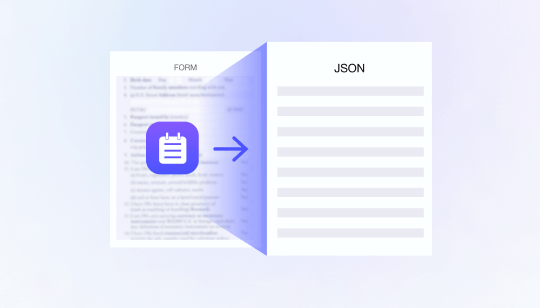
Expanding digital onboarding across multiple countries creates a document verification challenge. Each market may issue different identity cards, passports, residence permits, driving licences, or other accepted evidence. These documents vary in layout, language, security features, data sources, expiration policies, and machine-readable technologies.
Building a separate verification system for every country is expensive and difficult to maintain. A stronger strategy combines one reusable verification platform with market-specific document, compliance, and risk configurations. FinAuth enables this approach by integrating document recognition, OCR, authenticity analysis, facial verification, liveness detection, device intelligence, and risk orchestration within a configurable regional workflow.
1. Why Multi-Country Document Verification Is Difficult
Identity documents are not globally uniform. Even documents serving a similar purpose may differ significantly between countries and versions.
Regional onboarding programs must account for:
- Different accepted document types
- Multiple layouts and historical document versions
- Latin and non-Latin scripts
- Transliteration and naming conventions
- Different date, address, and identifier formats
- MRZ, barcode, NFC, or visual-only data sources
- Country-specific security features
- Different expiry and document-recency policies
- Uneven image quality and device availability
Document coverage is therefore more than adding an OCR template. The system must understand which document has been submitted, extract the correct fields, evaluate its structural and security characteristics, and determine whether it satisfies the applicable market policy.
2. Build One Core Platform with Market Configuration
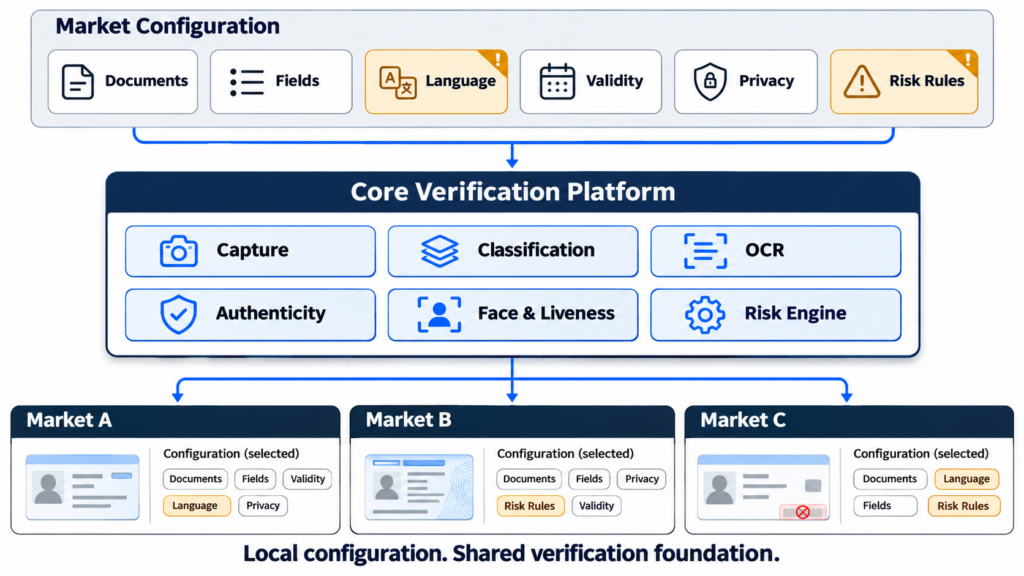
A scalable regional architecture separates reusable verification capabilities from local policy.
The core platform should provide:
- Document capture and quality analysis
- Type, country, and version classification
- OCR and structured field extraction
- MRZ or barcode parsing when available
- Cross-field consistency checks
- Document authenticity and manipulation analysis
- Face Verification and Liveness Detection
- Device, session, and injection-risk analysis
- Risk-based workflow orchestration
A configuration layer then determines which capabilities and rules apply in each market. It can define accepted documents, mandatory fields, language handling, expiry policies, verification thresholds, privacy requirements, and escalation actions.
This approach avoids maintaining disconnected technology stacks. A new market primarily requires document coverage, testing, policy configuration, and operational validation—not rebuilding the complete verification process.
3. Normalize Data Without Losing Local Meaning
A regional platform needs a common internal data model, but normalization must not erase important local distinctions.
For example, a name may appear in local script, Latin transliteration, and machine-readable form. These representations may differ legitimately because MRZ character sets do not support every national character or diacritical mark. ICAO Doc 9303 standardizes essential MRZ data for international machine reading while recognizing that the visual inspection zone may contain a different representation.
FinAuth can preserve both the original extracted value and a normalized comparison value. This allows the workflow to support:
- Exact checks within the same source
- Script-aware and transliteration-aware comparisons
- Format validation by country and document type
- Comparison between visual fields and machine-readable data
- Consistent downstream APIs across markets
A difference caused by valid transliteration should not automatically become a mismatch. Conversely, normalization should not hide material conflicts in names, document numbers, dates, or nationality.
4. Compare Available Sources, Not Assumed Sources
Not every document contains an MRZ, barcode, or contactless chip. Verification logic should first identify which sources are expected for the detected document type and version.
When multiple sources are available, FinAuth can extract them independently and compare relevant fields such as:
- Name
- Date of birth
- Document number
- Expiry date
- Nationality or issuing authority
An MRZ can provide standardized machine-readable data and support comparison with visible fields. A barcode may contain additional issuer-defined data. NFC-enabled documents can provide cryptographically protected information when supported by the document and capture channel.
However, consistency does not prove authenticity. A manipulated document may contain internally matching fields. Cross-field validation must therefore operate alongside template analysis, security-feature inspection, image-integrity checks, document presence detection, and capture-source assessment.
NIST similarly distinguishes document validation from simple extraction. Its guidance calls for checking document format, counterfeit or tampering indicators, security features, and the accuracy of essential fields. It also requires MRZ or barcode data to be compared with printed information when those sources are present.
5. Localize Policy, Not Only Recognition
Technical document support does not mean the document is acceptable for every product or market.
A regional verification policy should define:
Accepted evidence: Which passports, national identity cards, residence documents, or licences may be used.
Required fields: Which attributes are necessary for onboarding and which are optional.
Validity rules: Whether expired documents, temporary documents, or older versions can be accepted.
Assurance requirements: Whether document verification alone is sufficient or must be combined with face and liveness checks.
Privacy controls: Which fields may be collected, retained, masked, or transferred.
Deployment requirements: Whether processing must occur in a particular environment or region.
FATF guidance recommends evaluating digital identity systems according to their assurance, technology, architecture, governance, and protection against manipulation. It supports a risk-based assessment rather than assuming that every digital identity method provides equivalent reliability.
6. Test Coverage Under Real Market Conditions
Document verification should be evaluated using the documents, devices, capture channels, languages, and user conditions expected in production.
Testing should include:
- Current and legacy document versions
- Genuine documents with normal wear
- Different mobile cameras and browsers
- Low light, glare, blur, crop, and perspective
- Local scripts and long or compound names
- Genuine documents containing unusual but valid data
- Printed copies, screen recaptures, and manipulated images
- Unsupported or incorrectly classified documents
Performance should be monitored by country, document type, version, and verification stage. A high regional completion rate can conceal poor performance for one country or document class.
FinAuth provides structured results for classification, OCR, authenticity, manipulation, face, liveness, and device checks. This makes it possible to identify whether failures originate from document coverage, capture quality, extraction, security analysis, or local policy.
7. Use Risk-Based Routing Across Markets
A document result should contribute to a broader identity decision rather than operate as an isolated pass-or-fail control.
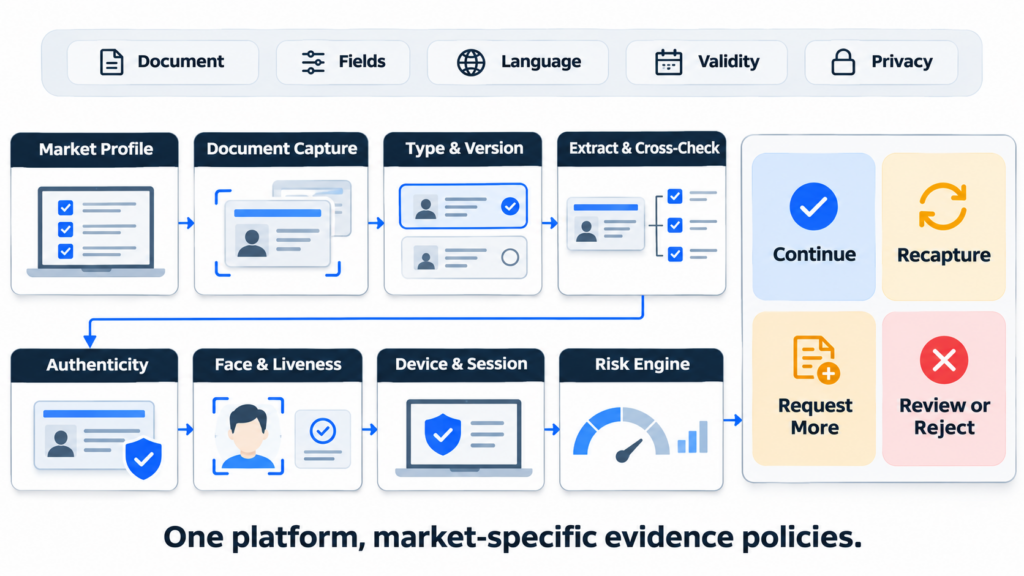
FinAuth Risk Engine can combine:
- Document authenticity
- Field and source consistency
- Face Verification
- Edge or Cloud Liveness Detection
- Capture and injection integrity
- Device and session risk
- Customer and service context
A trusted session can continue automatically. A quality problem can trigger guided recapture. Missing or uncertain evidence can request an additional document or biometric check. Strong manipulation or coordinated-risk indicators can receive priority review or rejection.
The workflow remains consistent across the region, while each market controls the evidence requirements and actions appropriate to its regulatory and fraud environment.
8. Multi-Country Document Verification Q&A
Does every country require a separate verification system?
No. A reusable core platform can support document capture, OCR, authenticity, biometrics, and risk assessment across markets. Country-specific requirements should be managed through document libraries and configuration.
Can MRZ validation confirm that a document is genuine?
No. MRZ checks can identify format or cross-field inconsistencies, but matching data alone does not prove authenticity. Security-feature, manipulation, and capture-integrity analysis remain necessary.
How should multilingual names be compared?
The system should preserve original-script values and use controlled normalization or transliteration for comparison. Expected representation differences should be distinguished from material identity conflicts.
How does FinAuth support regional expansion?
FinAuth combines multi-country document recognition, structured OCR, authenticity analysis, Face Verification, Liveness Detection, device intelligence, and configurable risk workflows within one platform.
9. Conclusion
Effective multi-country document verification requires more than accumulating templates. Businesses need a common verification foundation, accurate local document knowledge, configurable market policies, representative testing, and layered fraud controls.
FinAuth enables regional digital onboarding through one configurable architecture. Organizations can reuse core identity capabilities while adapting accepted evidence, required fields, risk rules, privacy controls, and decision paths to each market.