Know Your Customer checks are often concentrated at onboarding. A customer submits an identity document, completes face and liveness verification, and receives access after passing the required checks.
However, customer risk does not remain fixed after account creation. Identity information can change, documents can expire, accounts can be accessed from unfamiliar environments, and legitimate users can become targets of account takeover. Transaction behavior may also shift in ways that indicate fraud, money laundering, or unauthorized account use.
Digital businesses therefore need an ongoing KYC strategy that detects material risk changes and triggers the appropriate level of reverification.
Why Onboarding KYC Is Only a Starting Point
Initial KYC establishes whether a customer appears legitimate at a specific moment. It does not guarantee that every future session, profile change, or transaction will remain trustworthy.
Risk can increase when:
- A customer’s document expires or identity information changes.
- An account is accessed from a new device or unusual location.
- Contact information, passwords, or withdrawal settings are modified.
- Transaction volume or frequency changes significantly.
- Funds are sent to new recipients or high-risk destinations.
- An account shows signs of automation, credential sharing, or takeover.
- New fraud intelligence links the identity, device, or network to suspicious activity.
Applying the same risk level throughout the customer lifecycle can leave businesses exposed. At the same time, requiring full KYC repeatedly creates unnecessary friction and operating costs. The objective is to identify meaningful changes and respond proportionately.
What Signals Can Reveal Customer Risk Changes?
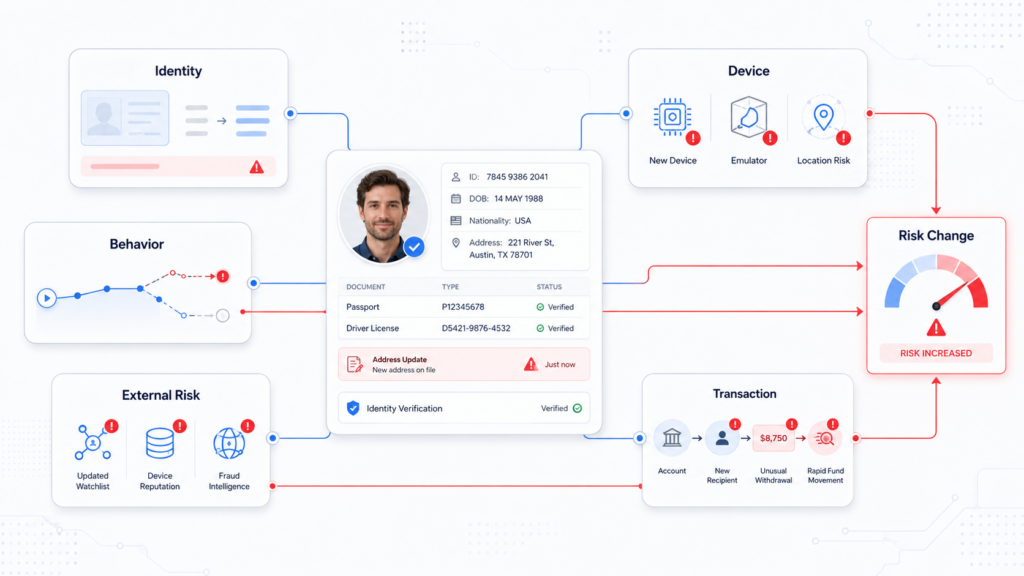
Effective monitoring requires information from multiple sources. A single anomaly may be legitimate, but several connected anomalies can indicate a material change in customer risk.
Identity and Profile Signals
Changes to a customer’s name, address, phone number, email, occupation, or beneficial ownership information may require additional checks. Expired documents, inconsistent profile data, or repeated attempts to change sensitive fields can also increase risk.
Profile changes become more significant when they occur shortly before account recovery, the addition of a new recipient, or a large withdrawal.
Device and Session Signals
Device intelligence can reveal whether an account is being accessed through a previously trusted environment. Relevant signals include:
- New or previously unseen devices
- Emulator or virtual machine usage
- Proxy, VPN, or unusual IP activity
- Location, timezone, and language inconsistencies
- Rapid switching between devices or regions
- Multiple customer accounts associated with one device
A new device is not automatically fraudulent. However, a new device combined with password recovery, profile changes, and unusual transactions may justify immediate reverification.
Behavioral Signals
Customer behavior provides context that static identity information cannot. Changes in typing rhythm, navigation sequence, touch patterns, transaction timing, or account usage can indicate that a different person is controlling the account.
Businesses can compare current behavior with historical patterns and peer-group baselines. The greater the deviation, the stronger the case for additional verification.
Transaction and Account Signals
Large withdrawals, rapid fund movement, new beneficiaries, unusual transaction frequency, or activity outside a customer’s normal geographic area may indicate elevated risk.
These signals should be evaluated against the customer’s previous activity, account type, transaction purpose, and expected behavior. A transaction that appears normal for one customer may be abnormal for another.
External Risk Intelligence
Sanctions, politically exposed person status, adverse information, compromised credential data, device reputation, and known fraud networks can all change after onboarding.
When updated intelligence affects an existing customer, the business may need to reassess the account even if no unusual activity has occurred inside the platform.
Converting Risk Changes into Reverification Triggers
Collecting signals is only the first step. Businesses need a decision framework that determines when a change is significant enough to require action.
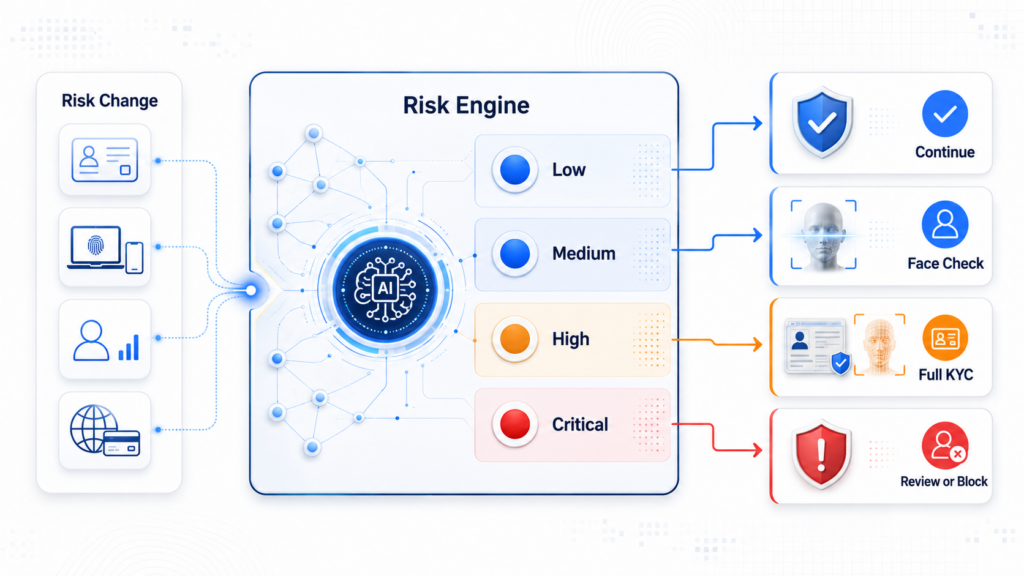
A risk engine can combine rules and machine learning to evaluate the customer, account, device, behavior, and transaction together. Each signal can be weighted according to its reliability, severity, and relationship with other events.
Common trigger models include:
Event-Based Triggers
Reverification begins when a predefined high-impact event occurs, such as account recovery, a sensitive profile change, a new withdrawal method, or an unusually large transaction.
Threshold-Based Triggers
The system continuously updates a customer risk score. Reverification is triggered when the score crosses a defined threshold or increases sharply within a short period.
Time-Based Triggers
Periodic KYC refresh remains useful for document expiry, regulatory requirements, and higher-risk customer segments. However, scheduled reviews should complement real-time monitoring rather than replace it.
Combined Triggers
The strongest approach combines time, events, and accumulated risk. For example, a new device alone may not trigger action, but a new device followed by account recovery and a large withdrawal could immediately require stronger verification.
Matching Reverification to the Risk Level
KYC reverification should not be a single fixed process. Different risk levels require different responses.
For a low-risk change, the platform may allow the customer to continue while increasing monitoring. A medium-risk session may require face verification and passive liveness. Higher-risk activity may require active liveness, document recapture, document authenticity checks, or validation of updated identity information.
Extremely high-risk cases may be blocked or routed to manual review.
A typical decision structure is:
- Low risk: Continue and monitor
- Medium risk: Face and liveness verification
- High risk: Full identity and document reverification
- Critical risk: Block or manual investigation
This proportional approach reduces friction for trusted customers while strengthening controls around sensitive actions.
Designing an Effective Reverification Strategy
Businesses should define which events are monitored, how signals affect risk, and what verification action corresponds to each risk level. Policies should also account for customer segment, product type, transaction value, regional requirements, and historical fraud patterns.
Every decision should produce an auditable record containing the trigger event, relevant signals, risk score, verification result, and final action. This supports internal investigations, regulatory reviews, and future strategy optimization.
Performance should be monitored continuously. Excessive reverification can reduce conversion and increase support costs, while weak thresholds may allow suspicious activity to proceed. Reviewing completion rates, false positives, blocked fraud, and manual-review outcomes helps teams refine policies over time.
Supporting Continuous KYC with FinAuth
FinAuth combines identity verification, document authenticity checks, face matching, Edge and Cloud liveness detection, device and session intelligence, behavioral risk analysis, and configurable risk decisioning.
These capabilities help businesses monitor customer risk throughout the account lifecycle and trigger different verification workflows according to the event and risk level. Full-session logs and evidence retention also support consistent policy execution and compliance auditing.
KYC should not end when an account is opened. By detecting changes across identity, device, behavior, and transactions, businesses can identify emerging risks earlier and apply reverification only when it is justified.


