As financial institutions accelerate their global expansion, identity verification has evolved from a simple compliance procedure into a core security foundation that runs through the entire business chain — from account opening and transactions to logins and risk control.
However, the complex regulatory environments of overseas markets, combined with diverse user profiles and the rise of AIGC-driven fraud techniques, have turned identity verification into one of the most difficult challenges in global financial operations: How can institutions effectively block attacks while maintaining a smooth and seamless experience for genuine users?
The “Trade-Off” Dilemma: Balancing Detection and Approval Rates
In the past, fraudsters mainly relied on forged documents or stolen photos. Today, generative AI has dramatically lowered the cost of forgery — deepfake videos, synthetic faces, and real-time face swaps can now be produced in seconds with lifelike accuracy, rendering traditional verification methods almost defenseless.
At the same time, user diversity further increases the difficulty of accurate verification. Different countries have varying document formats, image quality standards, lighting conditions, and appearance norms. Overly strict verification rules can reject genuine users, hurting conversion rates, while overly lenient rules open the door to fraud.
FinAuth: Finding the “Golden Balance” in Dynamic Risk Control
As a financial-grade KYC identity verification platform, FinAuth integrates multi-layered anti-attack mechanisms and AI-driven configuration algorithms to defend against various types of fraud while optimizing performance for different regions.
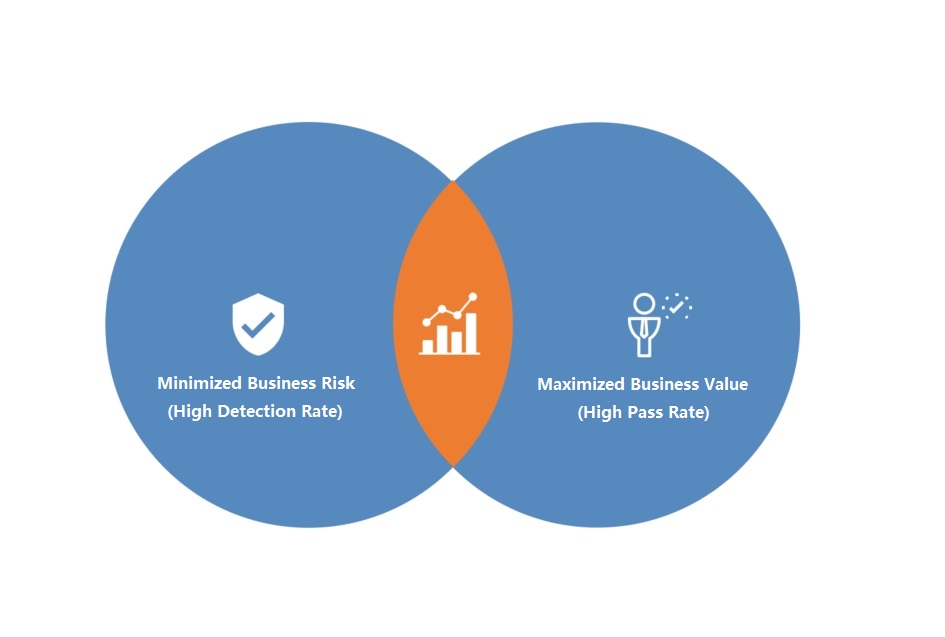
Its goal: to continuously approach the “golden balance” — the point where security and user experience coexist at their best.
Multi-Layer Defense: Accurate Detection of AIGC-Based Attacks
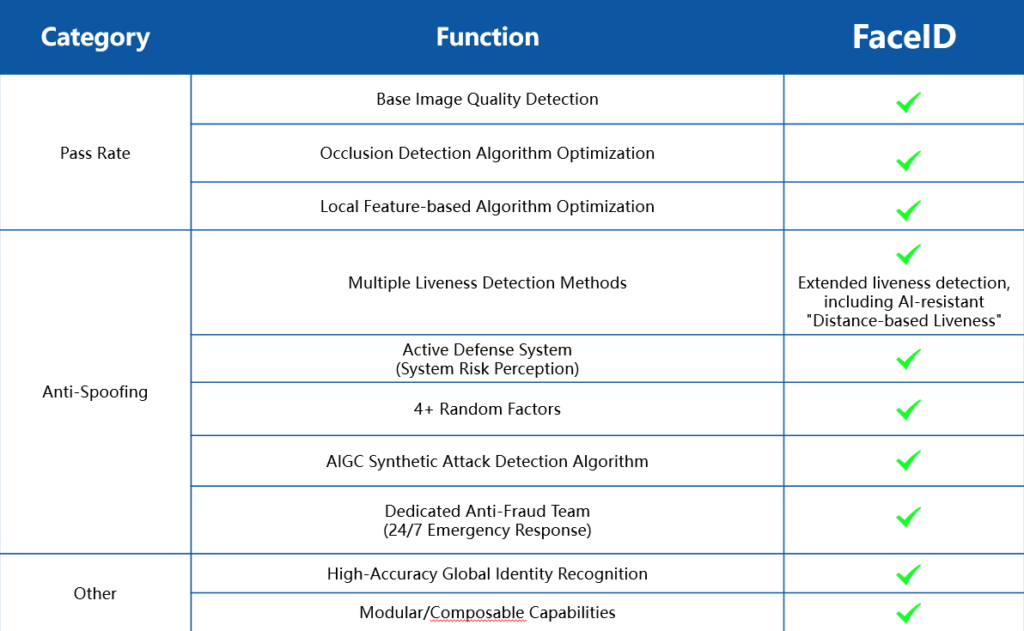
FinAuth introduces an innovative “Distance Liveness Detection” technology, which randomly adjusts the recognition distance to effectively counter synthetic image and video injection attacks.
Meanwhile, the Active Defense System analyzes device characteristics, user behavior, and image attributes across multiple dimensions to proactively identify and block risky requests.
In particular, FinAuth enhances H5 environment detection in browser-based verification scenarios — significantly improving attack detection rates and overcoming a long-standing challenge in the industry.
Scenario-Based Modeling: Enhancing Pass Rates and User Experience
For different countries and user groups, FinAuth optimizes its image recognition algorithms to adapt to regional traits such as beards, head coverings, and distinctive makeup styles, improving pass rates across demographics.
Additionally, FinAuth supports a base image quality pre-check to evaluate whether an image meets the recognition threshold before matching, thereby reducing rejections caused by poor-quality images.
The system also optimizes performance under complex lighting conditions, minimizing recognition failures and boosting verification success and business efficiency.
Beyond Functionality: The Strategic Balance Between Security and Experience
Unlike conventional verification systems, FinAuth’s advantage lies not only in technological completeness, but also in its strategy-level intelligence.
Instead of simply adjusting thresholds for different scenarios, FinAuth leverages AI-based configuration algorithms to dynamically adapt verification policies according to device signals, user behavior, and detected fraud intent.
This allows FinAuth to “understand” suspicious requests rather than rely on a one-size-fits-all rule — avoiding the typical trade-off where stricter rules increase security but severely reduce pass rates.
This fine-grained operational logic is key to achieving maximum security with minimal user friction.
Case Study: The “Two-Sided Dilemma” of a Southeast Asian Digital Bank and FinAuth’s Balanced Approach
The Challenge: A Tug-of-War Between Security and Growth
In 2023, a fast-growing digital bank in Southeast Asia faced a typical growth dilemma. To combat a surge in AIGC-generated fraud attacks, its existing verification provider took the most direct approach — raising the strictness threshold of liveness detection.
While this move increased the attack detection rate to 95%, it also had a severe side effect: the pass rate for legitimate users dropped from 92% to 75%.
Many real customers — especially those using older devices or operating in low-light conditions — were mistakenly flagged as “high risk” and blocked. Customer complaints surged, and business growth stalled.
This is the typical consequence of threshold-based overcorrection — rejecting a large number of legitimate users just to stop a few fraudulent ones.
The Solution: FinAuth’s Dynamic Strategy and Precision Defense
After adopting FinAuth, the bank experienced a fundamental turnaround. FinAuth did not simply raise or lower a global threshold; instead, it applied an AI-driven dynamic configuration strategy that differentiated responses based on user risk levels.
Through specialized AIGC anti-attack algorithms and device-level security strategies, FinAuth increased the detection rate to over 99% — without sacrificing user experience or pass rates, successfully neutralizing AIGC-driven fraud operations.
Conclusion
In this ongoing battle between attack and defense, FinAuth stands out by combining security precision with user-centric experience design. It not only upholds compliance and risk control standards but also helps enterprises increase approval and conversion rates, ensuring smoother onboarding and operation for legitimate users.
As AIGC technologies continue to evolve, the confrontation between identity verification and intelligent fraud will only intensify. Like a finely balanced scale, FinAuth uses continuously advancing AI technology as its counterweight — helping global financial institutions find their “golden balance” between security and growth in an increasingly complex international environment.