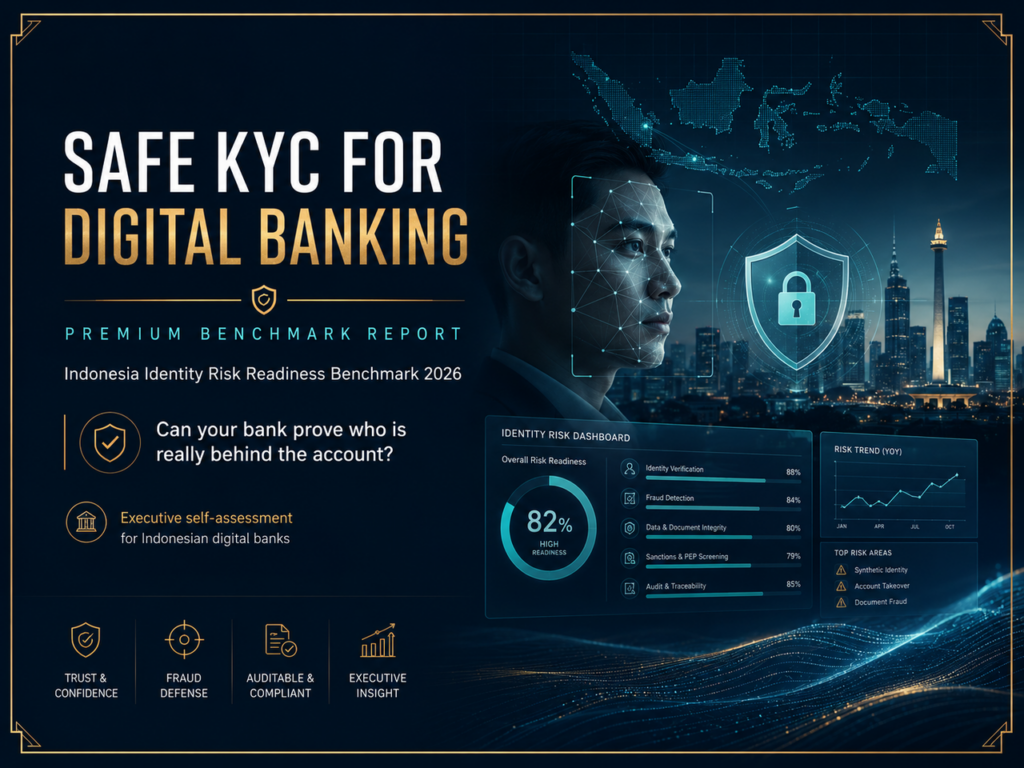
Indonesia’s digital banking market has moved beyond the question of whether customers can be onboarded remotely. For 2026, the more important question is whether a financial institution can prove that every identity decision was trustworthy, explainable, and defensible after the account has already entered the system.
As digital banks, e-wallets, fintech lenders, payment providers, and financial apps scale across Indonesia, identity risk is becoming more than an onboarding issue. It now sits at the center of fraud prevention, AML exposure, customer experience, operational resilience, and audit readiness. A fast KYC process is no longer enough if the institution cannot later explain who was behind the account, what evidence was collected, what risk signals were present, and why the decision was trusted.
This benchmark report is designed as a practical executive self-assessment for Indonesian digital financial institutions. It helps leadership teams evaluate whether their current KYC process is only checking submitted documents and selfies, or whether it is strong enough to manage identity risk across the full customer lifecycle.
The report includes a 5-minute Identity Risk Readiness Scorecard, a four-level maturity model, an eight-dimension identity risk framework, executive KPI suggestions, priority risk signals, and a 30 / 60 / 90-day action plan. It covers the critical control areas that matter most in 2026, including real-user verification, KTP intelligence, face match reliability, liveness and deepfake defense, injection and device risk, repeat fraud patterns, audit evidence, and conversion control.
For senior leaders, the value is simple: this benchmark turns KYC readiness into a leadership conversation. It gives risk, compliance, fraud, product, operations, and technology teams a shared language for identifying weak points before fraud pressure, regulatory expectations, or growth targets expose them.
The strongest question is no longer: “Did this applicant pass KYC?”
The stronger question is: “Can we prove why this identity decision was trusted?”
Download the full benchmark to assess your institution’s readiness and identify the identity-risk gaps that deserve executive attention in 2026.